Personalized food and medicine based on a genetic profile
Summary
This is my idea for fully personalized therapy and supplementation. It starts from the genetic profile of one person. Based on that profile and a database of doses and interactions, software creates a recipe for one person and one day. A device then combines all active substances into a single gel form, instead of a handful of tablets and capsules.
The technology for this exists today, and it partly existed when I started. The first 3D printed medicine, Spritam, was approved by the FDA in 2015. Hospitals in Europe are already running clinical studies with printed chewable doses for children. A large study published in 2023 showed that genotype guided prescribing reduces clinically relevant adverse drug reactions by about 30 percent.
The idea did not stall because of technology, but because of regulation and the system. And I have to be honest about one part. For medicines, genetics already has a solid scientific basis for certain gene and drug combinations. For nutrition, the evidence is mixed so far, and no serious person can promise today that a genetics based diet works better than good general advice.
This page describes an idea and the state of the field. It is not medical advice.
The core of the idea
The idea connects three fields that rarely meet, genetics, pharmaceutical formulation and precise dosing. The goal is for a person to get exactly what they need, no more, no less and without assumptions.
Individual genetic analysis. Genetic characteristics are used to determine the body's needs, sensitivities, drug metabolism and predispositions. The most important part for medicines is pharmacogenomics, meaning how genes affect how fast the body breaks down a drug and how it responds to it.
Automatic creation of a personalized recipe. Software links the analysis results with a database of doses, interactions, therapeutic protocols and supplement needs. The recipe is created for one person and one daily dose. The final decision still belongs to a physician, and a pharmacist checks the recipe.
A single oral form. Instead of several pills, capsules and tablets, the therapy is combined into one gel form with precise doses. The advantage is obvious. Easier intake for children, older people and patients who cannot tolerate solid forms.
A device for preparing personalized doses. The device doses several active substances in exact amounts, and the operator adds only the specific ingredients for a given profile. The system is meant to be simple, without the need for large pharmaceutical plants. Today I would describe it as a 3D printer for extruding semi solid material, the same technology hospitals already use in clinical studies.
Why the idea mattered
The idea would solve several real problems.
- Polypharmacy. An older person often takes several medicines and supplements a day, at different times, and easily skips or mixes something up.
- Difficulty taking tablets. Children and older people struggle to swallow solid forms, and some patients receive medicines only through a feeding tube.
- Inaccurate or impractical dosing. Tablets are broken and split to get a child's dose, and splitting by hand is not precise.
- No real personalization. The same dose is given to people who break the drug down at completely different speeds.
- Irregular therapy. The more pieces a day, the less likely the therapy will be taken regularly.
- Generic products. Supplements are sold for the average person, not for a specific one.
The idea envisioned a world where a patient or user gets exactly what they need.
Who has this problem
| Group | Specific problem today | What a personalized dose would change |
|---|---|---|
| Children | Adult doses are broken and split by hand | Exact dose by body weight, in a form the child accepts |
| Older people | Several medicines a day, difficulty swallowing | Fewer pieces, one intake schedule |
| Patients on feeding tubes | Tablets are crushed, risk of blockage and error | A form that disintegrates quickly in a small amount of liquid |
| Rare metabolic diseases | Doses change often, no ready made strengths | The dose is made exactly for that week and that patient |
| People with known genetic variants | The drug works too weakly or causes adverse reactions | Dose or drug choice adapted to the genetic profile |
| Supplement users | The same product for everyone | A combination based on real needs, where evidence supports it |
How the system would work, step by step
- Genetic test. A sample is analyzed in an accredited laboratory. The result is a list of relevant genetic variants, above all those that affect drug metabolism.
- Interpretation. Software links the variants with publicly available gene and drug guidelines, with drug interactions and with the therapy the person already takes.
- Physician's decision. The software proposes, the physician decides. Without that there is neither accountability nor safety.
- Making the dose. In a pharmacy or hospital pharmacy, the device prints one gel dose, or a daily series of doses, with exact amounts of each active substance.
- Quality control. Active substance content and dose uniformity are checked, and each dose gets a label and a batch record.
- Follow up. The dose is adjusted based on the response to therapy, and a new batch is made without changing the whole production process.
What science confirms today, and what it does not
This is the part where I want to be most precise, because this is where the most is promised.
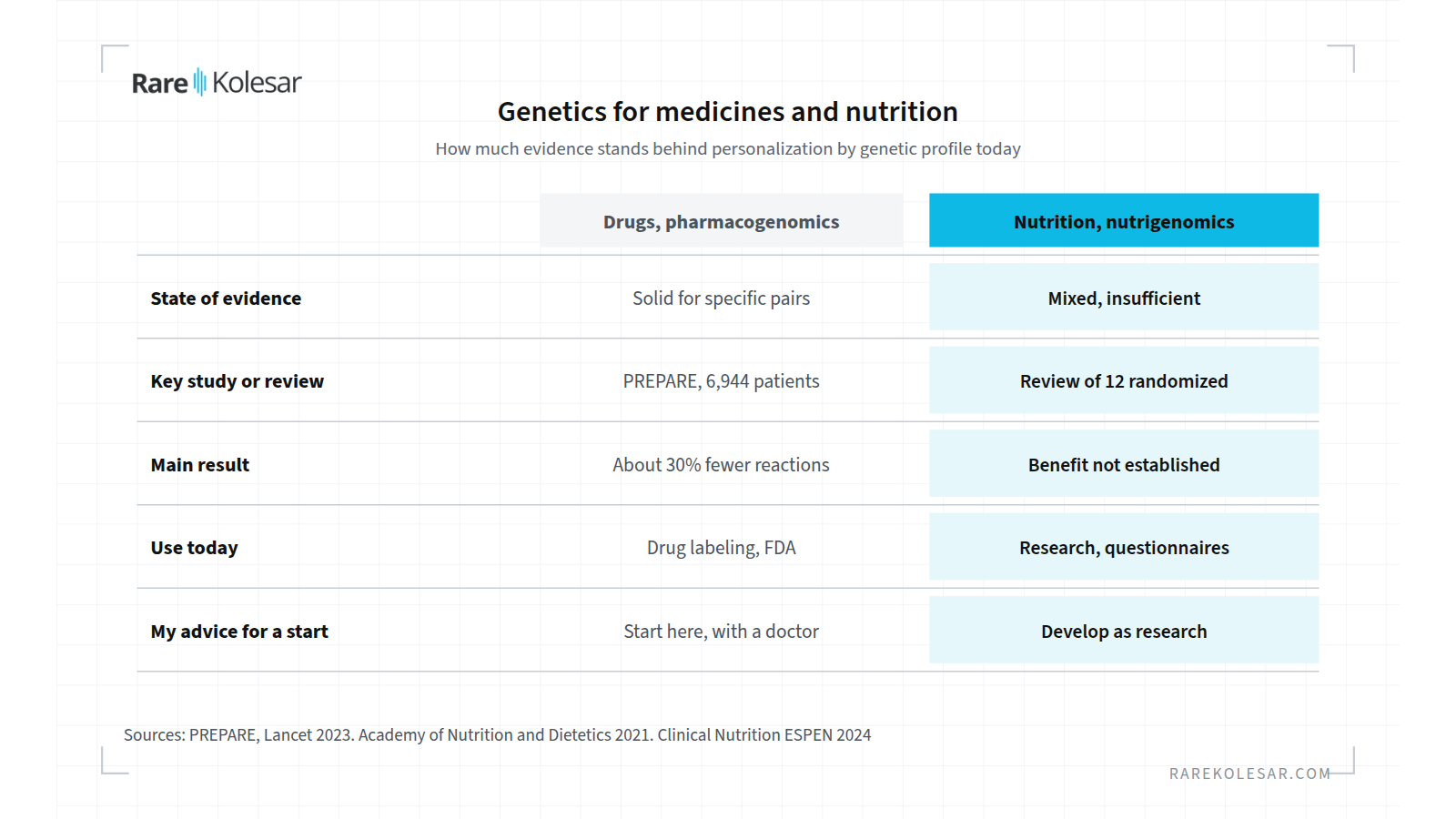
Medicines and genetics, pharmacogenomics. Here the evidence exists. The FDA maintains a public table of drugs whose labeling contains genetic information, and today it has several hundred entries. Examples are abacavir and the HLA-B gene, clopidogrel and the CYP2C19 gene, capecitabine and the DPYD gene. The largest study so far, PREPARE, published in The Lancet in 2023, included 6,944 patients in seven European countries. In patients with a relevant genetic variant, genotype guided prescribing led to about 30 percent fewer clinically relevant adverse drug reactions, 21 percent versus 27.7 percent.
Nutrition and genetics, nutrigenomics. Here the evidence is weaker. A 2021 consensus report of the Academy of Nutrition and Dietetics reviewed 12 randomized trials and concluded that there is insufficient evidence to determine whether adding genetic testing to nutrition counseling changes outcomes. A 2024 review in Clinical Nutrition ESPEN describes the results as mixed, with small samples and short follow up. Some links between specific genes and the metabolism of certain nutrients are well known, but that is not the same as proof that a diet based on a genetic test gives a better result.
That is why today I would start the idea on the medicines side, where the foundation is solid, and develop the nutrition and supplement part as research, with a clear message to the user about what is proven and what is not.
What already exists in the world
When I was developing the idea, most of this was in laboratories. Today parts of it are already in the clinic.
| Example | Year | What it shows | Status |
|---|---|---|---|
| Spritam, Aprecia, USA | 2015, extended 2025 | First 3D printed drug approved by the FDA, binder jetting. Since 2025 also approved for nasogastric and gastrostomy tube administration | On the market |
| Chewable isoleucine doses for children with maple syrup urine disease, Spain | 2019 | First clinical study with a medicine printed at the point of care, doses adjusted for each child | Clinical study completed |
| Levothyroxine for infants | 2023 | Study with 91 infants, printed doses more uniform than splitting tablets by hand | Clinical study |
| Two amino acids in one chewable dose | 2024 | First clinical example of combining two substances in one printed dose for children | Clinical study |
| OPERA, Gustave Roussy, France | ongoing | Personalized polypill, a breast cancer drug together with medicines for side effects | Clinical study ongoing |
| Triastek, China | IND for T20G 2025 | Industrial 3D printing of controlled release drugs, several products in clinical development | Clinical development, no marketing approval |
| Nourished, United Kingdom | since 2020 | Printed gummy supplements with seven ingredients in one dose, personalized through a questionnaire, not genetics | On the market, as a food supplement |
| UK point of care manufacturing regulations | July 2025 | First legal framework for decentralized manufacture of personalized medicines | In force |
The Nourished example matters to me for one reason. It shows that one dose with several ingredients is technically and commercially feasible. But personalization there is based on a lifestyle questionnaire, not genetics, and that is an honest reflection of where the science stands.
In the region, the Faculty of Pharmacy at the University of Belgrade has been researching printed medicines for years using FDM, SLA and SLS technologies, including drugs with tailored release. So the knowledge exists here too. I wrote more about how binder jetting works, the technology Spritam is made with, in the post comparing PBF and binder jetting.
What is needed to start
People. A clinical pharmacologist or physician who takes responsibility for the therapy. A pharmaceutical technologist for formulations. A genetic analysis laboratory. Developers for the software that interprets the results. A person for regulation and the quality system. An engineer for the device and the printing process.
Equipment, by type. A printer for extruding semi solid materials, adapted for pharmaceutical use. Analytical equipment for checking active substance content and dose uniformity. A space with controlled conditions, like hospital pharmacies have.
Partners. A hospital pharmacy as the first place of use. A faculty of pharmacy for formulations and validation. An accredited genetic laboratory. An early conversation with the national medicines and medical devices agency, before anything is developed.
Regulatory framework. In the EU, a medicine prepared in a pharmacy on prescription for one patient is a magistral formula and is exempt from the marketing authorization procedure under Directive 2001/83/EC. That is the most realistic entry point for an idea like this. A genetic test is an in vitro diagnostic medical device under Regulation (EU) 2017/746. Software that proposes therapy based on patient data would likely be considered a medical device under Regulation (EU) 2017/745, the EU MDR. Supplements are a separate category, regulated as food. Genetic data is a special category of personal data and requires the highest level of protection.
I described similar thinking about how regulation defines the business model in my idea on personalized orthopedics and in the post on biocompatible materials in surgery.
Where the idea ran into obstacles
The main challenge was not technical, but regulatory and systemic.
- The pharmaceutical industry is extremely closed and slow to innovate.
- Personalized therapy requires strict protocols, years of testing and clinical evaluation.
- The market was not ready for decentralized production of doses.
- Healthcare systems had no processes for this kind of model.
- Barriers to entry are high, and they are not only financial but also legislative.
The idea was ahead of its time and beyond what the market could quickly absorb. Today some of those obstacles are shifting. In July 2025 the United Kingdom introduced regulations for manufacturing medicines at the point of care. The European Medicines Agency has a working group for new manufacturing methods, with personalized medicine in its work plan for 2025 to 2027. Clinics are running studies that ten years ago existed only on paper.
Risks and open questions
- Evidence for nutrition. Until science shows a clear benefit, the food and supplement part must remain research, without promises.
- Compatibility of substances. Not all active substances are stable together in the same gel. For some combinations a single dose will not be possible.
- Stability and shelf life. Printed doses are made for a short period, so logistics must follow that fact.
- Accountability. Who is responsible if the software proposes a wrong dose? That is why the physician and pharmacist stay in the decision chain.
- Quality control of every batch. With a batch of one dose, classic sampling does not work, so methods that check a dose without destroying it are needed.
- Cost and reimbursement. Who pays for the genetic test and personalized preparation, the patient or the healthcare system?
- Data protection. A genetic profile cannot be changed like a password. A data leak is permanent.
Personal meaning
This project gave me one of my deepest professional experiences. It showed me what it means to innovate in the field with the greatest responsibility, human health. And it taught me how big the gap is between what is technologically possible and what the regulatory system allows.
Although this idea was not realized, it remained an important part of my path, because it marks the moment when I tried to enter a field more complex, slower and more demanding than any other. Today I see the world moving in the direction I imagined then, only more slowly and more carefully. And I think that caution is justified in medicine.
Frequently asked questions
Are there 3D printed medicines on the market today? Yes. Spritam, an epilepsy drug, was approved by the FDA in 2015 as the first 3D printed medicine, and in 2025 it was also approved for administration through a feeding tube. Several other printed medicines are in clinical studies, but the number of approved products is still very small.
Does a diet tailored to a genetic test give better results than ordinary advice? So far this has not been proven. Reviews from 2021 and 2024 rate the evidence as insufficient or mixed. Stronger evidence exists for genetics and medicines, where a large European study showed about 30 percent fewer clinically relevant adverse drug reactions.
Why a gel form and not a tablet? A gel or chewable dose is easier to take for children, older people and people who have trouble swallowing. Such a material can be printed in the exact amount for each person, without compression and without large machines, which is also the basis of hospital clinical studies with printed doses.
Can anyone with a 3D printer make such a dose? No. A medicine must be made by an authorized pharmacy or manufacturer, on a physician's prescription, with quality control of every batch. The genetic test and the software that proposes therapy are medical devices and have their own regulations in the EU.
What would be a realistic first step for such a project? A pilot in one hospital pharmacy, for one clear group of patients, for example children whose doses are split by hand today, in partnership with a faculty of pharmacy and with an early conversation with the medicines agency. I would introduce the genetic part only for gene and drug pairs that have recognized guidelines.
Could this idea start with supplements, since regulation is easier there? Technically yes, and such products exist. But without evidence that the genetic profile improves outcomes, such a product would promise more than science confirms today. I would do research there first, and only then sell.
Let's talk about applications
If you work in a hospital pharmacy, a faculty of pharmacy, a genetic laboratory or in formulation development, and you see sense in this, I will be glad to talk. From the additive manufacturing side, I can help with the choice of printing technology, the process and qualification. See how I work as a consultant and get in touch.
Sources
- SPRITAM approved by FDA for nasogastric and gastrostomy tube administration, Aprecia, PR Newswire, 2025
- A framework for conducting clinical trials involving 3D printing of medicines at the point of care, Parramon Teixido et al., Drug Delivery and Translational Research, 2025
- 3D printed polypills for personalized medicine and precision oral drug delivery, International Journal of Pharmaceutics: X, 2025
- Triastek 3D printed gastric retention product T20G receives FDA IND clearance, Business Wire, 2025
- A 12 gene pharmacogenetic panel to prevent adverse drug reactions, PREPARE, study summary, American College of Cardiology, 2023
- Table of Pharmacogenomic Biomarkers in Drug Labeling, FDA, 2026
- Consensus Report of the Academy of Nutrition and Dietetics, Incorporating Genetic Testing into Nutrition Care, Braakhuis et al., 2021
- Nutrigenomics guided lifestyle intervention programmes, a critical scoping review, Aljasir et al., Clinical Nutrition ESPEN, 2024
- 3D printed supplements, Nourished technology to create personalized gummy stacks, Nutrition Insight, 2023
- World first legislation backs decentralised manufacturing, European Pharmaceutical Review, 2025
- The role of 3D printing in the development of dosage forms with tailored drug release, Potpara, Medarević, Krstić, Ibrić, Farmacia, 2024
- Pharmacists from the University of Belgrade explore the pros and cons of 3D printing medications, 3D Adept Media, 2020
- Directive 2001/83/EC on medicinal products for human use, EUR Lex, 2001
- Regulation (EU) 2017/745 on medical devices, EU MDR, EUR Lex, 2017
- Regulation (EU) 2017/746 on in vitro diagnostic medical devices, EUR Lex, 2017