Personalised orthopaedics, digital modelling and additive manufacturing
Summary
The idea is a complete process that connects the patient's anatomy, digital modelling and additive manufacturing. The body is captured with an optical scanner, or an existing CT or MRI scan is used. From that scan I design a digital model of an orthosis, a surgical guide, a mould or an anatomical model for surgical planning. That model is then produced by additive manufacturing, in a controlled and repeatable way.
I tried to put this into practice. The technical part was the smallest problem. The biggest obstacles were slow procedures, difficult access to data and a system that has worked the same way for decades.
Today the framework is clearer than before. The EU Medical Device Regulation, MDR 2017/745, has a dedicated procedure for custom-made devices and a dedicated exemption for health institutions that manufacture devices for their own patients. Hospital labs that work this way already exist in Europe. That is why I believe personalised orthopaedics is a question of time, not a question of technology.
Who has this problem
The problem has several sides, and each one feels it differently.
- The patient waits for an orthosis, wears a device that rubs or does not fit, and comes back several times for adjustments.
- The orthotist works by hand, with plaster, thermoplastics, heating and bending. Quality depends on individual experience.
- The surgeon plans a complex operation only on a screen, without a physical bone model to hold.
- The health institution pays for repeated visits, corrections and operating room time.
What they share is that the shape of the body part is taken and improvised again every time, even though a digital shape captured once can be stored, modified and reused.
The core of the idea
Digital capture of anatomical data
The system relied on optical methods for capturing the body surface, as well as on existing medical images. The goal was for the doctor to get the exact shape of the treated body part in a short time. An optical scanner is enough for orthoses and insoles, because they follow the body surface. Surgical guides and bone models need CT, because they follow internal anatomy.
Patient specific modelling
From the captured model, a digital orthosis, surgical guide or mould is designed. Every model is unique and made for that specific patient. No universal sizes, no cutting, bending, heating or improvising. The digital model is stored, so the next orthosis for the same patient is made by editing the existing file, not from scratch.
Additive manufacturing of precise medical aids
Instead of manual shaping or long production procedures, orthopaedic aids are produced in a controlled and repeatable way. That means better ergonomics, more comfort, higher precision and more predictable preparation for therapy or surgery. An orthosis can be ventilated, thinner and lighter, because wall thickness and openings are designed exactly where they are needed.
Integration into existing medical processes
The special value of the idea was not the technology, but the fact that the doctor's routine would change as little as possible. The system was designed to fit the existing steps: diagnosis, planning, preparation and rehabilitation. The doctor still prescribes and decides. Only the way the device is made changes.
How the idea works, step by step
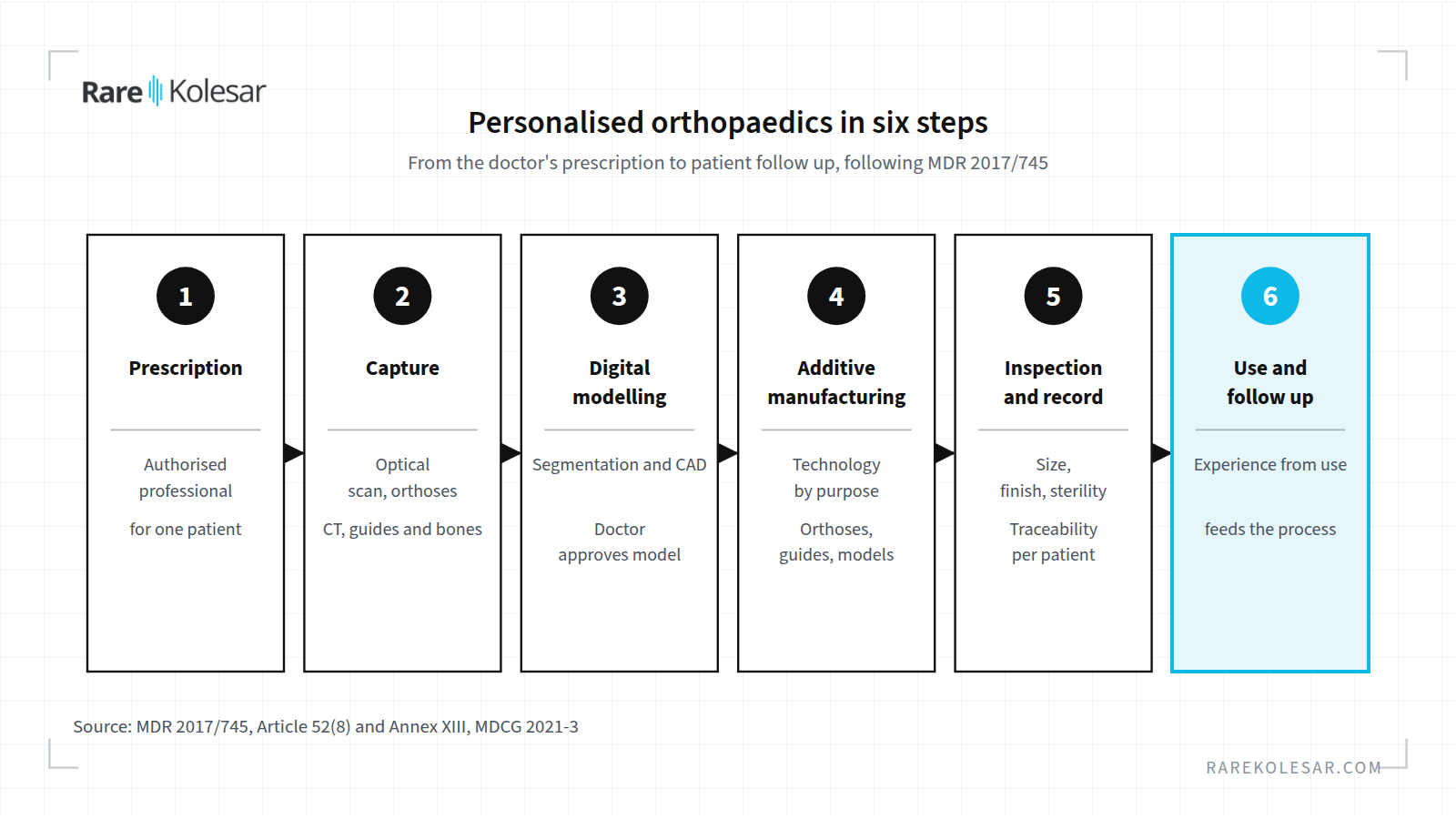
- Doctor's prescription. An authorised healthcare professional writes a prescription with specific design characteristics for one patient. This is the legal starting point of a custom-made device.
- Capture. An optical scan of the body surface for orthoses, or a CT scan for bone models and surgical guides. Scanning is quick and involves no direct contact with a wound or swelling.
- Digital modelling. An engineer extracts the anatomy from the scan (segmentation) and designs the device. The doctor approves the model before production.
- Additive manufacturing. The technology depends on the purpose. Material extrusion or polymer powder bed fusion for orthoses, resin vat photopolymerisation for precise guides and models.
- Inspection and documentation. Dimensional checks, finishing, sterilisation where needed, and a record of which file, material, machine and parameters were used for that patient.
- Use and follow up. The patient receives the device, and experience from use is recorded and fed back into the process. The MDR explicitly requires this.
The entry into this workflow is the same as in industrial reverse engineering and 3D scanning. The difference is that the "part" here is the human body, and mistakes are not allowed.
Why the idea had value
Orthopaedics has several constant problems:
- imprecise devices that are adjusted by hand
- long waits for orthoses
- risk in surgical planning without physical models
- quality that varies with the technician
- high costs for patients and health systems
Personalised devices can solve a large part of this. They are precise, repeatable and based on the patient's real anatomy. But I have to be honest. Additive manufacturing is not always faster. A Swiss study from 2024 found that the total production time of a 3D printed wrist orthosis was about 12 hours, of which about 45 minutes was active work, while a conventional thermoplastic orthosis was finished in about 14 minutes. The authors therefore recommend combining both approaches. The advantage of the digital workflow is not the speed of a single build, but repeatability, a stored file, fewer corrections and the ability to produce for several patients at once.
For more complex orthopaedic devices the results are more convincing. In a prospective study from Beijing, published in 2024, 55 patients with adolescent idiopathic scoliosis wore a 3D printed brace and 48 wore a conventional one. The 3D printed brace was 25 to 30% lighter and thinner, 3 mm instead of 4 mm. Curve progression occurred in 1 patient in the 3D printed brace group, compared with 10 in the conventional group. It is not a randomised trial, but it shows the direction.
What already exists in the world
This idea is not theory. Hospitals in Europe already run their own 3D printing labs, and clinical data exist for several types of devices.
| Example | Where | What they do | What it shows |
|---|---|---|---|
| Gregorio Marañón hospital lab | Spain | Models, guides and devices for several specialties, ISO 13485 quality system | A hospital can be a serious manufacturer |
| UMC Utrecht 3D Lab | Netherlands | Extrusion, photopolymerisation and bioprinting inside the hospital | The in house model works long term |
| Oslo University Hospital 3D Center | Norway | Extrusion, photopolymerisation and powder bed fusion | Scandinavian systems accept this model |
| UNICA3D LAB, Cagliari | Italy | About 40 virtual plans and 24 anatomical models in the initial phase | The start goes through models, with no patient contact |
| 3D printed scoliosis brace | China | 55 patients, brace 25 to 30% lighter | Better outcomes and comfort in a cohort study |
| 3D printed wrist orthosis | Switzerland | Compared with thermoplastics | Longer production, but repeatability and aesthetics |
A 2025 review on starting an orthopaedic 3D lab in a hospital also gives a useful calculation. According to one analysis it cites, about 63 models or guides per year are enough to cover the fixed costs of such a lab through operating room time savings. The same review states that labour makes up more than 90% of the cost of models made by material extrusion. That confirms what I keep repeating, the machine is not the biggest cost, people and knowledge are.
Regulatory framework, the MDR and custom-made devices
Without regulation this idea cannot exist. Here is what matters, without the whole textbook.
Custom-made device. Under Article 2(3) of the MDR, this is a device made according to a written prescription of an authorised person, with specific design characteristics, intended for the sole use of one patient. It carries no CE marking. Under Article 52(8), the manufacturer follows the procedure in Annex XIII and issues a statement that the device meets the general safety and performance requirements of Annex I. Documentation is kept for at least 10 years, and for implantable devices at least 15 years. Class III implantable custom-made devices also require a notified body.
3D printing is not automatically "custom-made". Guidance MDCG 2021-3 states that a 3D printed device is not automatically a custom-made device. If the manufacturer adapts a design to the patient's anatomy within a pre-validated design envelope, it is a patient-matched device and follows the regular route with CE marking.
Health institution exemption. Article 5(5) of the MDR allows a hospital to manufacture and use devices for its own patients without CE marking, provided the general safety and performance requirements are met. The conditions are that the device is not transferred to another legal entity, that there is an appropriate quality management system, in practice most often ISO 13485, that the institution justifies why an equivalent device on the market cannot meet the patients' needs, and that it regularly reviews experience from clinical use. The exemption does not apply to manufacturing on an industrial scale. An important note, guidance MDCG 2023-1 states that custom-made devices are outside the scope of this exemption and follow their own MDR rules. That is why the first step is always to determine which route each device takes.
| Custom-made device | Health institution exemption | |
|---|---|---|
| Legal basis | Article 2(3), Article 52(8), Annex XIII | Article 5(5) |
| Who is the manufacturer | Anyone who takes on the manufacturer's obligations | Only the health institution |
| Trigger | Written prescription by an authorised person for one patient | Needs of the institution's patients not met by the market |
| CE marking | No, Annex XIII statement | No, public declaration by the institution |
| Transfer to another entity | Yes, the device is supplied | No, it stays in the institution |
| Quality system | Required, with a notified body for class III | Appropriate system, in practice ISO 13485 |
Class depends on intended purpose. An orthosis worn on the skin and an anatomical planning model are in the lowest risk categories. A surgical guide comes into contact with an open wound and bone, so the requirements are higher. An implant is in the highest classes. That is why I would start with models and orthoses, not with implants. I wrote more about what biocompatibility means and why it does not transfer from one material to another in the article biocompatible materials in surgery.
Serbia and the region. Serbia is not an EU member, but its Law on Medical Devices and the national agency ALIMS follow the logic of EU rules. A hospital that sets up an ISO 13485 quality system and MDR documentation today is ready both for national rules and for future EU accession.
Where the obstacles were
The idea was good, but the system around it was not ready. The main obstacles were:
- slow administrative procedures in healthcare
- difficult access to medical data
- rigid protocols and resistance to change
- lack of standardisation in process digitalisation
- limited budgets and no long term strategy
The technological part was the smallest problem. The problem was integrating this kind of innovation into a system used to working the same way for decades.
What is needed to start
Today I would start differently than I did then. Not with a big, complete story, but with one department, one type of device and one clear legal route. I see this confirmed through my collaboration with friends in Sarajevo who work in medical 3D printing. Progress is fastest with anatomical models and phantoms, where there is no patient contact, while the team builds knowledge, doctors' trust and a quality system.
| Area | What is needed | Note |
|---|---|---|
| People | A doctor who leads the project, a biomedical engineer for segmentation and modelling, an orthotist, a quality person | The engineer and the orthotist are the key, not the machine |
| Capture | An optical 3D scanner for the body surface, access to CT scans in DICOM format | Scan quality defines device quality |
| Software | Medical image segmentation, CAD for modelling, print preparation | Medical software licences are a significant annual cost |
| Production | Material extrusion for models, resin vat photopolymerisation for guides, polymer powder bed fusion for orthoses | Metal and implants through contract manufacturing or partners |
| Quality | Quality management system per ISO 13485, risk management per ISO 14971, traceability | An entry ticket, not an option |
| Partners | Hospital, technical faculty, contract manufacturing, regulatory advisor | The faculty brings knowledge and students |
Before choosing equipment, the same rule applies as in industry. First the purpose, then the legal route, then the technology. I wrote separately about how to choose a technology, and similar logic applies to the idea of a centre for reverse engineering and additive manufacturing.
Risks and open questions
- Who is the manufacturer. A hospital, a private company or a partnership? The legal route and the liability depend on it.
- Who pays. If the health insurance fund does not recognise a 3D printed orthosis, the patient pays alone, and the idea stops there.
- Materials. A material that is fine for a model is not automatically fine for contact with skin or a wound. Biocompatibility is demonstrated for a specific intended use.
- Production time. For acute injuries, conventional thermoplastics remain faster. The digital workflow makes sense where the device is long term or complex.
- Data. Medical images are personal data. Clear rules are needed on who sees them, where they are stored and for how long.
- People. Without a doctor who believes in the project and an engineer who understands anatomy, no equipment helps.
Personal meaning
This project gave me deep insight into how the medical system works and how hard it is to introduce innovation into an environment where mistakes are not allowed. It taught me that technology on its own is not enough. You need to understand the procedures, protocols, risks and the dynamics of a doctor's work.
It will remain one of the most complex ideas I have tried to implement. Even though it did not come to life in full, it showed that personalised orthopaedics can become standard. It is only a question of time and of the system's courage to accept it.
Let's talk about implementation
If you are a hospital, a clinic, an orthotic workshop or a faculty and you are thinking about your own 3D printing lab, I can help you define the right first step. Which devices make sense, which legal route they take, which equipment and which people are needed. I do not sell equipment, so the recommendation depends only on your needs. Contact me through the consulting page.
Frequently asked questions
Is every 3D printed orthopaedic device a custom-made device? No. According to guidance MDCG 2021-3, 3D printing alone does not make a device custom-made. It requires a written prescription by an authorised person with specific design characteristics for one patient. If the design is adapted within a pre-validated envelope, it is a patient-matched device and follows the regular route with CE marking.
Can a hospital print orthopaedic devices for its own patients without CE marking? Yes, under Article 5(5) of the MDR, if the device is not transferred to another legal entity, the hospital has an appropriate quality management system, justifies why an equivalent device on the market is not sufficient and does not manufacture on an industrial scale. The general safety and performance requirements of MDR Annex I still apply.
Is a 3D printed orthosis faster to make than a conventional one? Not always. A 2024 study found that producing a 3D printed wrist orthosis took about 12 hours in total, compared with about 14 minutes for a thermoplastic one. The advantage of the digital workflow lies in repeatability, a stored file and fewer corrections, not in the speed of a single build.
Which devices are best to start with? Anatomical models for surgical planning and orthoses worn on the skin. They are in lower risk categories, do not enter the body, and build the team's knowledge and the quality system. Surgical guides and implants come later.
How long must documentation for a custom-made device be kept? Under MDR Annex XIII, at least 10 years after the device is placed on the market, and at least 15 years for implantable devices.
Does the MDR apply in Serbia? Serbia is not an EU member, so the MDR does not apply directly. The national Law on Medical Devices and the agency ALIMS follow the logic of EU rules, so working to the MDR and ISO 13485 is the safest basis both today and for the future.
Sources
- Regulation (EU) 2017/745 on medical devices, EUR-Lex, 2017
- MDR Annex XIII, Procedure for custom-made devices, medical-device-regulation.eu, 2019
- MDCG 2021-3 Questions and Answers on Custom-Made Devices, European Commission, 2021
- MDCG 2023-1 Guidance on the health institution exemption under Article 5(5), European Commission, 2023
- Starting up an in-house 3D lab for orthopaedics, Parodi et al., AME Surgical Journal, 2025
- Production time and practicability of 3D-printed wrist orthoses versus low temperature thermoplastic wrist orthoses, von Haller et al., Hand Therapy, 2024
- Patient-specific 3D-printed Brace for Adolescent Idiopathic Scoliosis, Li et al., World Neurosurgery, 2024
- Zakon o medicinskim sredstvima (Law on Medical Devices, Serbia), Paragraf, 2017