IGM Mladost d.o.o.

IGM Mladost, spare parts for a roof tile production line
Client
IGM Mladost d.o.o. manufactures roof tiles. The project is in maintenance, specifically producing spare parts for industrial machines on the production line.
Challenge
The standard process for a spare part went like this: measurement, 2D drawings, tooling order and production. The whole cycle took 4 to 6 weeks. For critical parts subject to frequent wear, that is too slow.
Solution
We started from the existing, worn metal part. We did reverse engineering, meaning 3D scanning the part and building a 3D model from the scan. Then we optimized the geometry for additive manufacturing and produced the part with FFF technology in PPS CF. The new part is dark grey, with a visible carbon fiber texture.
Technologies
- 3D scanning and reverse engineering
- FFF, printing by melting filament layer by layer
- PPS CF, polyphenylene sulfide filled with chopped carbon fibers. This is not CFF, where a continuous fiber is laid into the part.
Result
| Metric |
Before |
After |
| Delivery time |
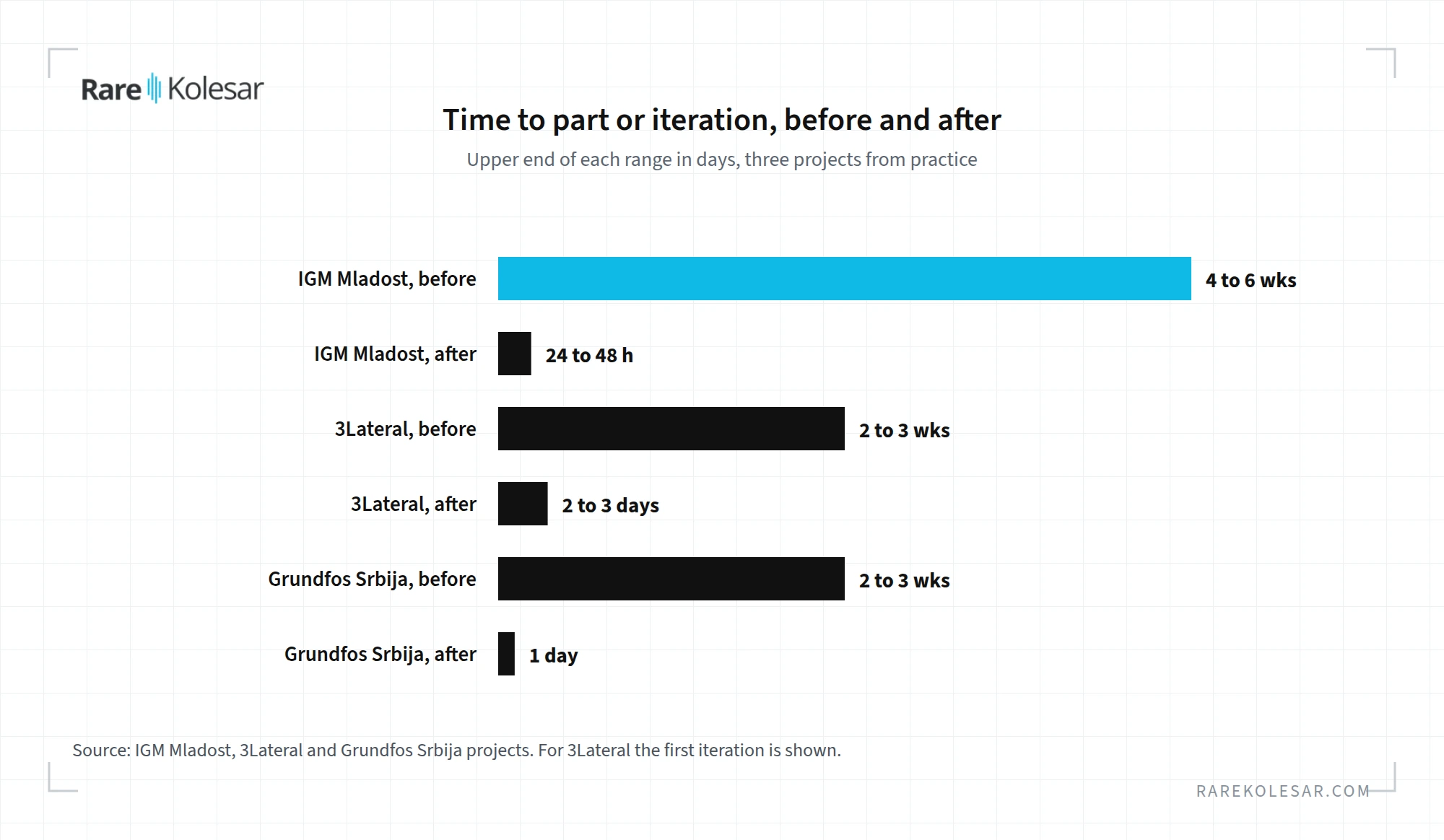
4 to 6 weeks |
24 to 48 hours |
| Cost per part |
€800 to 1,200 |
€45 to 80 |
| Minimum quantity |
10 to 50 pcs |
1 pc |
| Part weight |
100% (metal) |
about 60% (PPS CF) |
| Iteration time |
more than 6 weeks |
1 to 2 days |
What other companies can take from this
PPS CF as a metal substitute works when the part is not exposed to extreme mechanical loads. For such parts the savings in time and cost are dramatic. The first step is to list the maintenance parts that wear often and take weeks to arrive. I write more about scanning as an entry point in reverse engineering and 3D scanning as an entry point to additive manufacturing, and about material choice in how to choose the right material without guessing.
3Lateral / Epic Games Novi Sad

3Lateral / Epic Games Novi Sad, motion capture camera mount
Client
3Lateral is a Novi Sad studio specialized in digital humans, meaning scanning, modeling and facial animation for games and film. Epic Games, the company behind Unreal Engine, acquired 3Lateral in January 2019.
Challenge
Motion capture records an actor's movement so it can be transferred to a digital character. It needs precise, lightweight mounts and adapters that fit different cameras and markers. A typical example is the helmet camera mount, a thin boom arm that holds a small camera in front of the actor's face. Standard CNC machining was slow for iterations. Standard FFF lacked sufficient precision.
Solution
We set up a hybrid approach, where each technology does what it does best:
- FFF for rapid iteration and low cost prototypes
- SLA, printing from liquid resin cured by light, for high precision and smooth surfaces
- SLS, laser sintering of powder, for functional parts and mechanical strength
- CNC for critical surfaces and tolerances
Technologies
FFF, SLA, SLS and CNC machining.
Result
| Metric |
Before (CNC only) |
After (hybrid approach) |
| First iteration |
2 to 3 weeks |
2 to 3 days |
| Prototype cost |
€200 to 500 |
€15 to 80 |
| Iterations per month |
1 |
4 to 6 |
| Mount weight |
100% (aluminum) |
40 to 70% |
| Concepts tested |
1 to 2 per project |
8 to 10 per project |
What other companies can take from this
The hybrid approach lets you test several concepts quickly before you finalize one. That was critical for development in the games and film industry, and the same holds for any development where the design changes faster than a CNC shop can respond. You do not pick one technology for the whole part, you pick the right technology for each phase and each surface.
Faculty of Technical Sciences Novi Sad (Interreg Danube)

Faculty of Technical Sciences Novi Sad, a unified methodology for laboratories
Client
The Faculty of Technical Sciences, University of Novi Sad, within the Danube DNA project (Digital Transformation Network of Active SMEs Training and Knowledge Transfer Centers) of the Interreg Danube programme. The project runs from January 2024 to June 2026, is led by the University of Novi Sad with partners from 12 Danube Region countries, and has a budget of about 2.16 million euros, 80 percent of it from Interreg funds. Its goal is a network of regional training and knowledge transfer centers that help small and medium companies with digital transformation toward Industry 4.0. Within that framework, Professor Movrin is developing a regional competence center that connects industry, research and education.
Challenge
Different laboratories worked with different methods. Results were inconsistent. Failed prints and project delays were common.
Solution
We introduced an industrial workflow:
- standards for all materials
- moisture and storage control for materials
- profile validation for FFF, SLA and SLS
- consistent quality control
- documentation for students, assistants and researchers
The competence center thus received a unified methodology. Laboratories now operate predictably and without major deviations.
Technologies
FFF, SLA and SLS, with validated profiles for each.
Result
- Projects are completed faster.
- Results are consistent.
- Students and researchers have clear working procedures.
What other companies can take from this
Companies with several machines or several sites have the same problem. Without shared profiles and procedures everyone works their own way, and results cannot be compared. For the region it also matters that it gains a generation of engineers who understand what an industrial process looks like, not hobby use. I explain why manufacturer profiles are not enough in why factory profiles are not enough for serious work.
Aumovio Serbia

Aumovio Serbia, housings and mounts for automotive displays
Client
Aumovio Serbia from Novi Sad, formerly part of Continental. Aumovio was created as the spin off of Continental's automotive business and has been an independent company listed on the Frankfurt Stock Exchange since 18 September 2025. In Novi Sad it has a research and development center and a plant for displays and instrument clusters. The company develops modules and displays for automotive systems and has used consulting support from day one.
Challenge
Housings, mounts and electronic elements must be precise, stable and durable enough to withstand vibration and heat. Iterations must be fast.
Solution
We set up a process that combines FFF and SLS depending on requirements:
- FFF for stable functional parts
- SLS for complex geometries
- standardized profiles for strength and dimensional stability
- rapid iterations for testing different module versions
Custom housings, mounts and test modules were developed that allow fast design changes. The complete system can be iteratively improved within one day.
Technologies
FFF and SLS, with standardized profiles.
Result
- Product development accelerated.
- Module precision improved.
- Dependency on external procurement reduced.
What other companies can take from this
Automotive electronics gains a tool for rapid validation of product generations in the early development phase. The key is not one machine, it is standardized profiles and a clear rule for which technology goes on which part. I describe how such a process is verified in what process qualification looks like in practice.
Grundfos Srbija d.o.o.

Grundfos Srbija, electric motor brackets in pump development
Client
Grundfos Srbija d.o.o., pump industry. The project is in the product development phase.
Challenge
During the development of new pumps, different electric motor bracket configurations need to be tested. Standard metal production required tooling orders and CNC machining. That is too slow for a phase where the design changes every few days.
Solution
During development and validation we replaced the metal brackets with PPS CF brackets. Iterations are printed overnight and tested the next day.
Technologies
FFF and PPS CF, polyphenylene sulfide filled with chopped carbon fibers.
Result
| Metric |
Before (metal and CNC) |
After (PPS CF) |
| Iteration time |
2 to 3 weeks |
1 day |
| Cost per iteration |
€300 to 600 |
€20 to 40 |
| Iterations per week |
0.3 |
3 to 5 |
| Time to design freeze |
3 to 4 months |
3 to 4 weeks |
| Development phase cost |
€8,000 to 15,000 |
€800 to 2,000 |
What other companies can take from this
In the development phase, iteration speed matters more than final material properties. PPS CF enables functional testing before moving to metal serial production. The serial part can still be metal, but you reach the final design in weeks, not months.