Do you sell equipment or materials?
No. As a consultant I do not sell equipment, materials or software, and I receive no commission from manufacturers. I hold equity in the distributor 3D Republika, but I do not take part in sales.
I help industrial companies decide whether, where and how 3D printing makes sense, and carry that decision through. I offer six services, each for a different moment in the process: from the first question of whether something pays off, through equipment selection and process implementation, to training your people and ongoing advisory.
I work as an independent consultant. I hold equity in a distributor, but I do not sell equipment or take part in sales, so my recommendation depends only on your part and your process.
If you are not sure where to start, begin with the production analysis. It shows which service you actually need.
| Service | When you need it | What you get | Pricing model |
|---|---|---|---|
| Cost assessment | you are considering whether 3D printing makes sense for a part | a report with cost per part, lead time and a technology recommendation | fixed price per project |
| Independent equipment and supplier evaluation | you have decided to invest and are choosing equipment | a comparison of offers including hidden costs, tender support | fixed price per project |
| Process implementation and qualification | equipment is arriving or already in place, but the process is not stable | profiles, procedures, quality control, documentation | fixed price per phase |
| Training | your people lack knowledge | training for engineers and operators on your equipment | per day |
| Custom software | your company lacks a tool for a step | a tool for your workflow, instructions and training | per project |
| Strategic AM advisory | you already use 3D printing and want to go further | monthly advisory, visits, a network of partners | monthly package |
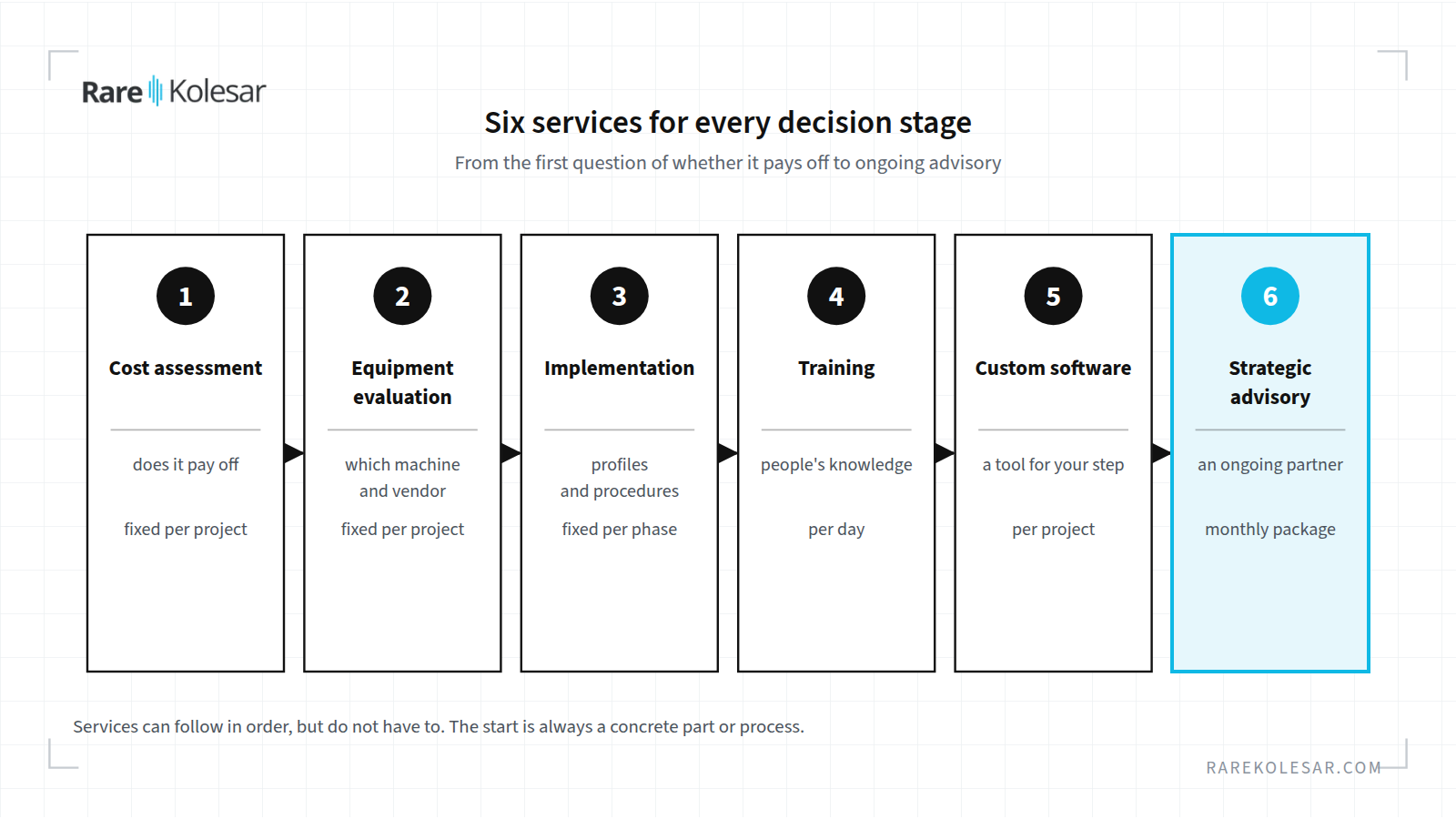
Every engagement starts with a conversation about a specific part or process, not about a machine. First I look at what you make, in what quantity and with what requirements. Only after that does it make sense to talk about technology, material and equipment.
The services can follow one another, but they do not have to. Someone comes only for a cost assessment and concludes that 3D printing makes no sense for their part. That is also a good result, because the decision was made before money was spent. When 3D printing does pay off, the next steps are equipment selection, implementation and training.
Every seller praises their own equipment, and that is normal. The problem is that a company then has trouble getting an objective picture. I do not earn from selling machines, materials or software, and I take no commission from manufacturers. What that means in practice is described in the article what vendor neutral means in machine selection.
Most mistakes in this industry are not a bad machine but a bad decision about why the machine was bought at all. I described the most common mistakes in the article why 90 percent of companies introduce 3D printing the wrong way. For examples from practice, see the case studies.
No. As a consultant I do not sell equipment, materials or software, and I receive no commission from manufacturers. I hold equity in the distributor 3D Republika, but I do not take part in sales.
The cost assessment. It answers the question of whether 3D printing makes sense for your part at all, before you invest in equipment or change your process.
The cost assessment and equipment evaluation are charged as a fixed price per project, process implementation as a fixed price per phase, training per day, software per project, and strategic advisory as a monthly package. The exact amount depends on scope and is agreed after the first conversation.
Yes. Company size is not decisive. What matters is that there is a specific part or process where additive manufacturing can bring a measurable benefit.
From Belgrade, without territorial limits, anywhere in the world. I do analysis and advisory remotely too, and visit factories when needed, in Serbian and English.
Then the report says so, with numbers. A decision not to do something, made in time, saves more money than any machine.
Send a CAD file or a description of the part through the production analysis. For metal parts there is also the free SLM DFAM Checker.