Cost assessment for additive manufacturing
Does 3D printing pay off for your part, in numbers.
- A few days for one part
- Fixed price per project
- No equipment sales
Summary
Are you thinking about 3D printing for a part, but unsure whether it really pays off compared with how you make it today, by CNC machining or casting? Before you invest in equipment or change your process, it is good to know the numbers.
I analyze your specific part or group of parts and compare additive manufacturing with your existing process on cost, lead time and performance. The result is a short, clear report with concrete numbers and a recommendation for the next step. For a single part, the assessment arrives in a couple of days.
What I analyze
You get a technology and material recommendation that is not tied to any equipment seller, because I do not sell equipment. I only give an independent opinion based on experience from dozens of completed projects.
| What I compare | What it means for you |
|---|---|
| Cost per part | the real cost, including material, machine time, preparation and post processing |
| Lead time | how quickly the part arrives today and how quickly it would arrive from 3D printing |
| Performance | whether the 3D printed part withstands the same load, temperature and wear |
| Quantity | up to what quantity 3D printing pays off, that is, where the break even point is |
| Production approach | whether your own machine or service bureau production is better |
The result is free of jargon and does not push you toward any particular solution. If the numbers show that 3D printing makes no sense for your part, the report says so. When 3D printing makes sense and when it does not, I described in the article when 3D printing makes sense and when it does not.
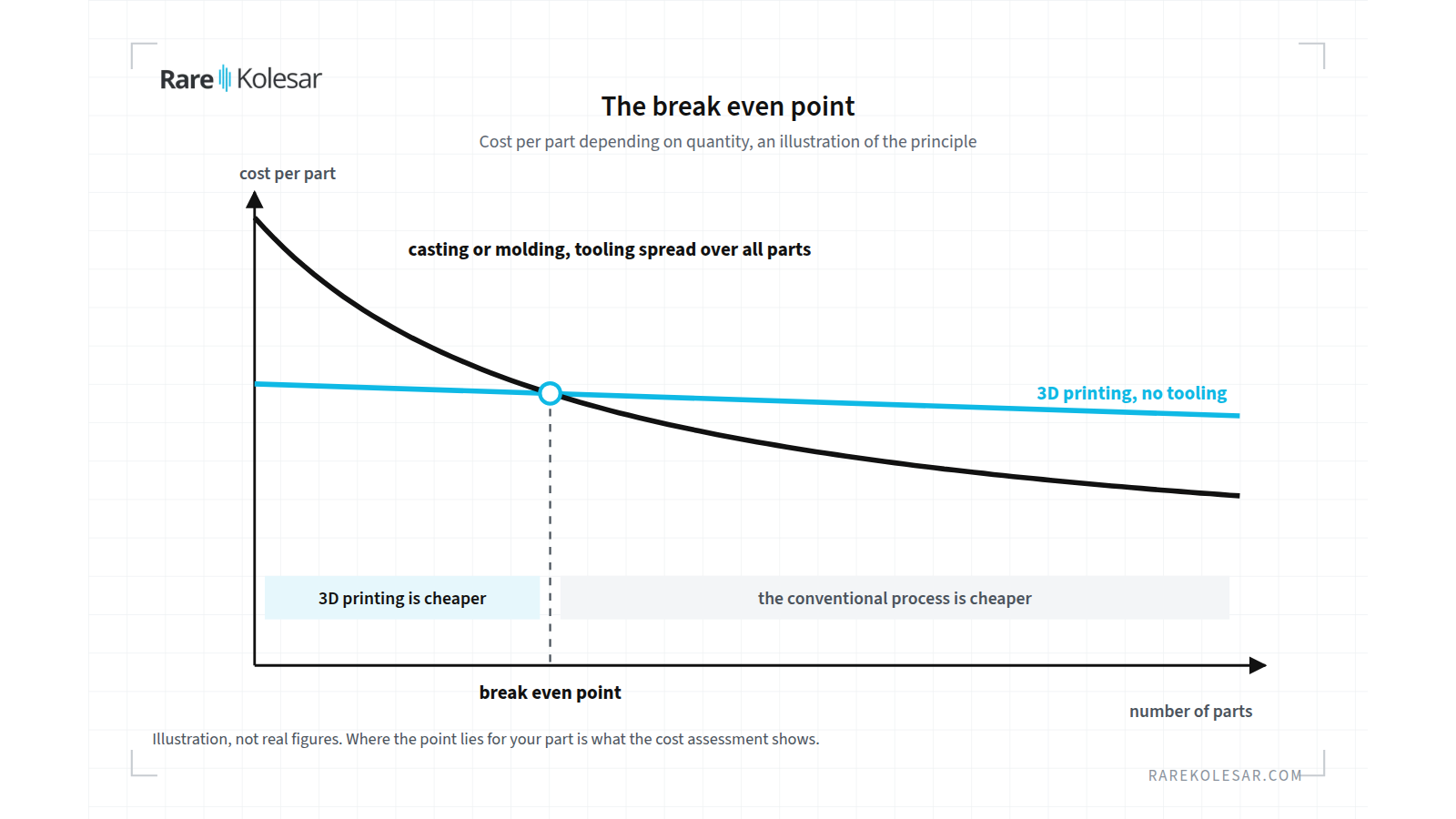
Up to the break even point 3D printing is cheaper, because there is no tooling. Beyond it, the casting or molding tool is spread over enough parts and the conventional process becomes cheaper. The assessment shows where that point lies for your part.
How the assessment works
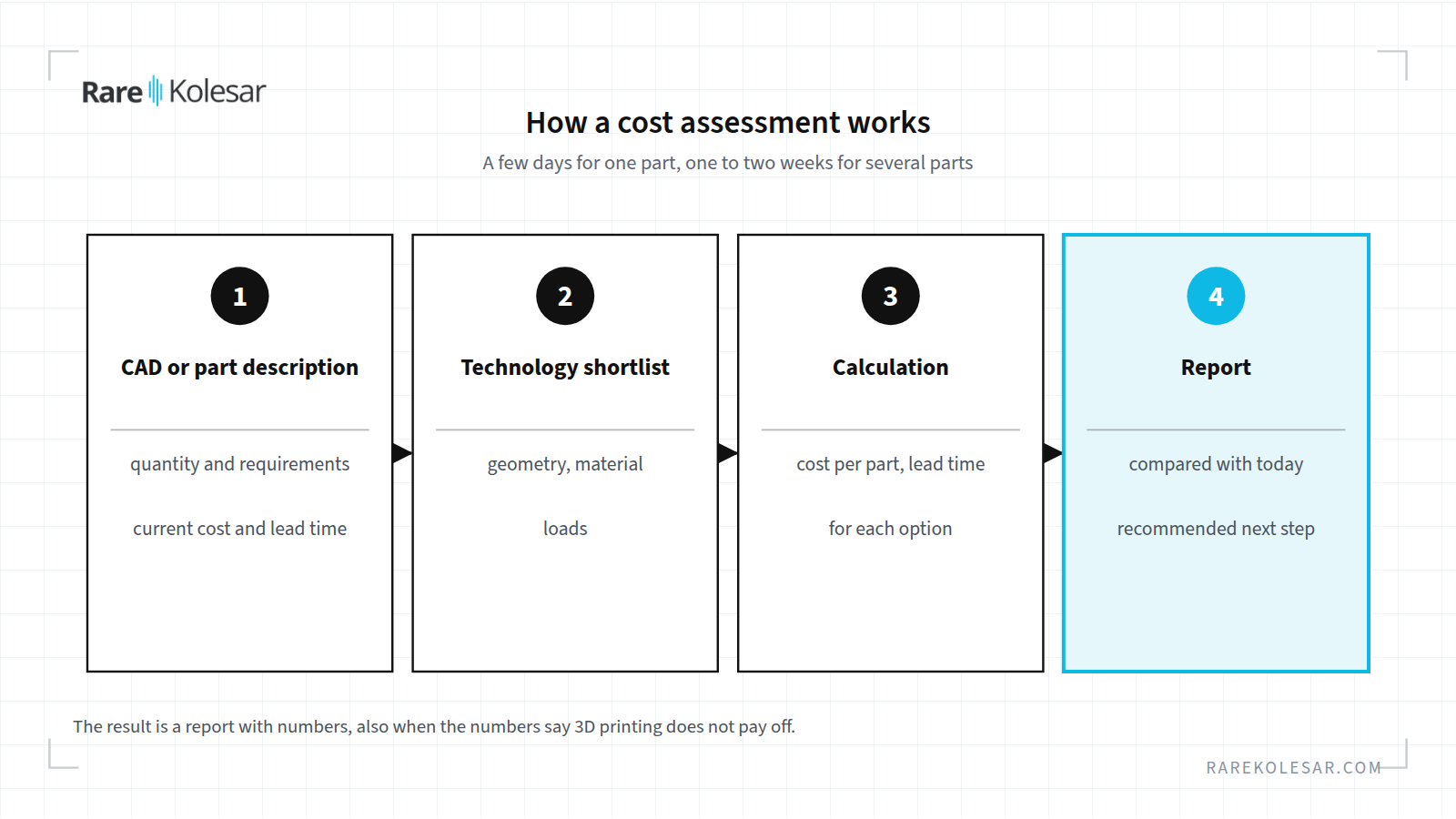
- You send a CAD file or a description of the part, with the quantity and requirements.
- I go through the geometry, material and loads and select the technologies that come into consideration at all.
- I calculate the cost per part and the lead time for each option and compare them with your current process.
- You receive a report with numbers and a recommendation for the next step.
How long it takes
For a single part and a basic comparison, the assessment arrives in a couple of days. For multiple parts or a more detailed analysis of material and technology, the engagement is more comprehensive and takes one to two weeks. Pricing is a fixed price per project, and the amount depends on the number of parts and the depth of analysis.
Who this service is for
This service is for you if you are only considering whether AM makes sense for your product. If you have already decided to invest and are choosing between specific machines or suppliers, independent equipment and supplier evaluation will help you more.
How to choose a technology once the decision is made, I described in the article how to choose a technology. For larger series, also see high volume production of 3D printed parts.
Frequently asked questions
What do I need in order to get an assessment?
A CAD file or a description of the part, the quantity you need and basic requirements, such as material, load and tolerances. If you have your current part cost and lead time, the comparison is more precise.
How long does the cost assessment take?
For a single part and a basic comparison, a couple of days. For multiple parts or a more detailed analysis of material and technology, one to two weeks.
Does the assessment include a machine recommendation?
It includes a technology and material recommendation. Choosing a specific machine and supplier is a separate service, independent equipment evaluation.
What if 3D printing does not pay off?
The report says so, with numbers. A decision not to do something, made before investing, is also a valuable result.
Can I check a metal part for free?
For metal parts there is a free geometry check, the SLM DFAM Checker. It shows whether the part is suitable for printing, while the cost assessment answers the question of whether printing pays off.
How is it priced?
As a fixed price per project. The amount depends on the number of parts and the depth of analysis and is agreed before the start.
Sources
Send a CAD file or a description of the part
Start through the production analysis. For the other services, see the consulting page.