Biocompatible materials and real applications in surgery: what "biocompatible" really means and where 3D printing stands today
Summary
Biocompatibility is not a property of a material, but an evaluation of a finished medical device in a specific application. ISO 10993 is not a single certificate, but an evaluation framework that depends on where the device touches the body and for how long. A material evaluated for short contact with skin is not thereby qualified for implantation.
Clearance applies to an intended use, not to a material. The FDA says so on its page about 3D printing of medical devices, and in 2025 it issued a warning letter to a company that used cleared materials outside their cleared intended use.
In surgery, additive manufacturing is clinical practice today for anatomical models, surgical guides, orthoses and patient-specific titanium implants. Bioprinting of living tissue is still research.
Titanium versus PEEK has no single winner. The outcome depends on the anatomical site and on the implant geometry, and porous 3D printed titanium changes the equation.
Adverse event reporting systems do not separate 3D printed implants from conventionally made ones. Keep that in mind with every claim of "better outcomes".
Why an article about biocompatibility, not about printers
When people talk about 3D printing in medicine, the conversation usually starts with the technology: which printer, which material, which resolution. That is the wrong order. The first question in surgery is not what can be printed, but what may go into the body, for how long, and who is responsible for it. This article starts from that question, and only then moves on to materials, technologies and applications, including those from our region. No equipment manufacturer is favored, and that is intentional.
Biocompatible is not one word, it's a matrix
ISO 10993 is a series of more than twenty parts. The core part, ISO 10993-1, does not prescribe a single test that a material passes or fails. It describes a biological evaluation process within risk management. A medical device is first categorized along two axes.
The first axis is the nature of contact. Under the 2018 edition, these are surface devices (skin, mucosal membrane, breached or compromised surface), externally communicating devices (blood path indirect, tissue or bone, circulating blood) and implant devices (tissue or bone, blood).
The second axis is contact duration: limited (up to 24 hours), prolonged (24 hours to 30 days) and long-term (over 30 days). Repeated use accumulates, so a device used several times can move into a longer category even if each individual use is short.
Only the combination of these two axes determines which biological endpoints must be evaluated. For almost all devices in contact with a patient, these are cytotoxicity, sensitization and irritation. As contact becomes deeper and longer, systemic toxicity, genotoxicity and pyrogenicity are added. For implants, local effects after implantation are evaluated according to ISO 10993-6, and for devices in contact with blood, hemocompatibility.
An important nuance: the standard requires each endpoint to be evaluated, not necessarily a new test for each. The evaluation can rely on existing data, chemical characterization of the material and a documented rationale. But every endpoint must be covered, by evidence or by argument.
The practical consequence is simple. A surgical guide that touches bone during a one-hour operation and a cranial implant that stays for life sit at opposite corners of this matrix. A material evaluated for the first case says nothing about the second.
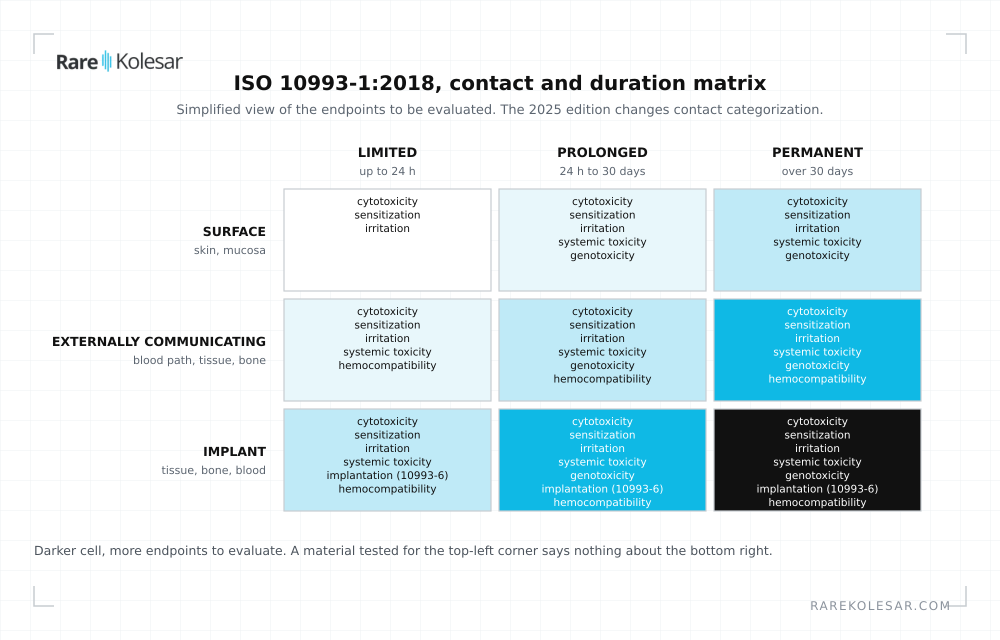
What changed in the 2025 edition. The sixth edition of ISO 10993-1 was published on 18 November 2025. The externally communicating category is no longer used; contact is categorized directly by tissue type: internal tissues, breached surfaces and circulating blood. New rules define how total exposure is calculated for daily and intermittent contact. Genotoxicity is now evaluated for virtually all prolonged contact devices, and bioaccumulation for all duration categories. Evaluations done under the 2018 edition should be compared against the new requirements.
A recurring confusion: "biocompatible" is not "suitable for implantation"
If you have read the article on food-contact certification for 3D printed parts, you will recognize the pattern. There, the problem was biocompatibility being presented as proof of food safety. Here, the problem goes one level deeper, inside biocompatibility itself.
A 2022 peer-reviewed review (Guttridge et al., Annals of 3D Printed Medicine) analyzed 130 commercial 3D printing resins marketed as biocompatible, 99 rigid and 31 flexible. Of the rigid resins, 28 cited ISO 10993-1, but only 8 provided details of the evaluated endpoints. Twenty-three materials used vague terms such as "capable", "compliant", "meets" or "satisfies". The authors conclude that users must check for themselves whether a material is suitable for their specific application.
The FDA itself states the principle clearly on its page about 3D printing of medical devices. A material cleared for a specific intended use, for example as a "tooth shade resin material", is not automatically cleared for any other purpose, for example an endosseous dental implant abutment. The FDA clears a finished device for a specific intended use, not a material for general use.
There is also a concrete case. On 9 June 2025, the FDA issued a warning letter to Reset Technology Corporation, which sold 3D printed partial dentures and at-home kits for taking one's own dental impressions. The impression material was cleared only for prescription use, and the company sold it to patients for use without a dentist's supervision, outside its cleared indication. For the dentures themselves, the company cited only a clearance for preformed plastic teeth, so the FDA considered that the dentures required their own premarket submission. The FDA stated that improper impressions can lead to improperly fabricated dentures, which can cause bone loss, irritation, sores and temporomandibular joint dysfunction. This case is not about biocompatibility testing, but it shows the same thing: a clearance for one intended use does not carry over to another.
Two more nuances are worth clarifying, because they are often confused.
First, USP Class VI is not the same as ISO 10993. USP classification is an older and narrower set of material tests. The FDA adopted ISO 10993 as the primary framework back in 1995, and a USP class today is not a substitute for an evaluation according to ISO 10993. When a 3D printing material supplier highlights "USP Class VI" as the main evidence, that is not evidence that the finished part is suitable for implantation.
Second, in SLA and DLP printing, biocompatibility is a property of a correctly processed finished part, not of the resin. Insufficient washing and incomplete post-curing leave uncured monomer, which is cytotoxic. Studies show that extended washing and correct post-curing reduce residual monomer, but do not remove it completely. The same resin can produce a biocompatible part in one workflow and a non-biocompatible part in another. This is the same message as in the article What process qualification looks like in practice, only with much higher stakes.
Materials and technologies, what is really used today
ISO/ASTM 52900 divides additive manufacturing into seven process categories, but four matter most for surgery.
Material extrusion (FDM). PLA, ABS, PETG, PC-ISO, PCL and medical-grade PEEK. Real uses are anatomical models, molds for shaping PMMA implants during surgery, prototypes of prostheses and orthoses, and surgical planning aids. Cranial implants made of medical-grade PEEK have been produced by FDM, in documented workflows with validated biocompatibility and steam sterilization, but that is an exception requiring industrial equipment and a controlled process. What is printed in medicine on desktop FDM printers is almost always models, not implants. Conventional FDM cannot be bioprinting, because the melting temperature would destroy the cells.
Vat photopolymerization (SLA, DLP, LCD). Dominant for dental applications and surgical guides, thanks to high resolution and smooth surfaces. With biocompatible resins, it is also used for some devices in contact with patients, but that is exactly where residual monomer is the biggest risk. In research, DLP is also used for bone regeneration scaffolds. A Romanian study from the Politehnica University of Bucharest (Codrea et al., 2024) used DLP to print scaffolds from GelMA hydrogel, gelatin modified to crosslink under light, with strontium-doped hydroxyapatite.
The compressive strength of the scaffolds was about five times higher than that of pure GelMA hydrogel, and human osteoblasts adhered well to the scaffold surface. The absolute values, however, are in the range of hundredths of a megapascal, far below bone. These are regeneration scaffolds, not load-bearing implants.
Polymer powder bed fusion (SLS, MJF). PA12 and PA11 polyamides for orthoses, prosthetic sockets, insoles and cranial remolding helmets for infants. Biocompatibility certificates for these powders usually cover skin contact, which is exactly the application they are intended for, and that is where they should stay.
Metal powder bed fusion (LPBF, EBM). The core technology for permanent load-bearing implants, with the titanium alloy Ti-6Al-4V and cobalt-chrome alloy as standard materials. Documented clinical applications are cranial and craniomaxillofacial reconstruction, pelvic reconstruction after tumor resection, vertebral body replacement and dental implants. The porous lattice surface allows bone ingrowth. Under EU regulation, implants are generally class IIb or III medical devices, with correspondingly strict conformity assessment, a completely different world from an SLS orthosis. For the mechanical properties of additively manufactured titanium, by manufacturer and with independent verification, see Comparing alloys in metal additive manufacturing.
Bioprinting is a separate category. It is the extrusion of hydrogels containing living cells at room or body temperature, crosslinked by ions, light or temperature. Today it is almost entirely at the research stage, and that should be said clearly.
Titanium versus PEEK, the real tension of this topic
For load-bearing implants, the choice of material is a compromise between two bad outcomes.
The titanium alloy Ti-6Al-4V has an elastic modulus of about 110 to 114 GPa. Cortical bone has about 15 to 20 GPa, and trabecular, spongy bone only 0.45 to 1.3 GPa. An implant five to eight times stiffer than cortical bone takes most of the load. The bone around it is no longer loaded, and bone that is not loaded is resorbed, according to Wolff's law. This is stress shielding, one of the main causes of aseptic loosening and revision surgery.
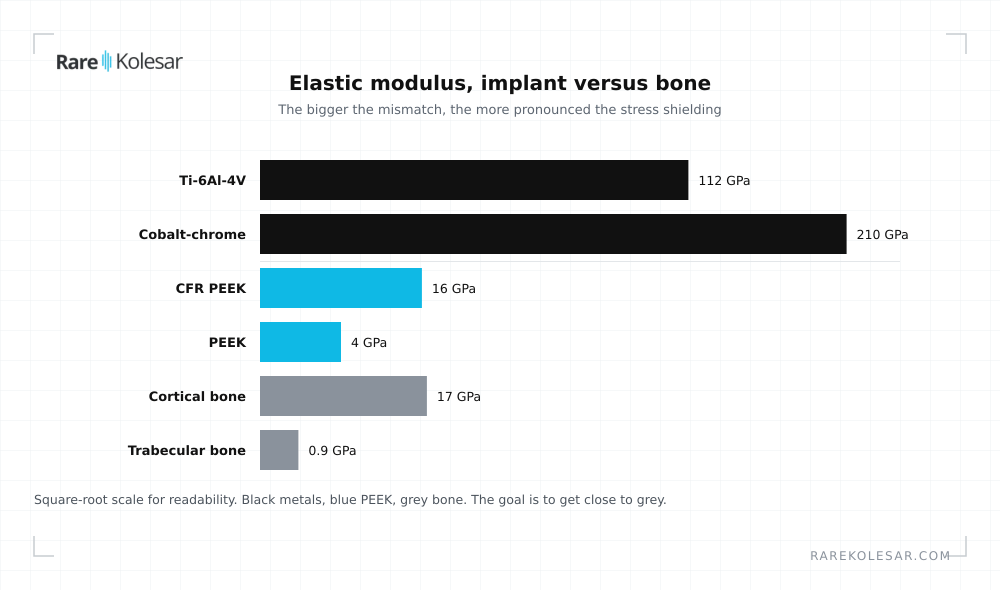
PEEK has a modulus of about 3.6 to 4 GPa, and carbon fiber reinforced PEEK (CFR PEEK) about 13 to 18 GPa, close to bone. But PEEK is bioinert, bone does not bond to it, and it has lower strength. A 2026 finite element study of dental implants showed peak cortical bone strain of 3103 microstrain for titanium, versus 1523 for CFR PEEK. That concentration of stress around the stiffer material is the mechanism of the problem.
The clinical data do not produce a single winner, and that is the most important conclusion.
For interbody cages, a 2017 meta-analysis showed that titanium cages had significantly more subsidence, the cage sinking into the vertebra, than PEEK cages. That analysis included six studies, four of them in the cervical spine, with conventionally manufactured titanium cages.
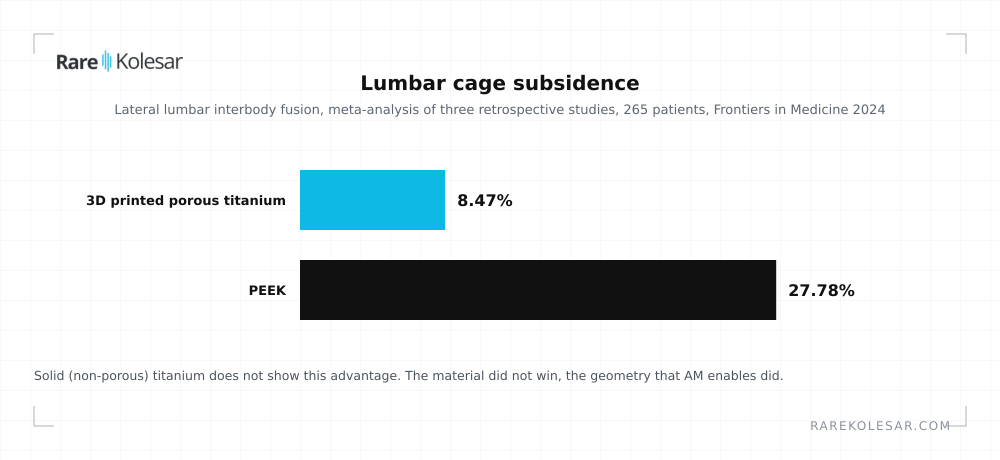
Newer studies with porous 3D printed titanium reverse the picture. A 2024 meta-analysis (Frontiers in Medicine) in lateral lumbar interbody fusion showed subsidence of 8.5 percent for 3D printed titanium, versus 27.8 percent for PEEK. The analysis included three retrospective studies and 265 patients. The first randomized trial, published in 2025, was small, with 17 patients. After six months, fusion was achieved at all levels with 3D printed titanium and at none with PEEK, while there was no difference in subsidence. The trial was stopped early because of the pronounced difference in interim results.
In other words, the material did not win, the geometry that additive manufacturing enables did.
In cranioplasty, the reconstruction of the skull, outcomes are largely comparable. A retrospective study from Mayo Clinic included 72 patients and 77 cranioplasties. Overall complications were 24 percent for PEEK and 23 percent for titanium, with no significant difference. One finding from the same study is worth remembering. In patients with a history of radiation therapy, titanium mesh infection was 38 percent, versus 3 percent in patients without radiation. With PEEK implants, irradiated patients had no infections.
There is also a third path. Porous titanium lattice structures can lower the effective modulus to the level of trabecular bone, and one lattice from 2025 reached only 0.09 GPa. In one retrospective study in transforaminal lumbar interbody fusion, composite PEEK and titanium cages had subsidence of 4.8 percent, versus 27.9 percent for 3D printed titanium. This also shows how much results vary with surgical approach and the definition of subsidence. Hydroxyapatite-coated PEEK shows better bone bonding to the implant surface in animal models. Low-modulus beta titanium alloys, around 36 GPa, are a metallurgical alternative.
Porosity is a double-edged sword. It lowers stiffness, but it can introduce mechanical risk, as the next section shows.
What complication data say, and what they cannot say
Published clinical results for 3D printed implants are mostly positive, but short-term and of low level of evidence.
Titanium metaphyseal cones in revision knee replacement have a survivorship free of revision for aseptic loosening of 99.7 percent, with an overall complication rate of almost 20 percent, most often infection. Patient-specific acetabular components of the hip have a survivorship of 97.7 percent after an average of 23 months. Patient-specific craniomaxillofacial implants have a pooled success rate of about 95 percent.
But subperiosteal dental implants, placed on the jawbone under the periosteum, show how early results can mislead. A 2026 systematic review reports survival of 97.8 percent in studies with follow-up of up to three years. In the study with the longest follow-up, survival after six years drops to 54.1 percent. The most common cause of late failure is soft tissue complications, above all implant exposure, and the authors recommend these implants only for carefully selected patients.
There is also a documented field corrective action. For the Stryker Tritanium PL, a 3D printed titanium posterior lumbar cage, a class 2 recall was initiated on 28 November 2018, covering 28,461 units in commerce, after reports of cages fracturing during and after implantation. The implants were not removed from the market. The surgical technique guide was updated, with a warning not to twist, cantilever or rotate the cage during placement. Still, the case raised the question in the profession of whether porous 3D printed implants are strong enough and whether the required tests are sufficient.
For context, around 200 comparable lumbar fusion devices in the FDA database accumulated between 700 and 900 fracture reports from 2004 to early 2019. Researchers searching by product name found 43 reports for 3D printed lumbar cages from all manufacturers between 2016 and 2018. Fracture, then, is not exclusive to 3D printing, but even these numbers do not give a rate.
And this is the key critical point. Neither the US adverse event database MAUDE nor the European system separates reports by manufacturing technology. Regulation is driven by device type and intended use, not by process, so the product code does not record whether an implant was 3D printed. MAUDE is also a passive system, without data on how many implants were placed, so its numbers are not rates. Europe has no single public database, and EUDAMED is still being rolled out gradually.
The consequence is that public databases cannot produce a complication rate specific to 3D printed implants that is comparable to conventional ones. Every claim of "better outcomes for additively manufactured implants" rests on clinical series and meta-analyses, not on population-wide surveillance.
The regulatory essentials, without the whole textbook
The EU Medical Device Regulation, MDR 2017/745, is one of the most demanding in the world and applies directly in all member states. Three points are decisive for additive manufacturing.
First, the MDCG 2021-3 guidance states that a 3D printed device is not automatically a "custom-made device" just because it is printed. It must meet the definition: a specific patient, a written prescription from an authorized person and specific design characteristics. A custom-made device carries no CE mark, but the manufacturer issues a statement and must meet the general safety and performance requirements.
The same guidance also introduces the concept of a patient-matched device. This is a device adapted to the patient's anatomy, but within a validated design envelope, using a standard production process. Such devices go through the regular CE marking route. A large share of patient-specific 3D printed implants belong here, not among custom-made devices.
Second, Article 5(5) of the MDR, the health institution exemption, allows a hospital to manufacture and use devices for its own patients without a CE mark, provided the general safety and performance requirements are met. The conditions are that the device is not transferred to another legal entity, that the institution has an appropriate quality management system, in practice usually based on ISO 13485, and that it justifies why the patients' needs cannot be met by an equivalent device on the market. The exemption does not apply to manufacturing on an industrial scale. This is the legal basis for hospital 3D printing labs in Europe, and the MDCG 2023-1 guidance explains it in more detail.
Third, biocompatibility is specific to the material, the process and the intended use, and it does not transfer automatically. That is the regulatory expression of everything said at the start of this article.
How Asia answers the same question. China is the only major country with a dedicated regulation for personalized medical devices. Its provisions on the supervision of customized medical devices were issued in June 2019 and have applied since 1 January 2020. They distinguish the same two categories as the European MDCG 2021-3 guidance.
A customized device is intended for a patient with a rare condition whom no device on the market can serve. It does not go through full registration, but through a case-by-case filing with the provincial regulator. The conditions are strict. Only top-tier hospitals may use it, the manufacturer must hold a registration for a similar series-produced device, and contract manufacturing and advertising are prohibited. Patient-matched devices go through regular registration, like any other medical device. In 2019, China's medical products administration also issued a dedicated guideline for registering custom-made and additively manufactured implants for bones, joints and oral hard tissue.
Japan and South Korea have mature but mutually unharmonized systems, each with its own classification. For a company, this means that entering several Asian countries takes more regulatory work than entering the whole European Union, where one CE mark is valid in all member states.
Everywhere in the world, the law asks the same question first: is the device for one patient, for a group of patients within a design envelope, or for everyone? The answer also decides what kind of company can be built in that country.
Examples that actually exist
Globally, a few examples cover the whole range, from models to living tissue.
Patient-specific titanium cranial and craniomaxillofacial implants, with several clinical series from 2024 and 2025, permanent metal implants that integrate with bone.
Multi-material anatomical models for surgical planning, for example at the university hospital in Brest, France, where full-color PolyJet models mimic different tissues. Models, not implants.
AuriNovo, the first bioprinted living ear, implanted in June 2022 in a 20-year-old patient born with an underdeveloped outer ear. The implant was made from a collagen-based bioink and the patient's own cartilage cells, within a clinical trial. The trial was completed in May 2023, and its results have still not been posted to the clinical trial registry. Bioprinting really is a different regulatory universe.
Spritam, the first 3D printed drug approved by the FDA, produced by binder jetting, approved in 2015. In 2025, it was also approved for administration through nasogastric and gastrostomy tubes.
And academic bone regeneration scaffolds, like the study from Bucharest, Romania, mentioned above, with measurable results.
Asia is rarely mentioned in European overviews, yet it has examples that are ahead of Europe.
In China, a 3D printed titanium acetabular cup for hip replacement, developed by Peking University Third Hospital with a domestic manufacturer using EBM technology, and a 3D printed artificial vertebral body were approved for clinical use in 2015 and 2016, earlier than in most European countries.
Also in China, in 2018, five children aged six to nine, born with an underdeveloped outer ear, received ears grown from their own cartilage cells. The cells were cultured on a biodegradable scaffold made by 3D printing from a CT scan of the healthy ear. In four of the children, cartilage clearly formed within six months. This is not bioprinting in the strict sense, but it came four years before the AuriNovo case.
In Vietnam, the Vinmec hospital system, together with engineers from VinUni university, performed Southeast Asia's first chest wall reconstruction with a 3D printed titanium implant in 2024. In 2025, it followed with a complete femur replacement in a young child with osteosarcoma, using a modular 3D printed metal implant that can be lengthened as the child grows, produced in Vietnam. These figures come from hospital press releases, not peer-reviewed papers. Vietnam is not a leader in research volume, but these cases show how fast a hospital with its own engineering team can bring the technology into the operating room.
In Singapore, the company Osteopore makes 3D printed bioresorbable polycaprolactone implants that close burr holes in the skull after neurosurgery and are gradually replaced by bone. According to the company, a ten-year retrospective study of 174 patients and 275 implants recorded no infections originating from the implant.
Serbia and the wider region have examples worth naming. I include them primarily for readers outside Serbia, so they can see the research and applications taking shape in the country and across the region.
At the Faculty of Pharmacy, University of Belgrade, Serbia, 3D printed drugs are being researched using SLS, SLA and FDM technologies.
Phantoms for surgical planning were developed in collaboration with the Institute for Cardiovascular Diseases Dedinje in Belgrade, Serbia.
At the Cantonal Hospital Zenica, Bosnia and Herzegovina, in the Department of Neurosurgery, the first cranial reconstructions in the country using 3D technologies were performed between 2019 and 2023. The implants are PMMA, shaped according to a model made from the patient's CT scan. A team of neurosurgeons and an engineer published the results in 2023 (Bečulić et al., Medicina), as a model for low and middle-income settings.
In Sarajevo, Bosnia and Herzegovina, Merim Jusufbegović from the Faculty of Health Studies and Adi Pandžić from the Faculty of Mechanical Engineering built a 3D printed pediatric head phantom for CT. Using the phantom, they optimized scanning parameters and showed that radiation dose can be reduced by 32 to 45 percent, depending on the child's age. The same team is also working on breast phantoms for mammography and an abdominal phantom for X-ray imaging.
Two centers are developing bioprinting in the region: AmnioPrintCare at the Institute for Medical Research in Belgrade, Serbia, which works with scaffolds from placental tissue, and BioSense in Novi Sad, Serbia. I do not do bioprinting myself, and on these topics I come to learn from those who do.
What to ask before anything goes into the body
Four questions separate a serious offer from marketing, and they apply to every material and every medical device.
- What type of contact? Skin, mucosa, tissue, bone or blood?
- What duration? Up to 24 hours, up to 30 days or long-term?
- Which biological endpoints were evaluated, and how? Ask for a list by name, not "compliant with ISO 10993". If the contact is prolonged or an implant, and systemic toxicity, genotoxicity and local effects after implantation are not covered, the claim is incomplete.
- Is there a clearance for exactly this intended use, a CE mark or 510(k), for the finished device, not for the material?
If any of these four questions remains without a clear answer, the word "biocompatible" on a datasheet means nothing usable.
Conclusion
Additive manufacturing in surgery is not a promise, but clinical practice for anatomical models, surgical guides, orthoses and patient-specific implants, with documented results. But it is also a field in which the word "biocompatible" is used imprecisely more often than precisely, in which the choice of material depends on geometry as much as on chemistry, and in which outcome surveillance still cannot tell a printed implant from a conventional one. Whoever understands the contact and duration matrix also understands why no datasheet is an answer, only the start of the questions.
Frequently asked questions
Can a material labeled "biocompatible according to ISO 10993" be used for an implant? Not automatically. ISO 10993 requires different biological endpoints to be evaluated depending on the type and duration of contact. For implantation, local effects after implantation, systemic toxicity and genotoxicity must also be covered, which materials evaluated for surface contact usually lack.
Is titanium or PEEK better for an implant? It depends on the site and the geometry. In lumbar fusion, porous 3D printed titanium shows less subsidence and better fusion than PEEK in recent studies, while conventional titanium does not show that advantage. In cranioplasty, outcomes are largely comparable, with caution about titanium mesh in patients who have had radiation therapy.
Is there data on how often 3D printed implants fail compared to conventional ones? Not at population level, because neither MAUDE nor the European system separates reports by manufacturing technology. Only clinical series and meta-analyses are available, mostly short-term.
Is a 3D printed implant automatically a "custom-made device" under EU regulation? No. Under the MDCG 2021-3 guidance, it must meet the definition: one patient, a written prescription and specific design characteristics. Implants adapted to the patient within a validated design envelope are patient-matched devices and go through the regular CE marking route.
Has ISO 10993 changed? Yes. The sixth edition of ISO 10993-1 was published in November 2025, with a different contact categorization, rules for calculating exposure duration and a broader genotoxicity evaluation. Older evaluations should be compared against the new requirements.
How are personalized medical devices regulated outside Europe? Since 2020, China has had a dedicated regulation for customized devices, with a filing at the provincial regulator instead of full registration, but under strict limits. Patient-matched devices go through regular registration there too. Japan and South Korea have their own, mutually unharmonized systems.
Is bioprinting of living tissue in clinical use? Mostly not. The best-known case, the bioprinted ear from 2022, was implanted within a clinical trial whose results have not yet been published. Bioprinting should be presented as an active research frontier, not as routine practice.
Sources
Standards and regulation - ISO 10993-1:2018 and ISO 10993-1:2025, Biological evaluation of medical devices, Part 1 - ISO/ASTM 52900, Additive manufacturing, General principles, Fundamentals and vocabulary - Regulation (EU) 2017/745 on medical devices (MDR) - MDCG 2021-3, Questions and Answers on Custom-Made Devices, https://health.ec.europa.eu/document/download/385d7e20-d8b5-49d0-abd7-8daf269bf1b8_en - MDCG 2023-1, Guidance on the health institution exemption under Article 5(5), https://health.ec.europa.eu/system/files/2023-01/mdcg_2023-1_en.pdf - FDA, Process of 3D Printing Medical Devices, https://www.fda.gov/medical-devices/3d-printing-medical-devices/process-3d-printing-medical-devices - FDA, Warning Letter, Reset Technology Corporation, 9 June 2025, https://www.fda.gov/inspections-compliance-enforcement-and-criminal-investigations/warning-letters/reset-technology-corporation-704828-06092025
Materials and biocompatibility - Guttridge C. et al., Biocompatible 3D printing resins for medical applications, Annals of 3D Printed Medicine, 2022, https://www.sciencedirect.com/science/article/pii/S2666964121000394 - Codrea C. I. et al., 3D-Bioprinted Gelatin Methacryloyl-Strontium-Doped Hydroxyapatite Composite Hydrogels Scaffolds for Bone Tissue Regeneration, Polymers, 2024, https://www.mdpi.com/2073-4360/16/13/1932
Titanium and PEEK - Quantifying Stress Shielding in Dental Implants, Materials, 2026, https://doi.org/10.3390/ma19050869 - Seaman S. et al., Titanium vs. PEEK interbody fusion, meta-analysis, Journal of Clinical Neuroscience, 2017, https://pubmed.ncbi.nlm.nih.gov/28736113/ - 3D-printed porous titanium versus PEEK cages in lateral lumbar interbody fusion, meta-analysis, Frontiers in Medicine, 2024, https://www.frontiersin.org/journals/medicine/articles/10.3389/fmed.2024.1389533/full - Weinberg J. H. et al., 3D printed porous titanium versus PEEK cages in TLIF, randomized controlled trial, Global Spine Journal, 2025, https://pmc.ncbi.nlm.nih.gov/articles/PMC12106382/ - Chahlavi A. et al., Reduced Subsidence With PEEK-Titanium Composite Versus 3D Titanium Cages in TLIF, Global Spine Journal, 2025, https://journals.sagepub.com/doi/10.1177/21925682241253168 - Asaad M. et al., PEEK versus titanium cranioplasty, Journal of Craniofacial Surgery, 2021, https://pubmed.ncbi.nlm.nih.gov/33074970/ - Design of an Ultra-Low Modulus 3D Printed Titanium Bio-Metamaterials for Bone Replacement, 2025, https://www.sciencedirect.com/science/article/pii/S2950431725000073
Clinical outcomes and surveillance - Short-Term Survivorship of 3D-Printed Titanium Metaphyseal Cones in Revision Total Knee Arthroplasty, Orthopedic Reviews, 2022, https://pubmed.ncbi.nlm.nih.gov/35769657/ - Cosola S. et al., Customized 3D-Printed Titanium Subperiosteal Implants, Journal of Oral and Maxillofacial Surgery, 2026, https://www.sciencedirect.com/science/article/abs/pii/S0278239126001837 - Clinical performance of additively manufactured subperiosteal implants, systematic review, International Journal of Implant Dentistry, 2024, https://link.springer.com/article/10.1186/s40729-024-00521-6 - Updating IFUs for Stryker's 3D printed Tritanium implant, Orthopedics This Week, 2019, https://orthotw.com/2019/03/updating-ifus-for-strykers-3d-printed-tritanium-implant
Asia - Provisions on the Supervision and Administration of Customized Medical Devices (Trial), China, 2019, overview: https://cms.law/en/chn/publication/highlights-on-recent-regulations-on-customized-medical-devices - NMPA, Guidelines for Technical Review of the Registration of Custom-Made and Material Additive-Based Medical Devices of Passive Implantable Bones, Joints and Oral Hard Tissues, 2019, https://english.nmpa.gov.cn/2019-10/15/c_424823.htm - 3D printed acetabular cup approved for hip surgery in China, 2015, https://www.3ders.org/articles/20150908-more-revealed-about-3d-printed-acetabular-cup-formally-approved-for-hip-surgery-in-china.html - Scientists grow new ears for children with defect, CNN, 2018, https://edition.cnn.com/2018/01/29/health/growing-ears-on-humans-study/index.html - Vinmec, Southeast Asia's first 3D printed titanium chest wall reconstruction, 2024, https://technode.global/2024/10/28/vietnams-vinmec-hospital-breaks-new-ground-with-southeast-asias-first-3d-printed-titanium-chest-reconstruction/ - Vinmec, complete femur replacement in a child, 2025, https://www.vinmec.com/eng/blog/vinmec-s-first-complete-femur-replacement-for-a-young-pediatric-cancer-patient - Osteopore, ten-year study of the Osteoplug implant, https://www.prnewswire.com/news-releases/new-medical-findings-from-10-year-study-of-3d-printed-regenerative-implant-osteoplug-301095952.html
Examples - 3DBio Therapeutics, AuriNovo, press release, June 2022, https://www.businesswire.com/news/home/20220602005051/en/ - Clinical trial NCT04399239, https://clinicaltrials.gov/study/NCT04399239 - Spritam, approval for tube administration, 2025, https://www.prnewswire.com/news-releases/spritam-levetiracetam-tablets-for-oral-suspension-approved-by-fda-for-nasogastric-and-gastrostomy-tube-administration-302509973.html
Regional examples - Bečulić H. et al., Breaking Barriers in Cranioplasty: 3D Printing in Low and Middle-Income Settings, Insights from Zenica, Bosnia and Herzegovina, Medicina, 2023, https://doi.org/10.3390/medicina59101732 - Utilisation of 3D Printing in the Manufacturing of an Anthropomorphic Paediatric Head Phantom for the Optimisation of Scanning Parameters in CT, 2023, https://pmc.ncbi.nlm.nih.gov/articles/PMC9858362/ - Design, Manufacturing and Quality Assessment of 3D-Printed Anthropomorphic Breast Phantom for Mammography, Springer, 2024, https://link.springer.com/chapter/10.1007/978-3-031-49062-0_24 - Bečirčić et al., Advancing Phantom Fabrication: Exploring 3D-Printed Solutions for Abdominal Imaging Research, Applied Sciences, 2024, https://doi.org/10.3390/app14188384