I have been following this industry for ten years. This is the first in a series of three texts on additive manufacturing in the defense industry, and it covers metal 3D printing, the next covers plastic, and the third analyzes the publicly published results of the Military Technical Institute in more detail. It relies exclusively on publicly available data, but my personal impression is that this is only the tip of the iceberg, since most of the projects I personally work on fall under NDA, a non disclosure agreement, and I cannot mention them publicly, and I assume other consultants and manufacturers in this field are in a similar situation. Real world adoption is therefore probably far broader than what you will read here or anywhere else.
I go through six technologies, from the oldest and most widespread to the newest, large format, multi laser powder bed fusion. For each one I separate what is independently confirmed from manufacturer marketing, add a comparison table, and end with a short financial assessment of the equipment manufacturers, since the market has clearly split over the past two years into financially stable players and ones in serious trouble. It closes with a look at the domestic research context, the Military Technical Institute's work on this topic.
Six types of metal 3D printing used in defense
One general note before I go through the technologies. For every 3D printed part, regardless of the technology, post processing is only needed on the part of the surface that has a strict dimensional tolerance or a low roughness requirement. If a part has no such requirement, it can stay in the state it comes out of the machine. This holds true for every technology I describe here, not just some of them.
1. Laser powder bed fusion (L PBF, SLM, DMLS)
This is the oldest and most widespread metal 3D printing technology. A laser melts a thin layer of metal powder, layer by layer, until the entire part is built. The abbreviations L PBF, SLM and DMLS essentially refer to the same family of processes, different manufacturers just use different names.
This technology has the longest track record in aerospace and defense. In 2011, Airbus Defence and Space installed the first flight qualified part made with this technology, a titanium bracket on a satellite. They later developed an antenna bracket that merges four parts and 44 rivets into one piece, 35 percent lighter and 40 percent stiffer.
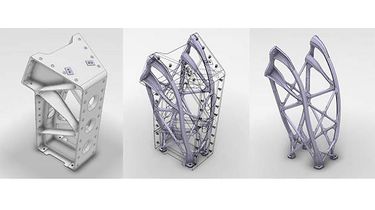
Image source and credit: Airbus, “Advancing aerospace materials”. Saab uses this technology for a cooling plate in the electronic warfare system of the Gripen fighter jet. The plate is only four millimeters thick, yet hollow inside, and improves cooling by up to 50 percent. Their technical director stated that this part cannot be made with any other technology.
Manufacturers of standard and mid size machines, firmly grounded in aerospace and defense certification, are EOS, Nikon SLM Solutions, GE Colibrium Additive, 3D Systems, Renishaw, TRUMPF, Velo3D, Additive Industries, and the Chinese Eplus3D, Farsoon, BLT, HBD.
The limitation of this technology is that it only makes new parts, it does not repair old ones. After printing, a part almost always needs thermal treatment, because of residual stress, which I explain in the next point.
2. Electron beam melting (EBM)
This technology works on the same principle as the previous one, melting metal powder layer by layer, but instead of a laser it uses an electron beam, and it runs in a vacuum, not in open air. An electron beam melts metal much faster than a laser.
Here I should explain the concept of residual stress. When metal is rapidly heated and cooled during printing, internal forces remain trapped inside the part, similar to bending a wire and having it stay slightly warped. These forces can later cause cracking or deformation of the part. With laser based technology, a part almost always has to go into a furnace for thermal treatment afterward, to release those forces. With electron beam melting, the build platform is kept at a high temperature throughout the entire print, so the whole part cools evenly, and there is much less residual stress.
That is why electron beam melting is the preferred technology for titanium turbine blades in aircraft engines. The Avio Aero factory in Cameri, Italy, produces tens of thousands of these blades per year with this technology for the GE9X engine.
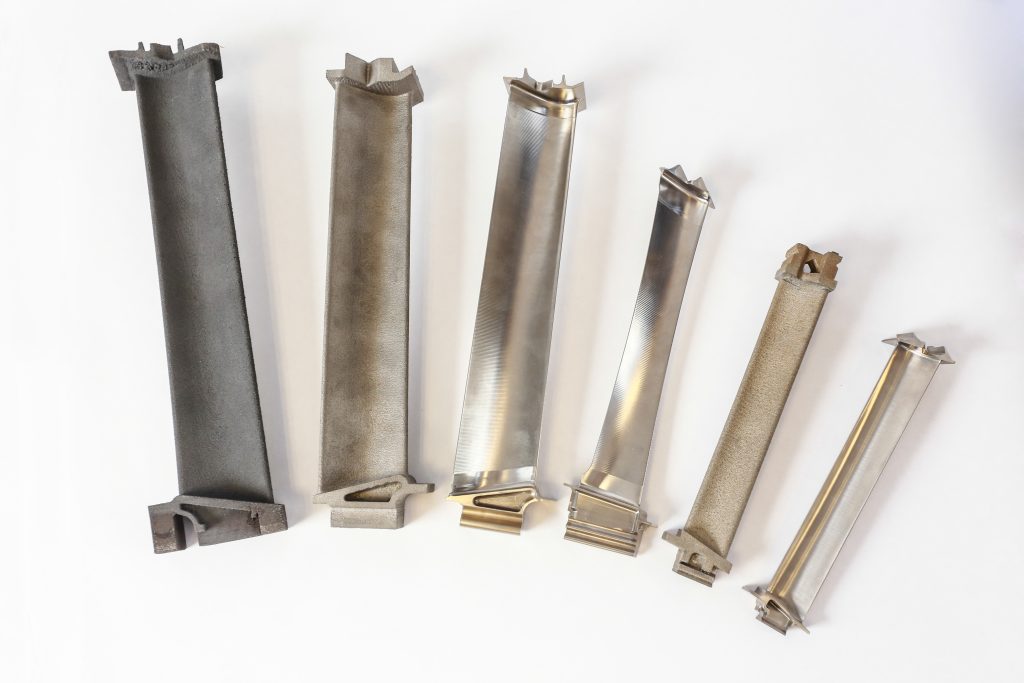
Image source and credit: GE Aerospace News, “The Blade Runners”, photo by Avio Aero.
The surface after printing is rougher than with laser based technology, so the part of the blade that needs to be precise and smooth goes through post processing. This is not some special drawback of electron beam melting compared to conventional manufacturing. These blades are traditionally most often produced by investment casting, and there too the raw, cast surface also goes through finishing. So, for comparison, there is no real difference there. The main limitation of electron beam melting is a narrower choice of materials compared to laser based technology.
The main manufacturer is GE Colibrium Additive, which grew out of the earlier company Arcam. There is also a newer player, the British company Wayland Additive, with its NeuBeam approach to the same technology.
3. Wire laser DED technology
DED stands for directed energy deposition, meaning metal is deposited exactly where it is needed, layer by layer, instead of building the whole part inside a bed of powder. In the wire laser version, the laser melts standard welding wire, not powder.
This is today the most publicly documented metal AM technology for military use, not by number of machines sold, but by number of real, confirmed military applications. Wire as a raw material is immediately safer for work on board a ship or in the field, there is no risk of inhaling fine metal powder, and no risk of dust explosion.
The main manufacturer of this technology is Meltio, a Spanish company. Their technology has been officially validated by the US, French and Spanish armed forces, as well as the South Korean marine corps. On a US amphibious assault ship, during a military exercise, the crew printed and replaced a broken part of a water desalination system in 34 hours, a part for which a regular supply order would have taken weeks or months.
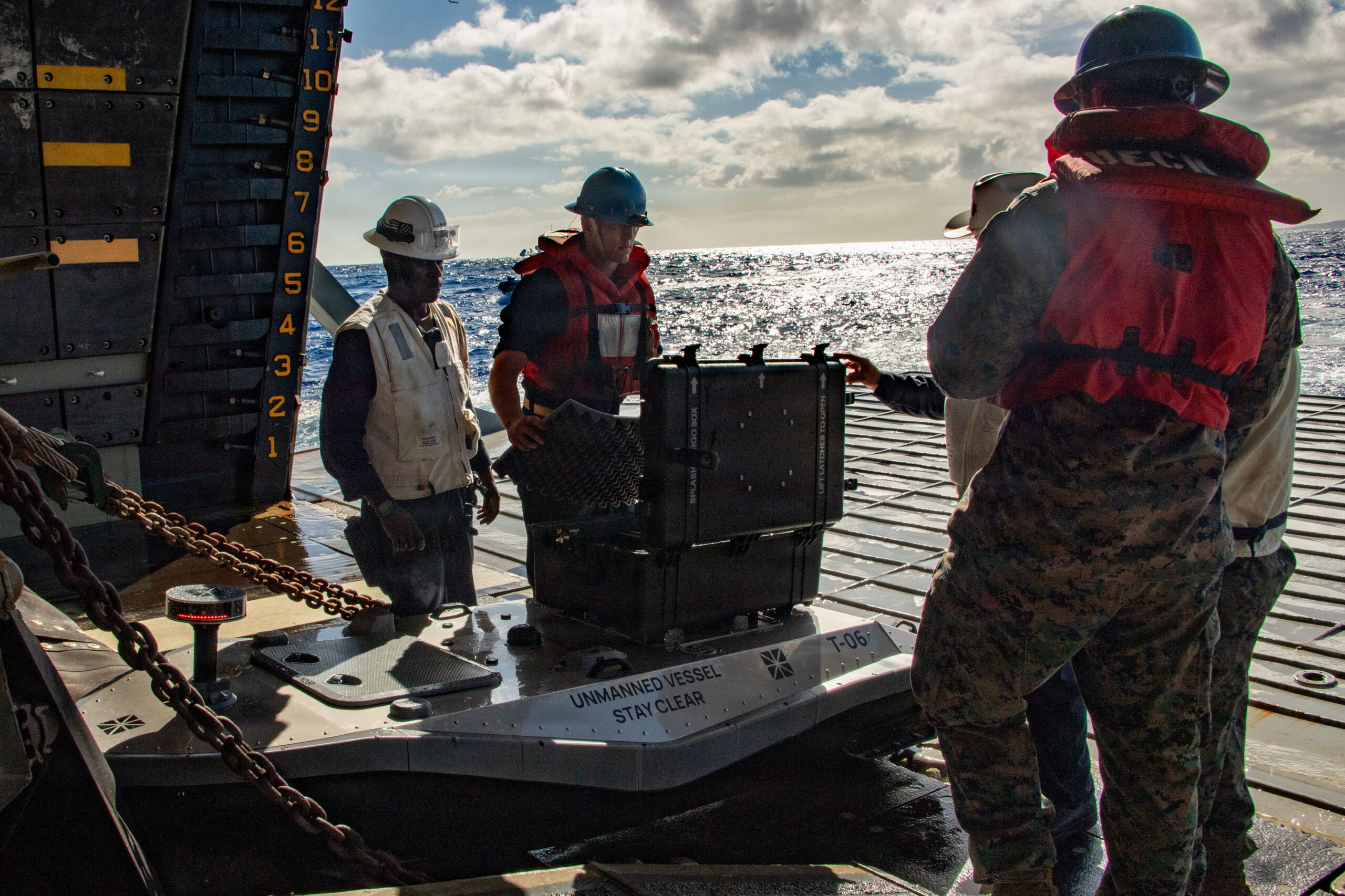
Image source and credit: US Navy photo, RIMPAC 2026. The French navy, using the same technology installed at their base in Toulon, repaired parts for the aircraft carrier Charles de Gaulle during an exercise in 2024.
Alongside Meltio, a related wire based technology, using a plasma arc instead of a laser, is offered by the Norwegian company Norsk Titanium, primarily for titanium aerospace parts.
For DED parts, machining is only needed where the part has a strict dimensional tolerance or must be smooth, exactly like every other technology on this list. A good example where that processing is not needed is reinforcement plates and track components for tanks, where strength and speed of replacement matter more than surface smoothness, so the part stays in the state it comes out of the machine.
4. Wire arc DED (WAAM)
This follows a similar philosophy to wire laser technology, but the heat source is an electric arc, as in conventional welding, not a laser. The deposition rate is much higher, which makes this technology suitable for large naval and structural parts, as well as repairing combat damage in the field.
Several defense companies in Europe have already built this technology into mobile, containerized workshops that can follow units in the field, for example the German company Rheinmetall with its Mobile Smart Factory unit.
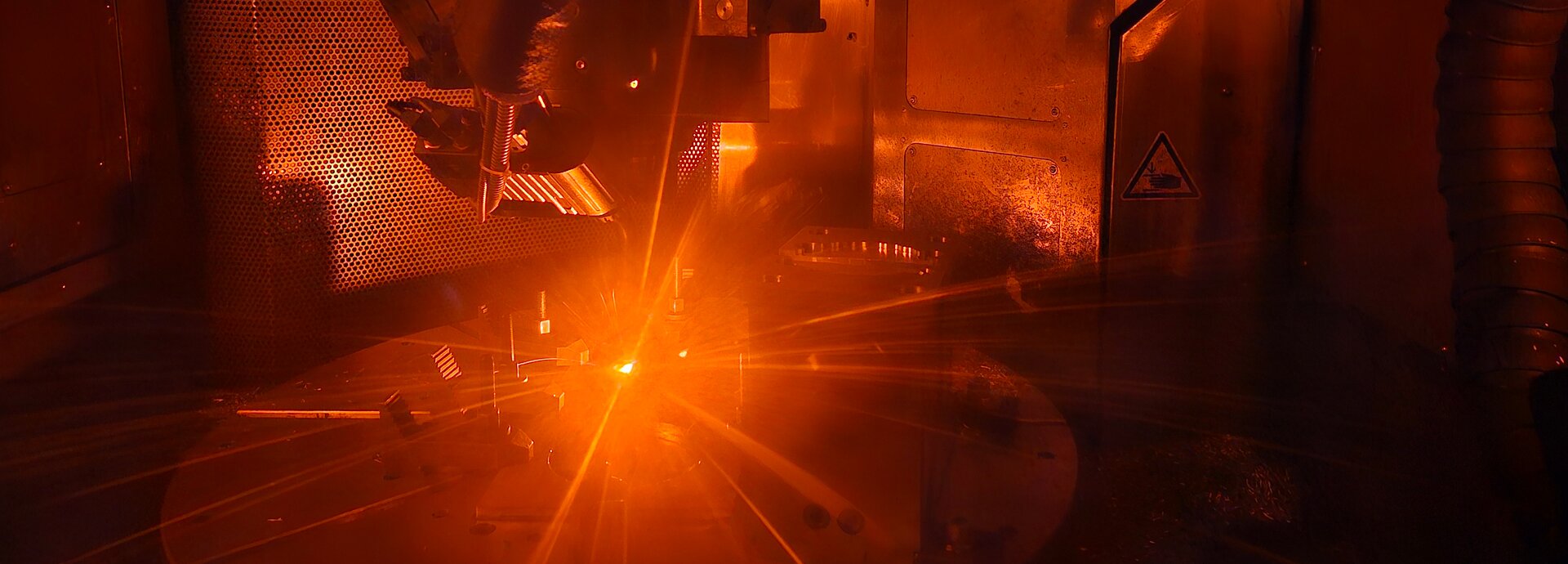
Image source and credit: Rheinmetall.
Equipment manufacturers for this technology are the German company Gefertec, the Australian company AML3D, the British company WAAM3D, and Lincoln Electric from the United States, which otherwise primarily makes welding equipment.
5. Metal binder jetting
This technology does not melt metal during the printing itself. A nozzle sprays liquid binder into a layer of metal powder, layer by layer, creating what is called a green part, still brittle and weak. After printing, the part goes into a furnace, where it is sintered, meaning the metal particles are heated to a temperature below the melting point and fuse into a solid part.
This is an excellent technology for small, complex parts produced in large batches, filters, tooling inserts. For now it has a thinner base of certified fatigue data for parts that carry serious structural loads, so for such applications it is still in a preparatory phase, not full production.
Manufacturers are Desktop Metal, which acquired the pioneer of this technology, the company ExOne, the American company HP with its Metal Jet line, the Swedish company Digital Metal, part of the Höganäs group, and GE Colibrium Additive, which has its own binder jetting line.
6. Large format, multi laser powder bed fusion
This is a separate category, even though it uses the same underlying technology as the first item on this list, laser powder bed fusion. The reason I separate it out is purpose. Standard machines, with one to four lasers, make precise, medium sized parts. This new generation of machines, with ten, twenty, even more than thirty lasers working at the same time, targets a completely different purpose, producing large structural parts as a single piece, engine casings, aircraft fuselage sections, parts that would otherwise have to be assembled from several smaller components. That requires a much larger investment, a different service model, and a different customer base, mostly large companies, not small and medium enterprises.
To give a sense of scale, the Chinese company BLT has a model called BLT S1000, with a build volume of roughly 1.2 by 0.6 by 1.5 meters, which is over one cubic meter, with up to twelve lasers. Their newer model, the BLT S1025, reaches a build height of 2.5 meters, with 26 or 32 lasers. Farsoon has a model called FS1521M, with a build volume of 1.53 by 1.53 by 1.65 meters, which is over three and a half cubic meters, with up to 32 lasers at 500 watts each. Nikon SLM takes a different approach, their model NXG XII 600 has a smaller build volume, around 0.6 by 0.6 by 0.6 meters, but with twelve lasers at one kilowatt each, the focus is on speed, not size. These figures are approximate, since manufacturers often offer several configurations of the same model.
The capability of these machines is not in question. BLT has documented cooperation with Airbus and work on titanium components for the C919 aircraft.
Image source and credit: BLT. For Western, export sensitive buyers, there is an additional question of sovereignty and export control around Chinese equipment, which has nothing to do with the technical capability of the machine itself.
Comparison table
| Technology | Typical defense use | Part size | Repair or new part | Maturity for military use |
|---|---|---|---|---|
| L PBF, SLM, DMLS | New flight and space critical parts, brackets, electronics cooling | Small to medium | New part only | Most mature, qualified flight parts already exist |
| EBM | Titanium turbine blades | Small to medium | New part only | Very mature in aircraft engines, niche elsewhere |
| Wire laser DED | Field and shipboard repair, parts on demand | Medium to large | Both, excels at repair | Operationally validated by several militaries |
| WAAM, wire plus electric arc | Large naval parts, field repair | Large | Both | Growing, already in mobile units |
| Metal binder jetting | Small serial components | Small | New part only | Mature for non critical parts |
| Large format, multi laser L PBF | Engine casings, aircraft structures | Very large | New part only | Technically mature, with a question of equipment sovereignty |
Who has documented public proof, and who is just marketing
Here I draw a clear line. Some companies I can confirm through third parties, not just their own press releases.
Documented, confirmed by a military or another third party customer, GE Colibrium Additive, through the LEAP fuel nozzle used on commercial and military engine variants, Nikon SLM, through its cooperation with Lockheed Martin on the F 35 program, Meltio, through official validation by the US, French and Spanish armed forces, and the South Korean marine corps, Airbus Defence and Space and Saab, through their own flight qualified parts with a name and a technical description, BLT, through cooperation with Airbus and work on the C919 aircraft, Avio Aero, through production of turbine blades for the GE9X engine.
Marketed toward defense, but without a named, confirmed project I could find, EOS, Farsoon, HBD, Eplus3D outside the Airbus related work, Desktop Metal after its bankruptcy. That does not mean such projects do not exist, it only means they have not been publicly disclosed or confirmed.
What is happening with equipment manufacturers
The metal AM equipment market has split into two clear directions over the past two years.
On one side are manufacturers who are financially stable or have strong institutional backing. The German company EOS remains private and financially stable. Nikon SLM Solutions, formed when Nikon acquired the German company SLM Solutions, has a confirmed partnership with Lockheed Martin. GE Aerospace, now operating under the name Colibrium Additive, is behind the LEAP fuel nozzle. The Chinese manufacturers BLT, Eplus3D and Farsoon are growing rapidly, with strong state support.
On the other side, several Western manufacturers are in serious financial trouble. Velo3D went through a near total collapse in late 2024, with a debt restructuring that turned a creditor into the owner of 95 percent of its shares. Desktop Metal filed for bankruptcy in July 2025 and was sold out of bankruptcy for just seven million dollars, even though it had been worth 2.5 billion only three years earlier. The German company voxeljet was delisted from the stock exchange, and shareholders were left with nothing through a restructuring procedure. 3D Systems is operating at a loss, even though its revenue from defense and aerospace specifically is growing the fastest.
My recommendation is simple. Check a manufacturer's financial health just as carefully as you check the machine's specifications. A machine without manufacturer support in five years is an expensive piece of metal.
Domestic context, the Military Technical Institute
Here at home, the Military Technical Institute in Belgrade is already conducting its own research into metal additive manufacturing, covering two of the six technologies described above. At the OTEH 2024 conference in Belgrade, researchers from the Institute published a paper on the influence of process parameters on the quality of parts made from 316L stainless steel using laser powder bed fusion. At the MME SEE 2025 congress in Trebinje, the same team published a paper on the characteristics of the same material produced using wire laser DED technology. That means domestic research capacity exists and covers both technologies, the first and the third on my list, regardless of which equipment manufacturer is ultimately chosen.
FAQ
Which metal 3D printing technology is most proven in actual military use? For field and on demand repair, wire laser DED technology, primarily Meltio, has the strongest documentation, confirmed by several of the world's militaries. For new, flight critical parts, laser powder bed fusion is the most mature technology.
Can metal 3D printing replace conventional weapons manufacturing? Publicly documented applications are focused on repair, tooling, brackets and structural parts, not on producing finished weapons. This text deliberately stays within that boundary.
Why is large format L PBF treated as a separate technology, when it uses the same principle as regular L PBF? Because the purpose is different. Standard machines make precise, medium sized parts. Large format, multi laser machines make large structural parts as a single piece, and require a completely different level of investment and a different customer base.
Is it safe to rely on Chinese equipment manufacturers for defense projects? Technically, some Chinese manufacturers, such as BLT and Farsoon, are among the most capable on the market, especially in large format systems. For Western, export sensitive programs, there is still an additional question of sovereignty and export control that needs to be considered independently of the technical specifications.
Does Serbia have domestic research capacity in this field? Yes. The Military Technical Institute has published papers on both the powder bed and the wire based metal additive manufacturing technology, both on the same material, 316L stainless steel.
This is the first in a series of three texts on metal and plastic additive manufacturing in the defense industry. The next text covers the application of plastic 3D printing, and the third analyzes the publicly published results of the Military Technical Institute in more detail.