Summary
Artificial intelligence in additive manufacturing sounds like a big deal. In practice, it really helps in two places today. First, closed loop process control, where software changes print parameters while the build is running. Second, parameter optimization before printing, where software learns from earlier builds.
The rest is either early stage, or old math with a new label. The numbers manufacturers publish are high, but they come from single tests and mostly from the manufacturers themselves. Read them as a direction, not a guarantee.
AI does not fix a bad process and it does not replace the engineer. A company without proper records of its builds, parameters and results has nothing to start from.
Closed loop process control, the most mature application
Closed loop process control means the following. A camera or sensor watches the build while it runs. Based on that data, software changes parameters on the fly, most often laser power. Today this is the most mature use of AI in metal powder bed printing.
EOS does this with its Smart Fusion software. An optical tomography camera measures the heat of each layer, and the software adjusts laser power so the part does not overheat. That way less support is needed.
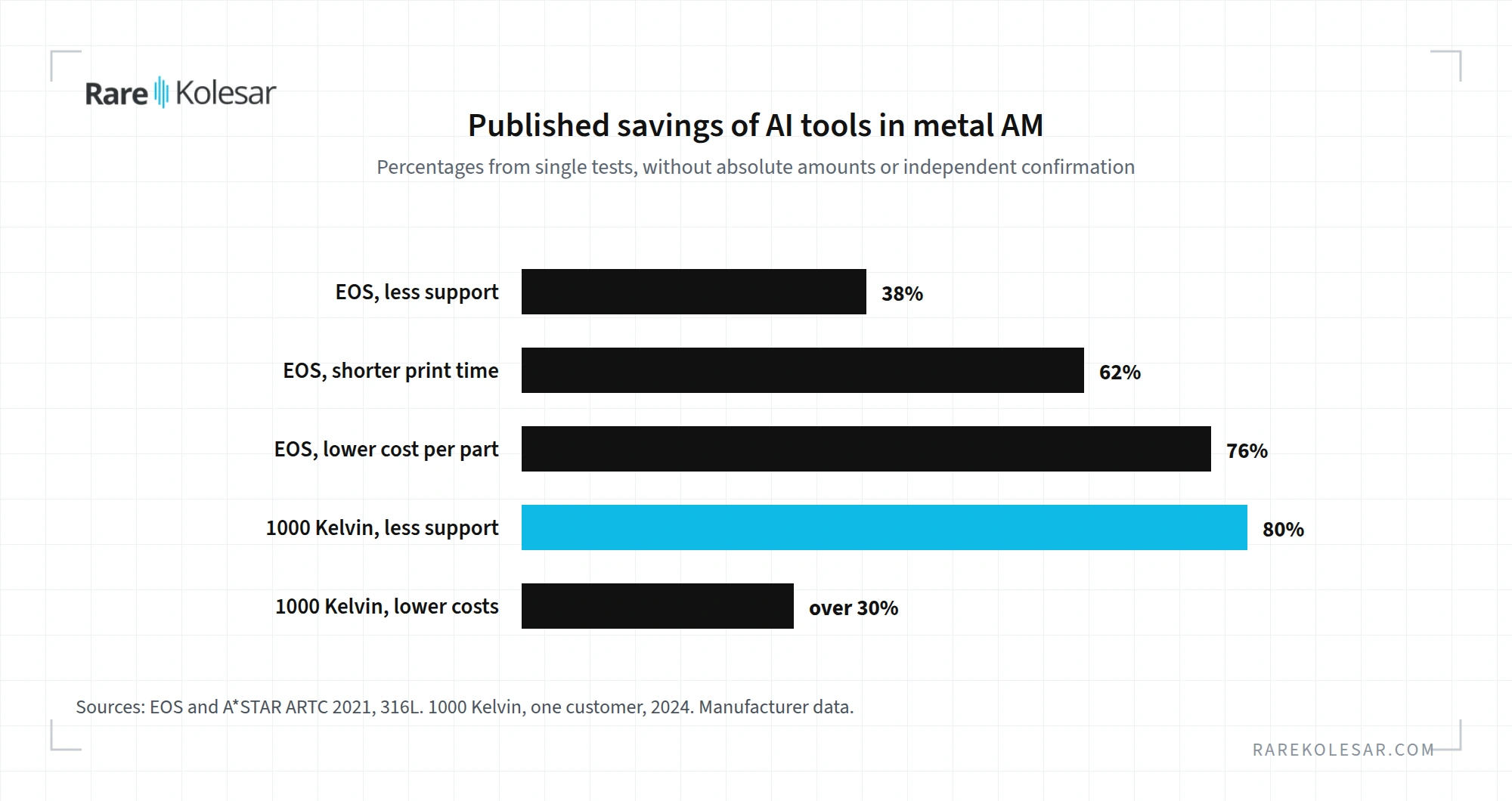
In 2021 EOS published the results of a test with the A*STAR ARTC institute in Singapore, on 316L stainless steel. 38 percent less support. 62 percent shorter print time. 76 percent lower cost per part. If this holds, the difference is large.
But these are numbers from one manufacturer, with one partner, on one test. They do not say what that support cost before and what it cost after. Only a percentage. Without absolute numbers, a percentage on its own does not mean much. Take it as a direction, not a guarantee for your process.
Additive Assurance from Australia has a system called AMiRIS. It watches the build with a near infrared camera. In November 2025 Nikon SLM announced the integration of this system into its NXG platform, with 12 lasers monitored at the same time. Additive Industries signed a partnership with the same company in 2024, for its MetalFab machines.
Additive Assurance states that conventional non destructive testing and validation can eat up 25 to 50 percent of part cost. This too is the manufacturer's own figure. It is still useful, because it explains why anyone buys a system like this. If inspection carries that large a share of your part cost, monitoring during the build makes sense.
AI tools change fast, and that is a risk
One example shows well how unstable this market is. For years Sigma Additive Solutions was one of the better known names in melt pool monitoring for metal printing. Its PrintRite3D system was built into machines from several manufacturers.
In October 2023 Sigma left additive manufacturing. All of its software and intellectual property was bought by Divergent Technologies, for its in house production system. Sigma then acquired a travel company, NextTrip.
The lesson is simple. When you buy an AI module, ask who is behind it, whether it is tied to one machine, and what happens to your data if the company disappears. I ask the same question when choosing the machine itself, as I wrote in what vendor neutral means in machine selection.
Parameter optimization before printing
The second area that really works is parameter optimization before printing. Software learns from earlier builds and suggests parameters that reduce scrap. Instead of ten test builds, you may need three.
Senvol ML has been doing this for years. BMW used it for aluminium on a four laser machine. The new parameters beat the manually optimized ones, and development took less time. Senvol ML is also used by the US Navy, Army and Air Force. The company's president, Zach Simkin, says machine learning for process and material development is already mature and adopted by industry.
1000 Kelvin AMAIZE works in a similar way, but it also suggests the scan strategy itself. It is available with EOS software and as an add in for Autodesk Fusion. One case from 2024, a California rocket launch company, reports 80 percent less support and over 30 percent lower overall costs. The same caution applies. This is one case, the company is not named, the numbers come from the software vendor, and there is no independent confirmation.
What AI does not solve
If a company does not keep proper records of its builds, parameters and results, none of these tools will help it. There is nothing to learn from. It will reach a wrong conclusion faster, not a better one.
If you do not have a defined qualification process, AI will not build it for you. I described what that process looks like in process qualification in practice.
AI does not replace the engineer on critical and regulated parts. A person still makes the call, especially for medical devices and in aerospace, where traceability and a documented process are required, not just a good result.
This is also my approach in the SLM DFAM Checker, a free geometry check for metal parts. A deterministic engine calculates the geometry, using rules for the selected material. AI writes the conclusion and the explanation, but it does not change the geometric assessment.
AI outside the print itself
There are also newer tools outside the print itself. Backflip AI turns a 3D scan or STL file into an editable CAD model with a feature tree. The company was founded in late 2024 by Greg Mark and David Benhaim, the founders of Markforged. The tool has been generally available since August 2026.
The company claims that converting a scan to CAD by hand costs about 1,500 dollars per part and takes hours or days, while its tool does it for about 10 dollars, in a couple of minutes. That sounds useful for reverse engineering and spare parts. But the product is new, and there is not much independent verification yet beyond what the company itself says. I cover this topic more broadly in reverse engineering and 3D scanning as an entry point to additive manufacturing.
FDM printers have a simpler, cheaper application. A camera with an AI model recognizes when a print goes wrong and pauses it. One example is Obico, which is open source, and some manufacturers build this into the printer itself. It saves filament and machine time, but it stops a failed print, it does not check part quality.
Comparison of approaches
| Approach | When it makes sense | Risk |
|---|---|---|
| Manual parameter tuning | Low volume, new material | Slow, depends on the operator |
| AI parameter optimization | Repeat production | Needs a history of data |
| Closed loop process control | Expensive parts, metal | Equipment cost, process dependent |
| AI failure detection on FDM | Unattended printing, overnight | Stops failures, does not guarantee quality |
How much to trust published numbers
| Tool | What it does | Published figure | Who published it |
|---|---|---|---|
| EOS Smart Fusion | Changes laser power during the build | 76 percent lower cost per part | EOS, test with A*STAR ARTC, 2021 |
| 1000 Kelvin AMAIZE | Suggests parameters and scan strategy | 80 percent less support | Software vendor, one customer, 2024 |
| Additive Assurance AMiRIS | Monitors the build in near infrared | Inspection takes 25 to 50 percent of part cost | System manufacturer |
| Backflip AI | Turns a scan into CAD | From about 1,500 to about 10 dollars per part | Manufacturer, 2026 |
None of these numbers has been independently confirmed. That does not mean they are wrong. It only means you should check them on your own part.
Frequently asked questions
Does a small company need AI tools for 3D printing? Not before it keeps proper records of its parameters and results. Without that base, an AI tool has no data to learn from.
Are the numbers manufacturers publish reliable? Partly. They usually come from one test and from the manufacturer itself. Take them as a signal, not a guarantee, and check them on your own part.
Where does AI in additive manufacturing really work today? In closed loop process control, where software changes laser power during the build, and in parameter optimization before printing based on earlier results. Both are most developed in metal powder bed printing.
Does AI replace the engineer? No. AI speeds up suggestions and analysis. The engineer still carries the decision and the responsibility, especially for regulated and critical parts.
What is closed loop process control in 3D printing? It is a process where a sensor or camera watches the build while it runs, and software uses that data to change parameters on the fly, most often laser power. The goal is to prevent a defect as it forms, not to find it after the build.
What should I watch for when buying an AI module for 3D printing? Ask who is behind the tool, whether it is tied to one machine, and what happens to your data if the company leaves the market. The case of Sigma Additive Solutions, which sold its software in 2023 and left additive manufacturing, shows that this does happen.
Sources
- Support Free Smart Fusion, EOS, 2021
- Nikon SLM Solutions and Additive Assurance Partner to Integrate AMiRIS Inside, Nikon SLM Solutions, 2025
- Additive Industries and Additive Assurance enhance LPBF monitoring, VoxelMatters, 2024
- Legacy QA is holding back metal AM, Additive Assurance, accessed 2026
- Divergent Technologies announces acquisition of all software and intellectual property from Sigma Additive Solutions, PR Newswire, 2023
- Divergent Acquires 3D Printing QA Assets from Sigma Additive, 3DPrint.com, 2023
- Senvol Speaks at RAPID + TCT on Case Study with BMW, Senvol, 2021
- Senvol demonstrates machine learning approach for Additive Manufacturing, Metal AM, 2023
- Senvol machine learning to be used for missile application with the U.S. Army, VoxelMatters, 2020
- US Air Force deploys Senvol machine learning software in multi-laser metal 3D printing programme, TCT Magazine, 2020
- EOS and 1000 Kelvin cut 3D printing costs by 80% with AI integration, 3D Printing Industry, 2024
- Backflip AI launches CAD copilot that turns 3D scans into editable models, VoxelMatters, 2026
- AI Failure Detection and Remote Control for Bambu Lab 3D Printers, Obico, accessed 2026