This is the second text in the series on additive manufacturing in the defense industry. The first text covered metal 3D printing, this one covers plastic. It relies exclusively on publicly available data, and real world adoption is probably broader than what has been publicly disclosed, for the same reason as in the first text, contract confidentiality.
I go through six technologies, from the most widespread to the least mature, silicone. For each one I separate what is independently confirmed from what is only a manufacturer's claim, and where it matters, I add a short financial assessment of the company offering the technology, because technical capability and financial stability are not the same thing.
Six types of plastic 3D printing used in defense
One general note before I start. With metal, a part almost always has to go into a furnace after printing, because of residual stress. With plastic that problem is much smaller, so thermal post processing is generally not needed, except for larger parts made from high temperature materials such as ULTEM or PEEK, where post cure annealing is sometimes done, not for residual stress but for better mechanical properties. Outside that exception, finishing a plastic part mostly means removing support structures and, where needed, machining the surfaces that carry a tight tolerance. If a part has no such requirement, it stays as it comes out of the machine.
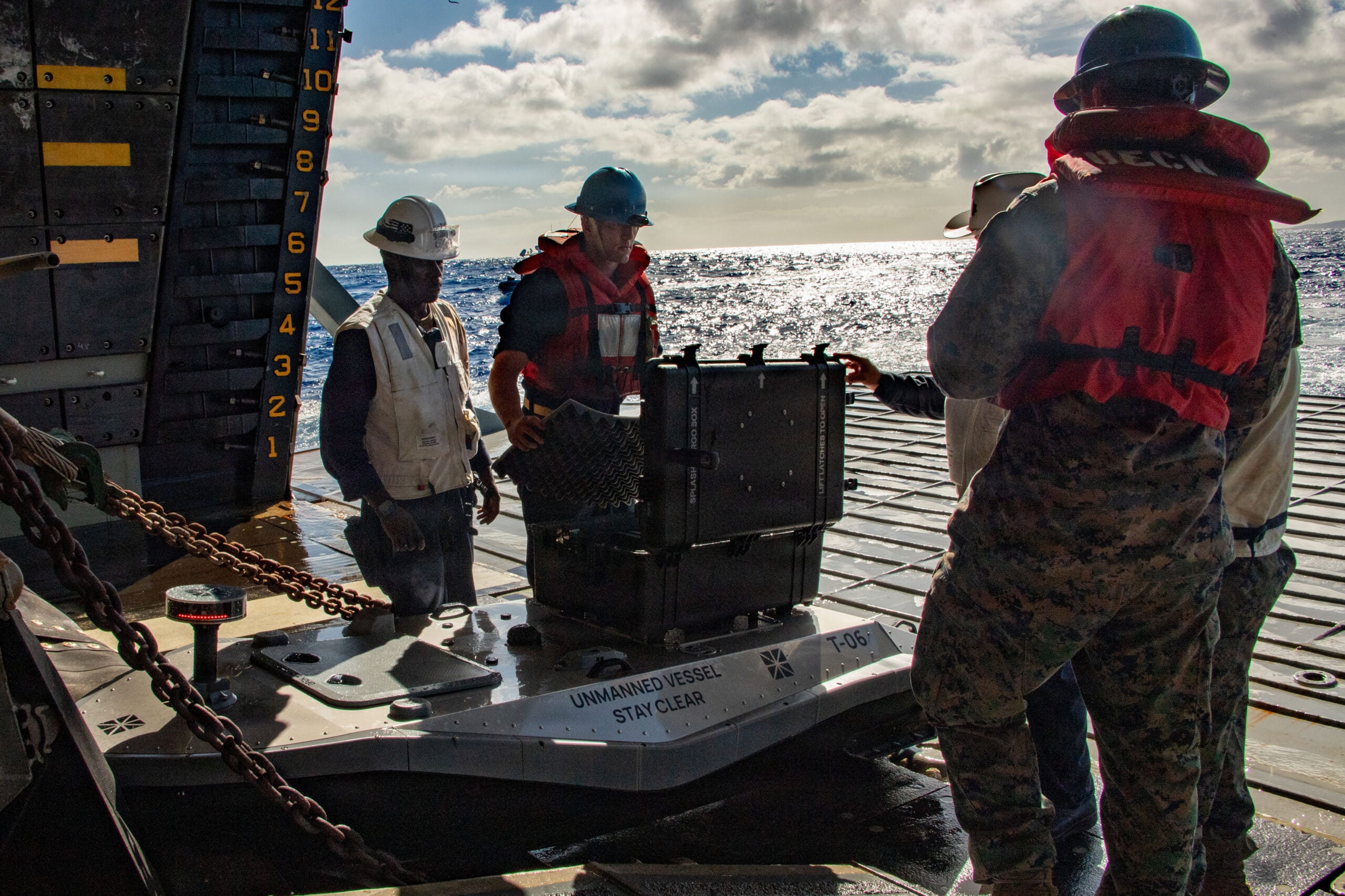
Credit: US Navy photo, RIMPAC 2026. Source: USNI News.

1. Fused deposition modeling (FDM, FFF)
The most widespread and cheapest plastic 3D printing technology. A nozzle melts filament and deposits it layer by layer. FDM and FFF refer to the same process, FDM is Stratasys's trademarked name, FFF is the generic term used by everyone else.
In defense and aerospace this is used mostly for tooling, jigs and assembly aids, not for finished parts. A tool made in a week for a few hundred dollars, instead of a conventional tool that takes months and costs tens of thousands, changes the economics of an entire production line.
For high temperature or flame resistant applications, materials from the PAEK family and PEI, sold as ULTEM, are used. ULTEM 9085 is already used for interior, non structural cabin parts, certified to FAR 25.853, which sets limits on flammability, smoke and toxicity. PEEK goes further, higher temperature resistance, better chemical resistance including Skydrol, and a low FST profile. Stratasys sells a certified version for FDM called Victrex AM 200, developed with the British company Victrex, for ducts and manifolds difficult to make conventionally. Victrex also supplies its lower melting LMPAEK line outside 3D printing, with Daher for 32 millimeter, 176 ply laminates, and with Airbus for doors and brackets, claiming up to an 85 percent better buy to fly ratio than aluminum. A third, cheaper option is PPS, inherently flame resistant and highly chemically resistant, but mechanically weaker than PEEK.
A concrete example, during exercise RIMPAC 2026 the US Navy combined 3D scanning and FDM printing aboard USS Essex to quickly manufacture replacement parts, including thermostat covers and oxygen system components. A plastic prototype is printed first to check fit, and only then, if needed, is the part made in a material suited to actual use.
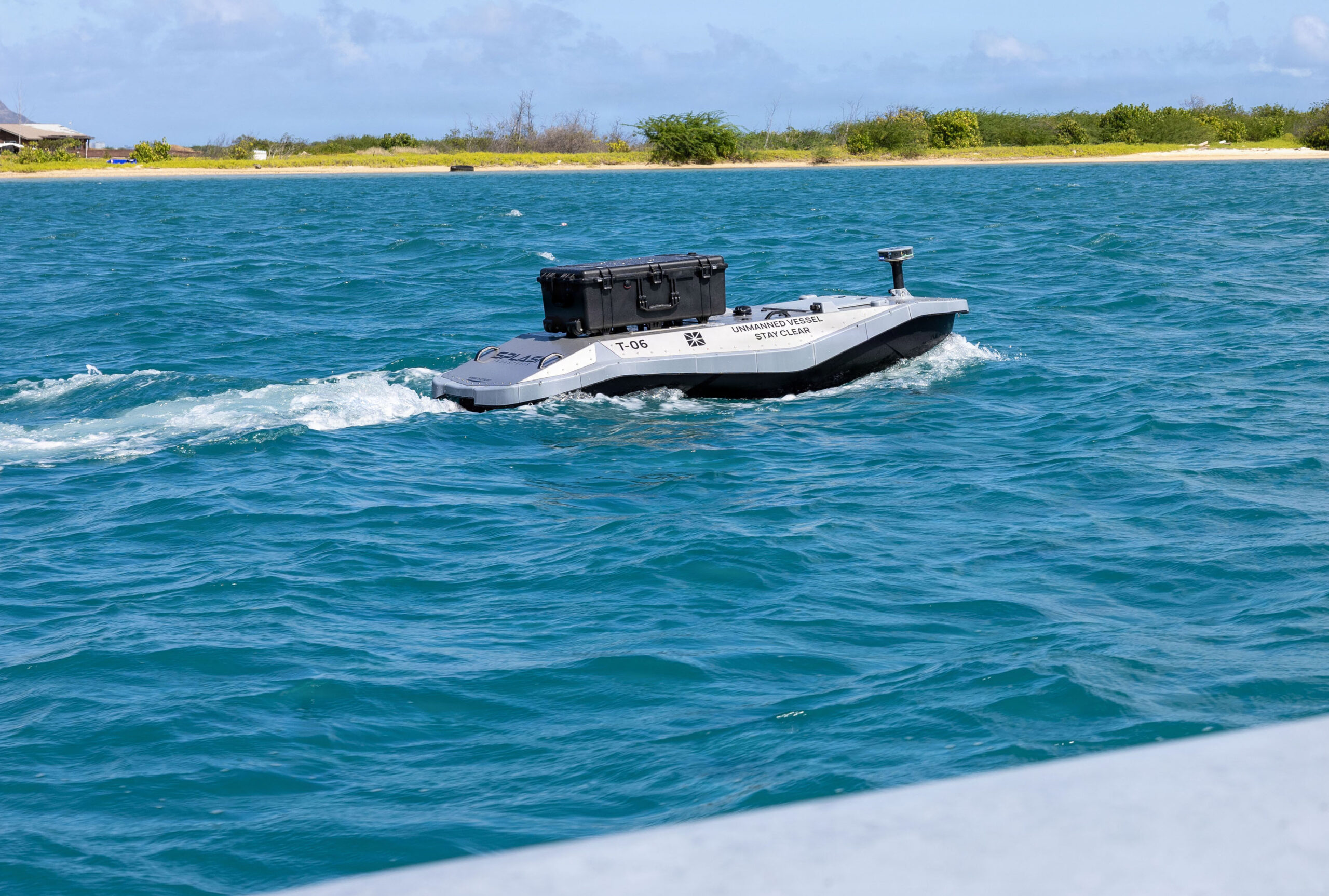
Credit: US Navy photo, RIMPAC 2026. Source: USNI News.

Ukraine's Ministry of Defence runs the Component Library platform, connecting over 200 domestic manufacturers with units in the field, with more than 170 developed parts and 11 types of services, including 3D printing, through the Diia platform. Listed parts include FPV drone frames, antennas and electronics housings.
Markforged, whose story I cover in more detail in the next section, cites in its own case study that a US Army unit at Fort Irwin used FDM to reproduce a discontinued night operations hatch plug. Regular procurement would have cost about 10,000 dollars and three months, the printed version cost 230 dollars, with a stainless steel version at 800 dollars. The unit reportedly saved 244,000 dollars this way. A valuable example, but it is a case study from the equipment manufacturer, not the Army, so I treat it as credible, not independently confirmed.
A separate example, technically interesting but worth real caution, is the US company Quantum Cyber, headquartered in West Palm Beach, Florida, listed on Nasdaq as QUCY. In August 2026 it completed an 80 unit FDM printer farm in Bridgeport, Connecticut, for structural drone parts. In June 2026 it launched its own filament production, standard PETG and a proprietary composite called Formula A, meant to shield drone electronics from electromagnetic pulse. According to a patent application from May 2026, Formula A is PETG filled with aluminum flake, carbonyl iron powder, carbon black and milled carbon fiber, with shielding effectiveness of 35 to 55 decibels from 10 kHz to 10 GHz, per ASTM D4935. The first mini interceptor was assembled on July 27, 2026.
A serious caveat is needed here. Every figure comes from the company itself, no military contract has been named, and the CEO has said the next step is simply converting capacity into contracted volume. White Diamond Research reported in June 2026 that CEO David Lazar holds preferred stock convertible into roughly 477 million common shares at 0.013 dollars each, against only 22.77 million shares outstanding, which would sharply dilute existing shareholders, and that the named drone partner has a nearly empty website with no listed prices. Lazar has a history of running small penny stock companies with frequent changes in focus. I treat this case as technically credible but financially high risk, pending independent confirmation of an actual contract.
Equipment manufacturers include Stratasys, 3D Systems, Roboze, INTAMSYS, Ultimaker, AON3D, and the former Markforged FDM line, now part of Stratasys.
2. Continuous Fiber Fabrication, CFF
Here I need to draw a sharp distinction that is often blurred. CFF is not the same as a carbon fiber filled material. In a filled material, tiny chopped fiber fragments are mixed into the plastic, like gravel in concrete, improving stiffness but not adding real structural strength. In true CFF, the machine lays a continuous fiber strand inside every layer, like thread sewn into fabric, giving the part measurable tensile strength comparable to aluminum, at much lower weight. The pioneer is Markforged, now selling its FX20 machine for structural drone parts and ground support equipment, where strength to weight ratio matters most. The fiber choice is wider than many assume, standard carbon fiber for maximum stiffness, a high temperature version, fiberglass where dielectric permeability matters, such as antenna housings, and Kevlar for impact resistance. A competing approach to the same idea comes from the Russian company Anisoprint, through its Fibreseeker product, a continuous composite fiber co-extruded with thermoplastic. Markforged's own site describes drone manufacturing work at the tactical edge, illustrated with photos credited to units such as the 7th Mobile Public Affairs Detachment, the 1st Cavalry Division and the 26th Marine Expeditionary Unit, but these are photo credits, not confirmed programs, so I treat this as marketing.
A solid, verifiable fact is the company's corporate history. Markforged went public in 2021 through a SPAC merger at a 2.1 billion dollar valuation. The stock then collapsed, the company was acquired by Nano Dimension in 2025, and Stratasys announced in May 2026 it was buying Markforged from Nano Dimension for 42.5 million dollars, while Nano Dimension keeps the metal binder jetting line. Stratasys's CEO cited growing defense and aerospace needs as the reason. A concrete, confirmed business move, though not on its own proof of any specific military project.
3. Selective laser sintering, SLS
A laser melts a thin layer of nylon powder, usually PA12, inside a sealed chamber. The part sits inside the powder bed throughout the build, so the powder itself acts as support, meaning no separate support structures need removing, unlike FDM.
Probably the best documented plastic technology in this text for real military and aviation use. Airbus officially qualified the material EOS PA 2241 FR, a self extinguishing nylon 12, on the EOS P 770 machine, for flight qualified parts, with Materialise as service provider, for air ducts and brackets. This was confirmed by name and title by EOS's Senior Vice President for Europe, Middle East and Africa, Markus Glasser, making it one of the most solidly documented examples here.
The Australian company Boresight, based in Fyshwick near Canberra with a facility in Huntsville, part of the Criterion Solutions group, listed since June 2026, makes cheap target drones with FDM and mission ready drones with SLS, using Nylon 12 Tough on Formlabs Fuse machines. Australian Aviation reported over 6,000 drones sold to 15 militaries in 12 countries, while Space and Defense named 11 Western armed forces as customers, including Australia, the UK, Canada and New Zealand, the US Army, Marine Corps, Navy and Air Force, and the Dutch, Italian and Finnish militaries, alongside commercial and defense customers Northrop Grumman, Anduril, DroneShield, Nammo and the MBDA and QinetiQ joint venture Houbara. By number of named military customers, probably the most broadly documented case in this series.
Boeing's rapid aircraft configuration development unit in Mesa, Arizona, uses SLS and DuraForm PA for parts on the AH-64D Apache Longbow helicopter, cooling ducts and fairings, for the US Army and foreign customers. They produced over 400 parts in five months. A rare example with a named manufacturer, a named program and a concrete number, confirmed through an official case study published by the machine maker. A second example, an actual military research program, is AIRION, a small Los Angeles company. AFWERX, the Air Force's innovation arm, issued a 2021 challenge on tactical dehydration among fighter pilots, who often avoid drinking water before flight since they cannot relieve themselves in the air, risking loss of consciousness under high g forces. AIRION beat larger contractors, and now, on three Formlabs Fuse 1+ 30W machines running around the clock, prints the AIRUS device, its body made from TPU 90A powder and its pump mechanism from nylon 12. A rare case of SLS entering equipment actually worn by a military pilot, not a prototype.
A third example is Metro Aerospace, a small Texas company, which uses DuraForm GF to make microvanes bonded onto the fuselage of the C 130 transport aircraft, or its civilian L 100 variant, reducing drag, with a claimed four percent fuel saving at cruise. They completed First Article Inspection certification in three to four months, a rare case of a plastic printed part passing real aviation certification.
Formlabs also cites a partnership with Palladion Systems on a counter drone system, where deployable arms are printed as a single build. No unit count or date is given, so this example is weaker than the previous three, but still stronger than a generic claim, since the customer is named.
Equipment manufacturers include EOS, 3D Systems, Farsoon in its non metal lineup, and Formlabs with its Fuse line.
4. Multi Jet Fusion, MJF
Developed by HP. An array of nozzles passes over a powder layer, applying a fusing agent exactly where a solid part should form, then infrared light melts the powder wherever the agent was applied. Its advantage over SLS is speed when producing several identical parts at once, well suited to drones.
The strongest example is Firestorm Labs, from San Diego. They build containerized, mobile microfactories called xCell, fitted with industrial HP MJF machines, able to run off grid and be transported by C-17 or C-130 aircraft, or slung under a CH-47. According to the company, in January 2025 they won a five year Air Force contract through AFWERX, with a 100 million dollar ceiling. TechCrunch checked and reported that only about 27 million had actually been obligated, an important distinction, a contract's ceiling is not the same as money actually spent, worth remembering for any large defense contract. In May 2026 they received a further 30 million dollars through APFIT, for five microfactories and over 200 Tempest drones for the Indo-Pacific. Lockheed Martin Ventures was among the company's 2024 investors, and the Army's 3rd Combat Aviation Brigade, per the company, printed over 90 drone parts during training. Weapons are not printed, they are attached separately.
Unusual Machines officially announced adopting HP MJF for drone parts, to move faster from prototype to batch production without tooling. A concrete, named example, among the documented cases, not just marketing.
5. Photopolymer resins, SLA and DLP
This technology uses light, a laser for SLA or a projector for DLP, to cure resin where a layer needs to form. In defense it has largely stayed at the prototype, tooling and enclosure stage, not flight critical parts. Formlabs positions its Form 4 and Form 4L machines, and materials like Rigid 10K and Tough 2000, for watertight electronics enclosures, underwater system parts and aerodynamic drone shells, noting the printers can run fully offline, useful under export control.
The named examples I found all come from the companies themselves, not from a military body. ORQA uses SLA for tooling and SLS for thousands of parts a year, SoSub prototyped underwater systems on SLA, Nakai Robotics has made over 3,000 parts, often finished with Cerakote, and Nomad Prototypes, from the UAE, builds drones from a resin called Liqcreate Strong-X, with 135 megapascal flexural strength. For this technology, nearly every example is a vendor case study, not a confirmed military program, so I treat it as useful but weakly documented.
6. Silicone
The least mature and most marketing heavy area in this text, which is why I give it more space than its actual documented use would otherwise deserve, precisely to show the gap between confirmed and announced.
The most solid, independently confirmed example is the French company Lynxter, with the firm APS Coating Solutions. Their S300X machine prints silicone from 5 to 45 Shore A, used for masks in plasma spraying ceramic coatings onto aerospace and defense parts. APS engineer Damien Pomarède, in an independent case study by Aniwaa in October 2023, said Lynxter made about 240 masks for the first job, sized 25 by 7 by 5 millimeters. No specific aircraft or program is named, since APS is a coating service provider, not the end customer, but this is, in my assessment, by far the most solidly third party confirmed silicone example here.
Worth mentioning is a related story from the same family of soft materials. PPG used a technology called ARE, ambient reactive extrusion, not silicone printing but a separate extrusion technique, to make six sets of replacement ramp seals for the Lockheed Martin C-130J, its first commercial sale of such parts, claiming over 30 percent lower cost and ten times faster installation. The material is polysulfide, not silicone, sold as PR-1425 or PR-1440, and some of these seals carry their own military stock number. I flag this because it is the best documented case of a flight used, 3D printed soft part in this whole topic, only the material is not silicone.
The French company 3Deus Dynamics, founded in 2020, uses a patented technology, printing inside a self correcting granular medium, without molds or supports. On its site the company claims that in 2025 it achieved a world first, a soft silicone seal with electromagnetic shielding that successfully flew on a helicopter. This is exclusively the company's own claim. The strongest independent source, the French outlet Bref Eco, only reports that CEO Julien Barthès said this was their first part qualified for a military program, shown at the 2025 Paris Air Show, without naming a helicopter or program. Independently confirmed, through several trade outlets, is that the company obtained EN 9100 and ISO 9001 certification in March 2026, alongside its earlier ISO 13485 from 2023. Claims about resisting a 1,200 degree kerosene flame for 15 minutes and shielding up to 80 decibels come exclusively from the company's own datasheets, I found no independent lab report confirming them.
Stratasys, in July 2025 with Japan's Shin-Etsu, launched P3 Silicone 25A, for its Origin DLP machine, described as a true silicone, 25 Shore A, flame resistant to UL 94 V0, biocompatible to ISO 10993-5. It is marketed for seals and dampers in aerospace and defense, but no named customer is given. The Swiss company Spectroplast, spun out of ETH Zurich in 2018, has a similar story, its SAM technology and TrueSil material, 20 to 60 Shore A, listing defense as a target market but without a single named defense customer, its only concrete product being a civilian safety light.
An instructive caution comes from the German company Wacker. Its ACEO service, launched in 2016, printed silicone on demand and marketed itself to aerospace among other industries. Despite over 5 billion euros in revenue and 70 years of experience, Wacker shut the service down at the end of 2021. I would not read that as proof the opportunity itself is unviable, if anything the opposite, the market was too small to justify the overhead of a company Wacker's size, which is exactly the kind of niche a smaller, specialized company can build a sustainable business on. It also matters that 2016 was a different technological era, much of what works in additive manufacturing today simply did not work well enough back then. Wacker's exit says more about its own business model than about the maturity of the technology itself, but it is still reason to read today's ambitious announcements from smaller companies with some caution, not automatic trust.
Polymer composites outside 3D printing itself
Worth a brief detour away from printers, since polymer materials in defense are a broader question than additive manufacturing alone. Radomes, the domes protecting radar and antenna systems on aircraft, ships and vehicles, are not 3D printed, they are made by conventional layup of resin impregnated fabric, but belong to the same material family and the same engineering logic, choosing a material for the requirement, not for what is on hand.
For a radome, the key property is dielectric constant, how much the material interferes with radio waves. Quartz fabric with cyanate ester resin gives a constant between 3.2 and 3.35, with very low losses, the choice for the most sensitive systems. A cheaper variant, quartz with low dielectric epoxy, runs 3.4 to 3.8, while plain glass fabric with the same epoxy runs 4.5 and above, with higher losses and moisture absorption. A lower constant means less signal distortion, so material choice directly affects a radar's range and precision, not just cost and weight.
Comparison table
| Technology | Typical defense use | Typical material | Support needed | Maturity for military use |
|---|---|---|---|---|
| FDM, FFF | Tooling, jigs, field and shipboard repair, drone housings | ABS, PC, nylon, ULTEM, PEEK | Yes, for overhangs | Operationally tested at sea and in the field |
| CFF, continuous fiber | Structural drone parts, ground support equipment | Nylon or epoxy with continuous carbon or fiberglass strand | Yes, for overhangs | Technically mature, military use mostly marketing stated |
| SLS | Secondary helicopter and aircraft parts, pilot equipment, drone parts | Nylon PA12, DuraForm PA and GF, TPU | No, the powder bed is self supporting | Mature, with named military programs |
| MJF | Batch production of drone parts, mobile microfactories | Nylon PA12, PA11 | No, the powder bed is self supporting | Mature, large named contracts with a clearly stated ceiling value |
| SLA, DLP | Electronics enclosures, tooling, prototypes, underwater system parts | Photopolymer resins, Rigid 10K, Tough 2000 | Yes, for overhangs | Mostly prototype and tooling, rarely a flight critical part |
| Silicone | Seals, gaskets, coating masks, vibration dampers | RTV2 silicone, Shore A 5 to 60 | Depends on the technology | Least mature, only one solidly confirmed example |
Who has documented public proof, and who is just marketing
Documented, confirmed by a military, government body, or named third party, the US Navy through its own RIMPAC 2026 statement aboard USS Essex, Ukraine's Ministry of Defence through the Component Library platform, Unusual Machines through its statement on adopting HP MJF, Stratasys through its statement on acquiring Markforged with defense explicitly cited as the reason, Boeing through its case study on the AH-64D Apache Longbow with over 400 parts, AFWERX and AIRION through an officially won challenge and a device actually in production, Metro Aerospace through completed FAIR certification on the C 130, Airbus and EOS through an official material qualification confirmed by an EOS vice president, Boresight through its own statement and independent reports of over 6,000 drones sold to 15 militaries, Firestorm Labs through an officially awarded contract, with the caveat that the ceiling is far larger than what was actually obligated, Lynxter and APS through an independent case study with a named engineer and mask count, PPG through its case study on the named C-130J, with the note that the material is not silicone.
Partially corroborated, with concrete detail but no named program or independent confirmation of the key claim, 3Deus Dynamics, whose certifications are confirmed by independent outlets, but whose claim of a silicone part that flew on a helicopter remains solely its own statement.
Marketed, with concrete, named but civilian or dual use examples, not military contracts, EOS through partnerships with Quantum Systems, 1zu1, Festo, Ecoparts and Swiss Drone Services, and Formlabs through Palladion Systems, with no unit count or date given.
Marketed, without a single named project, Markforged's own text on tactical edge drone manufacturing, where only photos of military units are cited, and Stratasys's P3 Silicone 25A and Spectroplast's TrueSil, both real and available, but without a named defense customer.
A special case is Quantum Cyber, whose claims about its printer farm and EMP filament look concrete and partly verifiable through a patent application, but come exclusively from the company, with no named contract, and with serious financial warning signs, covered below.
What is happening with equipment manufacturers
A similar picture to the first text, large, stable players on one side, small players in serious trouble on the other.
HP stands behind its MJF line as a large, stable system. EOS remains private and financially stable. 3D Systems is expanding its defense business, even while operating at a loss overall, as noted in the first text.
Markforged is the most dramatic collapse in this story. It went public in 2021 at a 2.1 billion dollar valuation, the stock nearly collapsed, Nano Dimension acquired it in 2025, and Stratasys bought it in May 2026 for just 42.5 million dollars. A drop of over 98 percent in under five years, for a pioneer of the technology now most cited as the future of plastic structural parts. The same recommendation as in the first text applies, check a manufacturer's finances as carefully as the machine's specifications. Quantum Cyber is a different but equally important type of risk. Unlike Markforged, a real manufacturer whose value genuinely collapsed, this is a small company whose CEO has a history of frequent pivots, and whose share structure analysts have questioned. The technology, a printer farm and EMP shielding filament, is not implausible, both are feasible, but a buyer needs to separate the credibility of the technology from the credibility of the company.
Similar caution applies to Unusual Machines, cited earlier as a documented MJF example. The technology is real, but the stock, UMAC, shows signs of speculative behavior, it disclosed Donald Trump Jr. as a board member in November 2024, jumped 57.2 percent in a day in late May 2026, trades at a high price to sales ratio, and short interest rose 188.4 percent since August 2025. That does not make the technical claims false, revenue is genuinely growing, but stock price and technical reality can move independently. Similarly, 3D Systems projects its defense segment becoming its largest business in 2026 with over 20 percent growth, a forecast, not an achieved result.
Domestic context
The Military Technical Institute, as in the first text, has published papers on metal additive manufacturing, covering two technologies. For plastic, I found no published paper from the same or any other domestic team. That does not mean it does not exist, only that I could not publicly confirm it. This area remains an open question for domestic research capacity.
FAQ
What is the difference between CFF and carbon fiber filled materials? In filled materials, tiny chopped fiber fragments are mixed into the plastic and improve stiffness, but do not give real structural strength. In true CFF, the machine lays a continuous fiber strand inside every layer, giving measurable tensile strength. The two are often confused, but they are fundamentally different technologies.
Can plastic 3D printing replace metal parts in defense? Not in load bearing parts. Plastic is used where weight matters more than load capacity, tooling, housings and non structural parts. For load bearing structures, the metal technologies from the first text remain the answer.
Which plastic technology has the strongest military documentation? SLS, mainly because of Airbus's official EOS material qualification and Boresight's over 6,000 drones sold to 15 militaries. Boeing's AH-64D Apache Longbow program, with over 400 parts, is a strong third example. FDM has broader but more general documentation, through disclosed use aboard US Navy ships and Ukraine's state platform.
Is silicone actually 3D printed for military and aerospace use? Technically yes, but with only one solidly confirmed example, the French company Lynxter and its coating masks. Every other silicone claim, including a seal that supposedly flew on a military helicopter, comes exclusively from the companies making it, with no independent confirmation.
Why does Markforged's collapse in value matter to an equipment buyer? Because it shows technical capability and financial stability are not the same thing. A buyer planning to use equipment for ten or fifteen years needs to check both.
This is the second in a series of three texts on metal and plastic additive manufacturing in the defense industry. The first text covered metal 3D printing, the third analyzes the publicly published results of the Military Technical Institute in more detail.