Summary
The price of an industrial polymer powder printer is only the first line in the budget. In my experience, the real entry cost is 30 percent higher than the machine price for expensive systems, and for cheap entry level machines it can be twice as high. Shipping, customs, a powder cleaning station, extra chambers per material, training, support and extended warranty all add up.
After checking about fifteen machines from HP MJF, Stratasys SAF, EOS, Farsoon, TPM3D, 3D Systems, Sinterit, voxeljet and Formlabs, the conclusion is that none of them wins on every parameter. For entering PA12 applications, the most balanced choice for me is the Formlabs Fuse 1+ 30W. The Fuse X1 carries the biggest upside, but also the biggest open risk.
The winner is the machine whose risk you understand before you sign the contract. That is why this article looks at service, packing density, consumables, materials and the financial health of the manufacturer, not only the price.
The rule before every price
Every price in this article is for the machine alone. The real entry cost has to be increased for shipping and customs, especially with manufacturers outside the European Union. You also need to add the supporting equipment that is rarely budgeted upfront: a powder cleaning station, extra chambers per material, tools, training, support and extended warranty.
My rule from practice is simple. On more expensive machines the addition is about 30 percent on top of the machine price. On cheaper entry level machines it can reach 100 percent, which means it doubles the total investment. If you want to know how to choose the technology before choosing a brand, I recommend the article on how to choose a technology.
HP MJF 5600, maturity with a price tag
HP has been in this business for about ten years, has a wide range of qualified materials and a global service network. On paper it sounds like the safest choice. In practice, you need to look at the numbers.
As far as I know, a 5600 series machine costs around 300,000 to 350,000 euros, and complete configurations with peripherals go considerably higher. The annual service contract is 55,000 to 65,000 euros. HP itself states that annual service is calculated at about 10 percent of the system value. The drum set is replaced roughly every 150 kg of powder and costs about 6,500 euros.
The key problem is packing density, meaning how much of the chamber volume is occupied by parts. On MJF it is realistically 10 to 15 percent, compared with 25 to 30 percent on good SLS machines. When you carry a fixed cost of more than 60,000 euros a year, and the chamber holds two to three times fewer parts than SLS, that cost is spread over fewer pieces. That directly raises the cost per part.
I know a concrete case. A contract manufacturing company in a Balkan EU country leased an MJF machine, could not make the numbers work and returned the machine to the leasing company after three years. For a company that runs at full capacity all the time, MJF still makes sense. As a general recommendation, it does not.
HP MJF 1200, the new compact model
In 2026 HP introduced the MJF 1200 with a 12 liter chamber, 320 x 165 x 230 mm, priced below 60,000 dollars, which is an estimate of about 55,000 euros. HP states packing density of up to 20 percent and availability in early 2027.
Announced dates should be taken with caution. The original MJF was late. In 2013 HP promised a printer by mid 2014, presented the technology in October 2014, and commercial deliveries started at the end of 2016. That is about two and a half years of delay. The same happened to Formlabs. The Fuse 1 was announced in June 2017 with delivery planned for mid 2018, and actually started shipping in January 2021, again about two and a half years later.
TPM3D, a large chamber and long experience
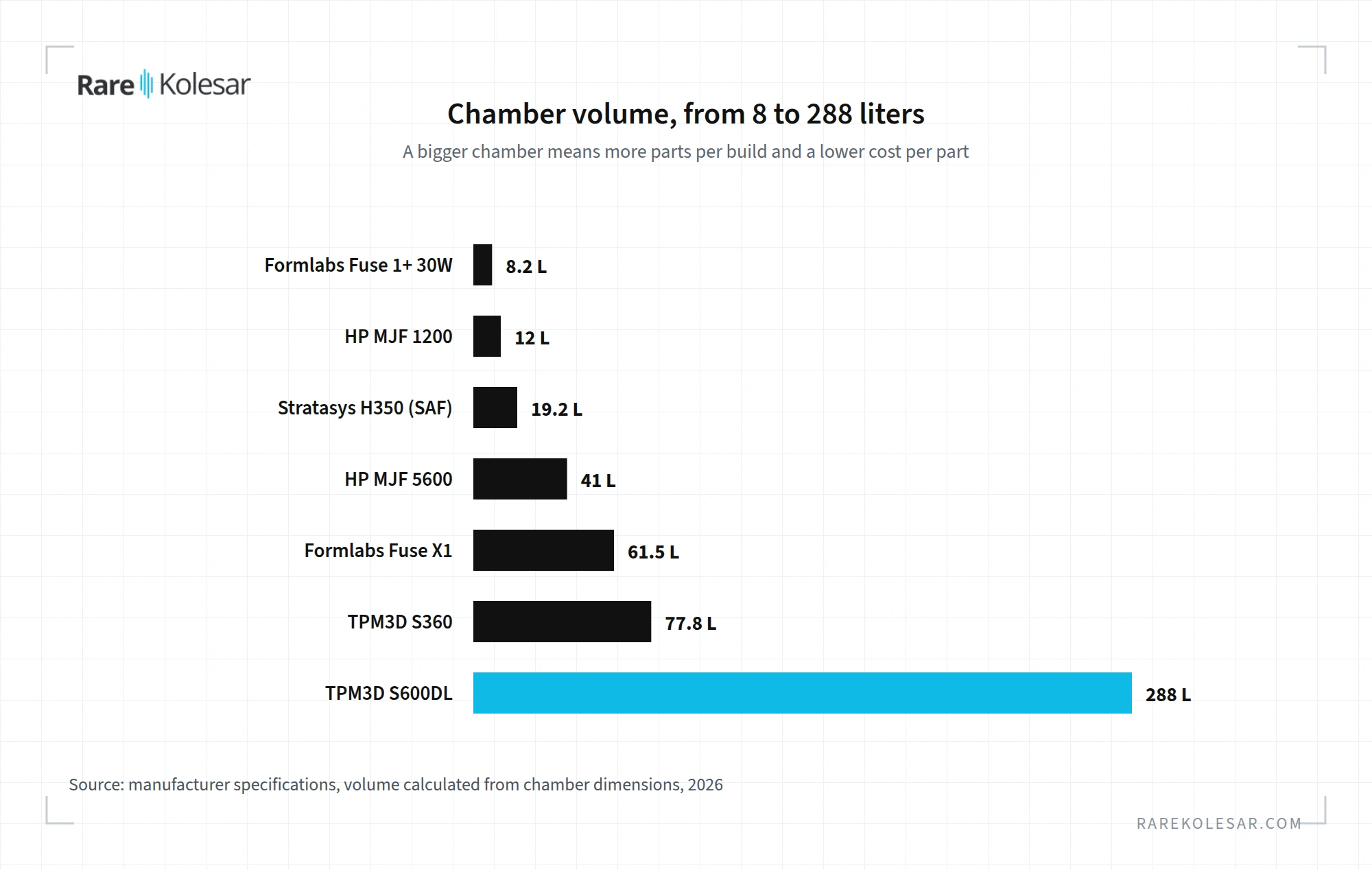
The TPM3D S600DL is an SLS machine with a 600 x 600 x 800 mm chamber, or 288 liters, the largest in this comparison. It has two 140 W CO2 lasers, and packing density is realistically 25 to 30 percent. There are also smaller models, the S360 with an estimated price of about 240,000 euros, and the new compact C series, the CF200 with a 30 W fiber laser, which I estimate at about 95,000 euros.
The team behind TPM3D has worked on SLS since 1999, and the company was formally founded in 2004. Since late 2025 they have an official European distributor, ANiMA from Greece. Greece is logistically closer to Serbia than Germany or the US. Taking everything into account, this line stays near the very top of my list.
Stratasys H350, predictable cost in a small chamber
The H350 uses SAF technology. There is no laser: a print head deposits a fluid that absorbs infrared radiation, and the powder is fused by a lamp. Packing density is about 12 percent, slightly above MJF. The print heads are not consumables and are included in the service contract, so the cost structure is simpler. In the region, support is available through IZIT from Croatia.
The downside is size. The chamber is 315 x 208 x 293 mm, about 19 liters. The Fuse X1 has 61.5 liters and the TPM3D S360 77.8 liters, so the H350 is three to four times smaller. A real quote from a 2024 tender was about 291,000 euros for the machine alone, plus 26,950 euros a year for service. I treat that price as an estimate tied to the moment of the quote.
EOS P 770 and 3D Systems SLS 380, mature brands with their own limits
The EOS P 770 is the most mature industrial SLS brand on the list, with two 70 W CO2 lasers and a 700 x 380 x 580 mm chamber. The price is not public and sits in the premium tier. Large parts in large EOS chambers have a known problem with edge curl and warpage. An academic study on its predecessor, the P 700, showed that powder bed temperature is the most important factor, and that a difference of just 1 to 2 °C changes the result. The bigger the chamber, the harder the heat is to control.
In 2001, 3D Systems bought DTM, the company that commercialized the original SLS technology from the University of Texas. That is the longest lineage on the list. The SLS 380 has a 381 x 330 x 460 mm chamber. Still, to this day I have not seen a single installation of this machine in the wider Southeast European region. Historical brand weight does not automatically turn into visible presence on the ground.
Financial health of the manufacturers
As a consultant, this matters most to me. If I recommend a machine and the manufacturer disappears from the market, service, warranty and spare parts disappear with it.
Sinterit, the Polish maker of the NILS 480 (chamber 200 x 200 x 330 mm), is in a court restructuring proceeding with its creditors. According to a notice in the Polish court gazette, the arrangement date was set for 17 April 2026. Before that, management changed, the founder left the company, and the German investor FIT AG financed the company several times.
voxeljet, the German maker of HSS technology and the VX200 machine, went through a court restructuring under the German StaRUG law. The court confirmed the plan in July 2025. The US investor Anzu Partners put in 2.5 million euros, 3.5 million euros of debt was written off, and the previous shareholders were excluded. voxeljet was then combined with ExOne under Anzu Partners. The company operates, but the risk is different than before.
Farsoon, contrary to expectations, is the financially healthiest on the list. Revenue grew about 45 percent in 2025, to 715 million yuan, the company is profitable and listed on the Shanghai stock exchange. Part of that stability comes from diversification: of more than 1,400 machines delivered, over 800 are metal systems. For the Flight HT1001P with its 1000 x 500 x 450 mm chamber, the price is not public. For the smaller HT403P we had a real 2023 quote of about 294,000 euros for the complete system with equipment, which means an estimate of about 190,000 euros for the machine alone.
Formlabs Fuse 1+ and Fuse X1
The Fuse 1+ 30W has a 165 x 165 x 300 mm chamber, about 8.2 liters, and finishes a build in under 24 hours. The estimated price is about 23,000 euros for the machine alone. From real production on two machines, I have data showing chamber fill ranged from 18 to 41 percent, depending on part geometry. The estimated monthly revenue for two machines at full load, 22 working days, was about 14,300 euros.
The Fuse X1 was introduced in June 2026, with deliveries planned for the fourth quarter of 2026. The price starts at 84,999 dollars, an estimate of about 78,000 euros. The chamber is 330 x 330 x 565 mm, 61.5 liters, and the manufacturer claims packing density above 30 percent. The laser is 120 W, four times stronger than the Fuse 1+ and 12 times stronger than the original Fuse 1 at 10 W.
That is where I also see risk. Going from 10 to 30 W already brought noticeably more quality errors in the field. A laser twelve times stronger carries real risk, despite the new thermal control with 13 independent heating zones. The history of the Fuse 1 teaches us that the first version of a new machine rarely works as promised right away.
Materials, the Sift and changing powder
This is not specific to Formlabs. It applies to any machine that works with powder, including metal machines. Powder gets into every gap, and different powders must never be mixed. So you need either a separate chamber per material, or periodic disassembly and thorough cleaning. The printer itself has to be completely clean between materials, because glass transition temperature differs from material to material, and residue of the previous powder disturbs the thermal calibration for the new one.
The Sift, the unit that separates and recycles unused powder, is often a bigger problem than the chamber. Either you fully disassemble and clean it at every material change, or you buy a separate Sift per material, which in my experience means an extra 10,000 to 20,000 euros per material.
PA12 is still by far the best supported material, with the best refresh rate, the easiest handling and no need for nitrogen. Two similar sounding terms need to be separated here:
- Refresh rate: what percentage of old powder you may mix with fresh powder in the next build.
- Refresh limit: how many times in total the same powder may go through a cycle before its properties degrade too much and it has to be discarded.
PA12 has the highest limit. With glass filled material (GF), the allowed number of cycles is limited and waste is higher, so you discard the entire remaining powder more often instead of just topping it up. In practice the manufacturer's software usually does not count this automatically per batch, so a manual log is kept. With carbon fiber filled powder (chopped fibers, not CFF with continuous fiber), there is a third factor, mandatory personal protective equipment, because the microfibers cut skin and mucous membranes, similar to glass wool.
Spare parts are not negligible either. According to the price list for the Fuse 1 series, filters cost 60 to 183 euros, gaskets about 25 euros, and larger assemblies such as motors and heaters 300 to 645 euros.
Formlabs service plans
Formlabs, like most manufacturers, offers service plans for the Fuse line. The Complete Service Plan is available for 1, 3 or 5 years. In the offer I saw, prices were 5,625 euros for one year, 11,250 for three and 16,875 for five years, including 25 percent VAT. These are also prices tied to the moment of the offer.
The plan covers replacement parts for the printer, accessories such as the Sift and spare build chambers, accidental damage, annual preventive maintenance and consumable parts such as filters and gaskets. The basic one year factory warranty covers considerably less. For three or more machines there is the Production Service Plan, with preventive maintenance twice a year and an onsite technician within two business days. For the Fuse X1 this plan is mandatory.
A service plan is not mandatory for the Fuse 1 series. If a company wants to carry the risk itself and pay for parts as needed, it can. The plan is for those who want a predictable fixed cost instead of an uncertain one.
Machine overview
All prices are for the machine only, without shipping, customs, the Sift, extra chambers, training and support. All prices, even those from real quotes, are estimates tied to the moment they were found, 2024 to 2026. Manufacturer and distributor prices change.
| Machine | Technology, energy source | Chamber (mm) | Volume | Price, machine only (estimate) | Packing density |
|---|---|---|---|---|---|
| Formlabs Fuse 1 (original) | SLS, 10 W fiber | 165 x 165 x 300 | 8.2 L | no longer sold | about 7 to 10 % |
| Formlabs Fuse 1+ 30W | SLS, 30 W fiber | 165 x 165 x 300 | 8.2 L | about €23,000 | 18 to 41 %, seen in practice |
| Formlabs Fuse X1 | SLS, 120 W fiber | 330 x 330 x 565 | 61.5 L | about €78,000 | over 30 %, per manufacturer |
| HP MJF 5600 series | MJF, no laser | 380 x 284 x 380 | 41.0 L | €300,000 to 350,000, with peripherals up to €550,000 | 10 to 15 % |
| HP MJF 1200 | MJF, no laser | 320 x 165 x 230 | 12 L | below €55,000 | up to 20 %, per manufacturer |
| EOS P 770 | SLS, 2 x 70 W CO2 | 700 x 380 x 580 | 154.3 L | not public, premium tier | about 20 to 25 % |
| Farsoon Flight HT1001P | SLS, 2 to 4 x 300 W fiber | 1000 x 500 x 450 | 225 L | not public | 25 to 30 % |
| Farsoon HT403P | SLS, 100 W CO2 | 400 x 400 x 450 | 72 L | about €190,000 | 25 to 30 % |
| TPM3D S600DL | SLS, 2 x 140 W CO2 | 600 x 600 x 800 | 288 L | not public | 25 to 30 % |
| TPM3D S360 | SLS, CO2 | 360 x 360 x 600 | 77.8 L | about €240,000 | 25 to 30 % |
| TPM3D CF200 (C series) | SLS, 30 W fiber | 200 x 200 x 320 | 12.8 L | about €95,000 | 25 to 30 % |
| Stratasys H350 | SAF, no laser | 315 x 208 x 293 | 19.2 L | about €291,000 | about 12 % |
| 3D Systems SLS 380 | SLS, laser | 381 x 330 x 460 | 57.8 L | not public | 20 to 25 % |
| Sinterit NILS 480 | SLS | 200 x 200 x 330 | 13.2 L | not public | 20 to 25 % |
| voxeljet VX200 HSS | HSS, no laser | 290 x 140 x 180 | 7.3 L | not public | not comparable in the same way |
What this means in practice
No machine wins on every parameter. HP offers maturity, but with a high fixed cost and low packing density. TPM3D and Farsoon offer a large chamber and a good cost per part. Stratasys offers predictable service in a small chamber. Sinterit and voxeljet carry a risk that is financial rather than technical.
For entering PA12 applications, after all the checks and all the added costs, the Fuse 1+ 30W remains the most balanced choice for me. A good example is producing assembly fixtures and tools for cable harnesses, which I wrote about in the article on cable harness tooling made with SLS. The Fuse X1 is at the same time the biggest upside and the biggest open risk.
That is why, when choosing a machine, I always look at the total cost of ownership and the manufacturer risk, not the spec sheet. I write more about this in what vendor neutral means in machine selection, and about when adoption makes sense in when 3D printing makes sense and when it does not.
Frequently asked questions
How high is the real entry cost compared with the price of an industrial SLS or MJF printer? In my experience, for expensive machines the real entry cost is about 30 percent higher than the machine price. For cheap entry level machines the addition can reach 100 percent. It consists of shipping, customs, a powder cleaning station, extra chambers, training, support and extended warranty.
Why can MJF cost more per part than SLS even though it is fast? MJF has lower packing density, realistically 10 to 15 percent, compared with 25 to 30 percent on good SLS machines. A high annual service contract, 55,000 to 65,000 euros for the HP 5600 series, is spread over fewer parts per build. That raises the cost per part, except for companies that keep the machine full all the time.
What is the difference between powder refresh rate and refresh limit? Refresh rate tells you what percentage of old powder you may mix with fresh powder in the next build. Refresh limit tells you how many times in total the same powder may go through a cycle before it has to be discarded. PA12 has the most favorable values, while glass filled materials allow a limited number of cycles.
Is a separate Sift or chamber needed for every material? Different powders must not be mixed, so you need either separate equipment per material or thorough cleaning at every change. A separate Sift per material is, in my experience, an extra 10,000 to 20,000 euros. That is why for most companies it is most rational to stay with one main material, usually PA12.
Why does the financial health of the manufacturer matter when buying a machine? If the manufacturer disappears or goes through restructuring, service, warranty and spare parts are at risk. Sinterit is in a court restructuring proceeding in Poland, and voxeljet went through court restructuring in Germany and changed owners. Farsoon, by contrast, grew revenue by about 45 percent in 2025 and is profitable.
Is a Formlabs service plan mandatory? For the Fuse 1 series it is not mandatory. The Complete Service Plan is available for 1, 3 or 5 years and shifts the cost of parts, consumables and maintenance to the manufacturer or distributor. For the Fuse X1, the Production Service Plan is mandatory.
How reliable are announced delivery dates for new machines? They should be taken with caution. The original HP MJF and the Formlabs Fuse 1 were each about two and a half years late compared with the original promises. The Fuse 1 was announced in June 2017 and delivered in January 2021.
Sources
- Formlabs Unveils Fuse X1, Formlabs, 2026
- Announcing Fuse X1, Formlabs, 2026
- Formlabs Launches Fuse X1, Technical Specifications and Pricing, 3D Printing Industry, 2026
- Formlabs launches Fuse 1 and Form Cell, Formlabs, 2017
- Formlabs launches Fuse 1, Formlabs, 2021
- Fuse Series Service Plans, Formlabs, 2026
- HP Multi Jet Fusion 1200, HP, 2026
- HP's MJF 1200 Targets Entry Level AM, 3DPrint.com, 2026
- Multi Jet Fusion, HP's promised 3D printer, The Register, 2014
- TPM3D partners with ANiMA to expand SLS distribution in Europe, VoxelMatters, 2025
- TPM3D CF200 and PPS200, TPM3D, 2025
- TPM3D Brand Review, Top 3D Shop, accessed 2026
- Farsoon posts 715M yuan 2025 revenue, VoxelMatters, 2026
- voxeljet Completes Court Approved Restructuring, Fabbaloo, 2025
- ExOne and voxeljet, Anzu Partners brings two pioneers together, 3DPrint.com, 2025
- Notice on setting the arrangement date, Sinterit, MUIR, 2026
- Sinterit otrzymuje kolejną kroplówkę, Centrum Druku 3D, 2025
- Sinterit enters industrial market with NILS 480, 3D Printing Industry, 2021
- voxeljet VX200 HSS, Aniwaa, accessed 2026
- Quantitative analysis on SLS part curling using EOS P700 machine, Journal of Materials Processing Technology, 2012