Most companies get the choice of technology for industrial 3D printing wrong, not because there is no good option, but because they decide too early and based on the machine's reputation rather than what the part needs.
The right order is: first what the part has to do, then geometry, quantity and economics, and only at the end whether the company has the people and organization to introduce the technology. You are not looking for the best option, you are removing the wrong ones.
The machine price is only the starting figure. A serious implementation takes about six months, and without one person who owns the process, even the best equipment does not deliver.
What it looks like in practice
A company hears about a certain technology, sees an example from another industry and concludes it is the solution to its own problem too. The investment is made quickly. Expectations are high.
A few months later, production does not deliver the expected results. Costs grow. The equipment stands idle more than it runs.
Then comes the question that should have been asked at the start: did we choose the right technology at all? The problem is that at that point the answer is no longer cheap.
The most common mistakes companies make
In most projects the problems are not technical. The problems are in the way of thinking.
They choose a technology by reputation, not by purpose
A typical example is choosing an MJP system, which prints real wax, for investment casting patterns. On paper it looks like a serious industrial solution. In reality the closed system limits flexibility, the pattern is sensitive while it waits, and service drives up costs.
For small series this becomes a big problem. A modern fast UV DLP or SLA system with castable resin is faster, scales simply by adding machines and has a much lower total cost. In projects I have worked on, the difference was up to ten times in favor of the DLP and SLA approach.
They look at the machine and ignore the process
Large FDM systems are often bought because they can make large parts. In practice a build takes days, the risk of a failure near the end is high, and one machine blocks the capacity of the whole company.
The problem is not the technology. The problem is that the part should not have been made that way.
They underestimate the economics
Companies look at the machine price and ignore the process cost. MJP has a hidden cost that few anticipate: the system regularly consumes material even when idle, just to keep the print heads from clogging. The heads are not cheap and the warranty does not cover them. DLP and SLA give a more stable and predictable cost under the same conditions.
They ignore people and organization
One of the most expensive examples I have seen was metal additive manufacturing, a laser wire deposition system mounted on a CNC platform. The technology was good. The integration was correct. But there was no responsible person, people kept changing and knowledge was lost. The result was poor regardless of the equipment.
If there is no single person running the process, the project will not work.
They expect quick results
A serious implementation takes about six months. It includes part analysis, technology selection, prototype, validation, building the process, training and standardization. What that means in practice is described in what process qualification looks like in practice.
Whoever tries to shorten this path pays for it later through mistakes.
How to choose a technology, a five step filter
The approach is simple. Do not look for the best option, remove the wrong ones. Each step narrows the choice before the next.
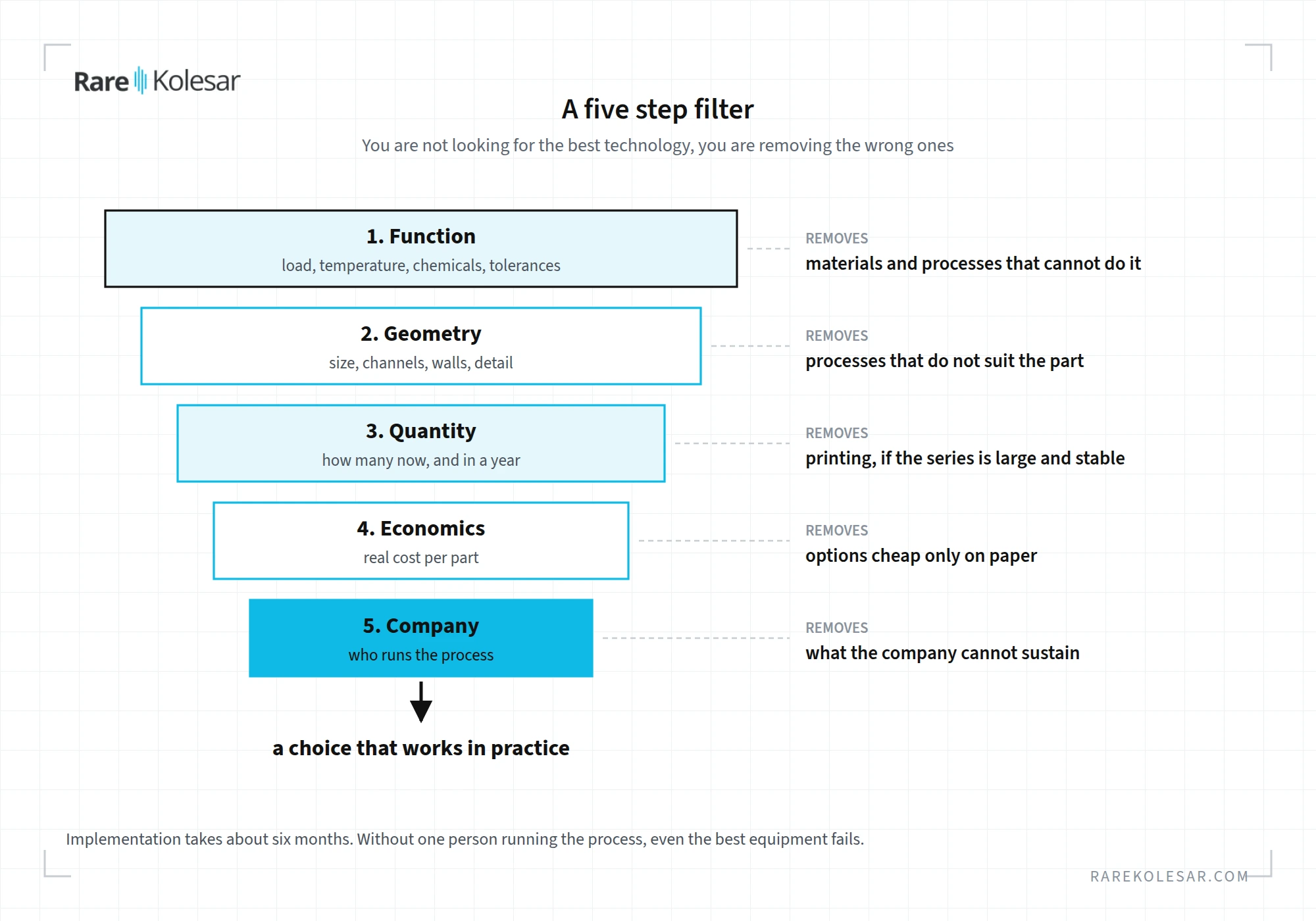
| Step | Question | What it removes |
|---|---|---|
| 1. Function | What load, temperature, chemicals and tolerances must the part withstand? | materials and processes that cannot do it |
| 2. Geometry | How large is the part, does it have internal channels, thin walls, fine detail? | processes for which the part is too large, too small or too slow |
| 3. Quantity | How many pieces now, and how many in a year? | 3D printing altogether, if the series is large and stable |
| 4. Economics | What is the real cost per part, with material, post processing, scrap and downtime? | options that are cheap only on paper |
| 5. Company | Who runs the process, who does post processing and inspection, is there continuity? | technologies the company cannot sustain |
First, what the part has to do
Load, temperature, chemical resistance, tolerances. If this is not clear, everything after it is guesswork. How to choose a material from these requirements is described in how to choose the right material without guesswork.
Then, geometry
This step immediately removes wrong choices. Large FDM often looks like the solution, but in practice means slow and risky production. In most cases the problem is not the size of the part but its design. A part designed for additive manufacturing can often be split, reduced or combined with other parts.
Then, quantity
Quantity decides whether 3D printing makes sense at all. A more detailed framework for this decision, with break even limits against injection molding and CNC machining, is in when 3D printing makes sense and when it doesn't.
Economics decides
This is where theory and practice part ways. A company chose an SLS system for functional prototypes because the machine price was attractive compared to the competition. What they did not account for was sieving and mixing old and new powder, the protective atmosphere and chamber cooling time between builds. When everything was added up, the real cost per part was closer to a farm of desktop FDM printers than anyone expected on paper.
The machine price is only the starting figure. The real economics show only when all operating costs are added up.
Finally, the company
This is the part everyone ignores. If the company has no one running the process, no discipline in operation and no continuity, the technology will not deliver. A vendor neutral approach to selection means the recommendation comes from analysis, not from a supplier's offer. More in what vendor neutral means in machine selection.
Which technologies usually remain after the filter
This is not a machine recommendation, but an orientation on which process groups most often survive the filter for typical requirements. The actual choice always depends on the part.
| Typical requirement | Processes that most often remain | What to watch |
|---|---|---|
| Investment casting patterns, fine detail, small series | DLP and SLA with castable resin | resin burnout, dimensional control |
| Functional polymer parts, tooling and fixtures in series | SLS, MJF | total cost of powder and post processing, machine utilization |
| Large polymer parts, prototypes, molds | FDM, printing from granulate | build time, risk of failure near the end |
| Strong, light polymer parts instead of metal | FDM with continuous fiber, CFF | anisotropy, load direction |
| Metal parts with internal channels, small series | powder bed fusion, PBF | supports, heat treatment, qualification |
| Large metal parts, repair and build up | DED, wire or powder | CNC finishing required, organization of work |
When it makes sense to bring in a consultant
If you have reached the stage of choosing a technology, there is a good chance you are already close to a wrong decision.
The biggest mistakes are made at the start: the wrong technology, the wrong cost estimate, ignoring the organization. Later they cost through unnecessary investment, lost time and systems that do not work.
A consultant's role is not to recommend a machine. It is to shorten the decision, remove the wrong options before they become a cost, and set up a system that works in real conditions. One conversation often prevents mistakes that cost tens of thousands of euros.
Fill in the production analysis or see consulting services.
Frequently asked questions
What is the most common mistake when choosing a technology for industrial 3D printing? Choosing a technology by reputation or by an example from another industry, instead of by what the specific part needs. A solution that looks serious on paper is often more expensive and slower in practice.
Why does the machine price not tell the real cost story? Because it does not include the hidden process costs: wear parts the warranty does not cover, material consumed even when the machine is idle, powder sieving, protective atmosphere and post processing. The real cost per part shows only when all of that is added up.
How long does a serious implementation of a new technology take? About six months. It includes part analysis, technology selection, prototype, validation, building the process, training and standardization.
Why is organization more important than the technology itself? If there is no single person running the process, knowledge is lost when people change. The result is poor no matter how good the equipment is.
What is the first step in choosing a technology? Defining what the part has to do: load, temperature, chemical resistance and tolerances. Without that, every next step is guesswork.
Which technology is best for investment casting patterns? For small series and fine detail, it is most often DLP or SLA with castable resin. They are faster, scale by adding machines and have a more predictable cost than systems that print real wax.
When does it make sense to bring in a consultant? Before the technology decision is made, not after. The most expensive mistakes are made at the start, and a consultant removes them before they become a cost.
Conclusion
Choosing a technology is not a technical decision. It is a business decision.
The most expensive mistake is not the wrong machine. The most expensive mistake is the wrong assumption.