This is an analysis for a Tier 1 wire harness manufacturer with five plants, one in Serbia, two in the EU and two in Africa, which today orders tooling for its assembly boards as CNC machining from service providers.
The recommendation is benchtop SLS, six Formlabs Fuse 1+ 30W machines at five sites, introduced in three phases, with PA12 as the only material across the whole network. The estimated investment is about 306,000 euros.
Profitability depends almost entirely on one number: how many complex nests per year actually move to SLS. In the base scenario, with about 9,450 nests per year, the investment pays back in about four and a half months. In the conservative scenario, with about 3,240 nests and a smaller saving per piece, payback takes a little over two years.
That is why the first step is a pilot with two machines at the largest site, for 8 to 12 weeks, with real data before deciding on the other sites.
Who this analysis is for
| Aspect | Detail |
|---|---|
| Sites | 5 plants: 1 in Serbia, 2 in the EU, 2 in Africa |
| Product | wire harnesses, assembly boards with 50 to 100 connector nests |
| Current tooling source | CNC machining from service providers, locally per plant, highest price in Western Europe, then Eastern Europe, then Africa, but the client describes the spread as moderate |
| Volume | tens to hundreds of new or changed models per year per plant |
| In scope | complex nests and fixture inserts in low and medium volume |
| Out of scope | simple nests, which stay on CNC machining, and end use or safety critical parts |
A nest is a holder that keeps a connector in an exact position on the assembly board while the operator routes and joins the wires. Every new or changed harness model needs new nests.
Why CNC tooling is expensive
The problem is not only the price per piece. For a client like this, the CNC approach carries three structural costs.
Lead time. A new or changed nest takes weeks. According to an overview published by ASSEMBLY Magazine, connector holders printed on HP Jet Fusion systems cut lead time from two to six weeks down to one day.
The cost of every change. Every design change means a new CNC order and a new setup. That is why engineers try to get the solution right the first time, instead of testing it.
Five suppliers at five sites. Each plant buys locally, with different standards, prices and lead times, and the African sites also carry transport and customs.
Published data from manufacturers and users show savings of 50 to 75 percent per part when moving from CNC machining to powder bed printing: up to 75 percent for HP MJF connector holders, and 50 to 70 percent for Stratasys SAF wire harness fixtures. In one of my projects for a global automotive parts manufacturer, a tool that cost about 100 euros from a service provider with a two month lead time now costs about 20 euros and arrives within 24 hours at most.
Which technology and why benchtop SLS
I reviewed nine powder bed platforms. For this case the deciding factors were the fixed cost per site, the size of the parts, and the fact that the machines sit at five sites rather than in one central facility.
| Option | What it offers | Why it is or is not the choice here |
|---|---|---|
| HP MJF 5600 and similar | high productivity, documented in connector holders | machine 300,000 to 350,000 euros, annual service 55,000 to 65,000 euros regardless of utilization, packing density only 10 to 15 percent |
| Large format SLS, EOS P770, Farsoon, TPM3D S600DL | large chamber, large parts | built for large parts, price and floor space not justified for small nests |
| Stratasys H350, SAF | documented in wire harness fixtures | about 291,000 euros per machine, one central machine instead of local production |
| Formlabs Fuse X1 | 61.5 liter chamber, 120 W laser, announced in June 2026, from 84,999 dollars | candidate for the largest site later, but a laser 12 times stronger than the original Fuse 1 carries a quality consistency risk, and the Fuse 1+ already shows more defects than its slower predecessor |
| Formlabs Fuse 1+ 30W | benchtop SLS, PA12 documented in connectors and fixtures | lowest risk per site, fast rollout, enough capacity for nests |
With MJF, on top of the service contract, a set of drums costing about 6,500 euros is replaced every 150 kilograms of powder, so the fixed cost before a single part is printed reaches 60,000 to 70,000 euros a year. The economics only work at consistently high utilization. One service bureau in the Balkans returned a leased MJF machine after three years.
The financial health of the manufacturer also matters, because a machine outlives a single contract. Sinterit has been in court supervised restructuring since April 2026, voxeljet went through restructuring under Anzu Partners, and Farsoon is the financially healthiest on the list, with 45 percent revenue growth.
For the Fuse 1+ 30W, the deciding points were these. PA12 is sufficient for tooling and fixtures, no glass or carbon fiber reinforcement is needed, and this material is documented in exactly this application on connectors and fixtures. The machine has been on the market since 2022, so it is not a new, unproven product.
Known limitations should be stated upfront. Changing material requires a separate chamber or thorough cleaning, which is why the recommendation is one material across the whole network. Formlabs also has a history of delays. The original Fuse 1 was announced in June 2017 with delivery promised for mid 2018, and reached customers only in January 2021. It took a deposit of 1,000 euros per order, and delivery was two and a half years late. The Fuse 1+ 30W is a mature product today, but with every new announcement, including the Fuse X1, delivery dates should be taken with caution. Formlabs has no service presence in Africa, so spare parts and training have to be planned in advance.
This is a recommendation for a specific client profile, not a general machine recommendation. With a different volume, different parts or one central site, the answer would be different.
Rollout plan in three phases
| Site | Machines | Phase | Note |
|---|---|---|---|
| Largest site | 2 | Phase 1, pilot | validates the process, training and savings model |
| Serbia | 1 | Phase 1 | candidate for the regional hub for spare parts and consumables |
| EU site 1 | 1 | Phase 2 | standard rollout after the pilot |
| EU site 2 | 1 | Phase 2 | standard rollout |
| Africa 1 | 1 | Phase 3 | requires spare parts stock and trained technicians |
| Africa 2 | 1 | Phase 3 | same as Africa 1 |
The pilot runs for 8 to 12 weeks. Only after it, with real prices and volumes, is the investment for phases 2 and 3 approved. This way capital is exposed only as far as the model has been confirmed.
The numbers
Assumptions
The client has to confirm these numbers. The base scenario is slightly above the upper end of published savings, in line with what I saw in my own project, and the conservative scenario is deliberately pessimistic.
| Assumption | Base | Conservative |
|---|---|---|
| New models per year, each of 4 standard sites | 40 | 30 |
| New models per year, largest site | 200 | 150 |
| Average nests per board | 75 | 60 |
| Share of nests complex enough for SLS | 35% | 20% |
| CNC price per nest, average of five countries | €170 | €130 |
| SLS cost per nest, material and time | €35 | €50 |
| Saving per nest in percent | 79% | 62% |
| Utilization in year one, due to ramp up | 70% | 50% |
Investment
| Item | Estimate |
|---|---|
| 6 × Fuse 1+ 30W complete package, with spare build chambers, Fuse Sift powder station, cleaning station, powder and training, about €50,000 per machine | €300,000 |
| Transport, customs and an allowance for the two African sites | €6,000 |
| Total | €306,000 |
Formlabs lists the complete package at 56,902 dollars. The machine alone in the basic package is cheaper, but without automated powder handling it is not realistic for tooling production at several sites. A rule from practice: for more expensive industrial machines, peripheral equipment, transport, training and support add about 30 percent to the price of the machine, and for cheaper entry level machines up to 100 percent.
Annual operating cost
| Item | Estimate |
|---|---|
| PA12 powder, filters, seals and consumables for 6 machines | €48,000 |
| Spare parts stock for the two African sites | €6,000 |
| Total per year | €54,000 |
Formlabs also offers a service plan, about 5,625 euros per machine per year including VAT, covering spare parts, accessories, wear parts and annual preventive maintenance. It is not mandatory for the Fuse 1+ and is not included here, because the proposal is to hold spare parts in the client's own hub.
Savings and payback
| Metric | Base | Conservative |
|---|---|---|
| Complex nests per year, largest site | 5,250 | 1,800 |
| Complex nests per year, 4 standard sites combined | 4,200 | 1,440 |
| Total complex nests per year | 9,450 | 3,240 |
| Saving per nest | €135 | €80 |
| Gross annual saving at full operation | €1,275,750 | €259,200 |
| Net saving in year one, after ramp up and operating cost | €839,025 | €75,600 |
| Net annual saving from year two | €1,221,750 | €205,200 |
| Payback | about 4.5 months | about 25 months |
The difference between the scenarios is huge, and that is the most important conclusion of this analysis. The machine did not decide it, the number of complex nests per year did.
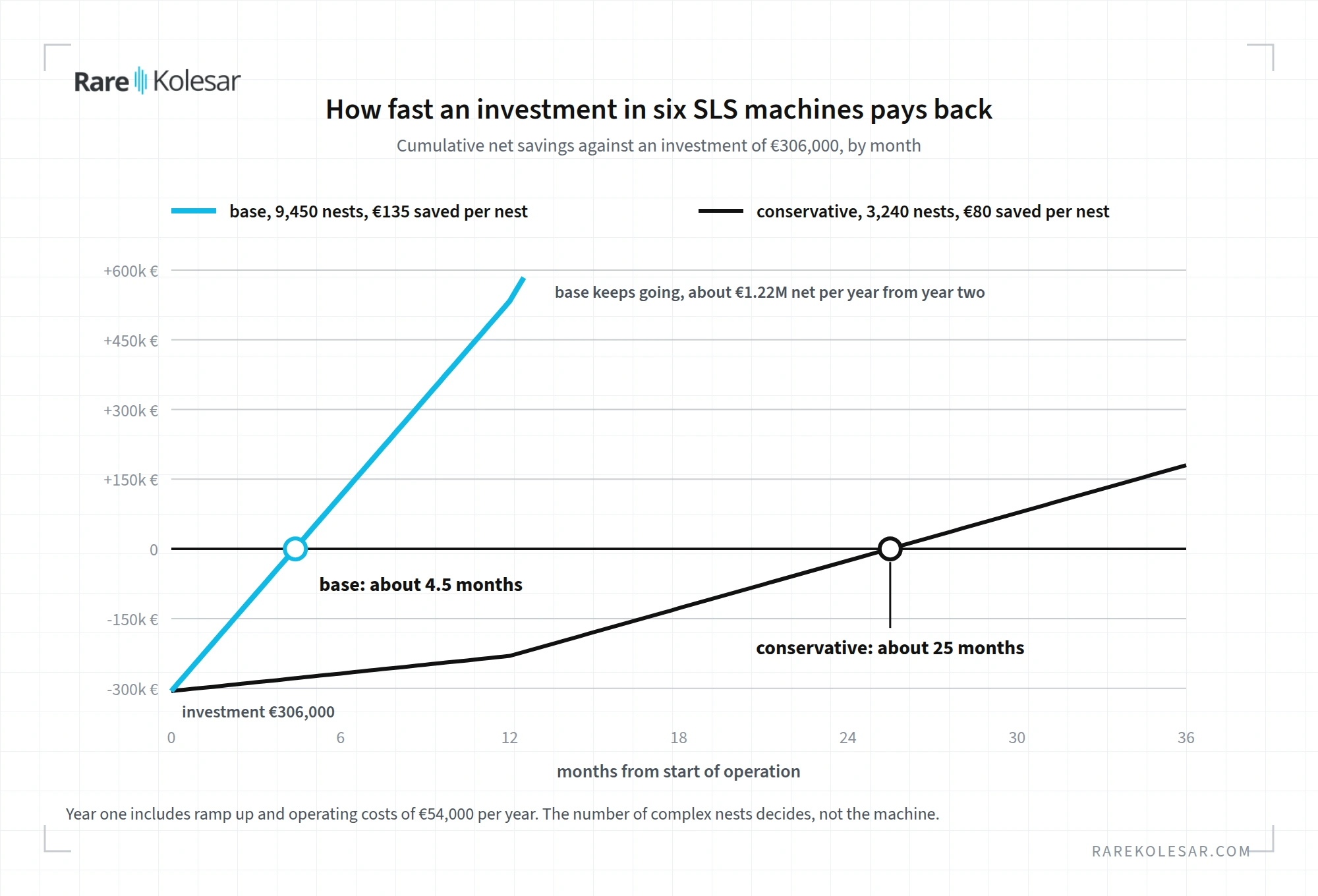
What decides profitability
When the investment and operating cost are divided by the saving per nest, you get the break-even limit. For the investment to pay back in two years at full operation, the network needs about 1,530 complex nests per year at a saving of 135 euros per nest, or about 2,590 nests at a saving of 80 euros.
That is why the pilot does not measure whether SLS works. It measures three numbers: the real CNC price per nest at each site, the real share of complex nests, and the real utilization of the machines.
Risks and how to reduce them
| Risk | Description | Mitigation |
|---|---|---|
| Service in Africa | the manufacturer has no service presence in African countries | spare parts stock in the Serbian hub, training 1 to 2 in house technicians per African site |
| Material changes | powder residue affects consistency | PA12 only across the whole network |
| Wrong assumptions | the inputs are planning estimates | validation in the pilot before phases 2 and 3 |
| Nest quality | an SLS nest has to meet the same dimensions and durability as a CNC one | first article inspection for every design, CNC tools are not withdrawn until SLS passes |
| Machine downtime | 4 sites have one machine each | keep CNC suppliers as a fallback |
First article inspection follows the same rules as for any part going into production, which I wrote about in how a single part gets qualified for production.
Recommendations and next steps
- Approve phase 1: two Fuse 1+ 30W machines at the largest site as a pilot.
- During the 8 to 12 week pilot, collect the real CNC price per nest per site, the real share of complex nests and the real utilization, then rerun the model before approving phases 2 and 3.
- Standardize on PA12 across the whole network.
- Designate Serbia, or the largest site if different, as the hub for spare parts and consumables, with a stock plan for the African sites.
- Keep CNC suppliers as a fallback. The goal is lower cost, not dependence on a single source.
- Find a regional partner for service and spare parts, instead of relying only on the manufacturer's service from Western Europe.
Frequently asked questions
How much does an SLS printer for tooling production cost? A benchtop SLS system with all the peripheral equipment needed for production, a powder station, spare build chambers and a cleaning station, costs about 50,000 euros. Large format industrial SLS and MJF systems cost from about 200,000 euros upwards, plus annual service contracts.
How much is saved when wire harness nests are printed instead of machined? Published data show 50 to 75 percent per part, and lead time drops from several weeks to one day. What that means in money depends on the number of nests per year.
How fast does an investment in SLS for tooling pay back? In this analysis, from about four and a half months in the base scenario to about 25 months in the conservative one. The number of complex nests per year decides, which is why it starts with a pilot.
Why not MJF, when it is documented in exactly this kind of connector holder? MJF is excellent for large centralized production, but annual service of 55,000 to 65,000 euros plus drums bring the fixed cost to 60,000 to 70,000 euros per machine per year, regardless of utilization. At five sites with moderate volume, that wipes out the saving.
Do SLS nests fully replace CNC? No. Simple nests stay on CNC machining, and CNC suppliers remain a fallback in case of downtime.
Sources
- ASSEMBLY Magazine, 3D Printing and Wire Harness Assembly, 2022
- Stratasys, Wire Harness Fixtures with SAF Technology
- Formlabs, Fuse 1+ 30W Complete Package
- Meridian Cable Assemblies, 3D printing in cable assembly production
I prepared this analysis as an independent additive manufacturing consultant, based on planning data provided by the client and publicly available industry data. The financial projections are planning estimates and should be validated against actual costs and volumes before a final investment decision. I hold an equity stake in a company in the additive manufacturing business, but I do not sell equipment or take part in sales.