Summary
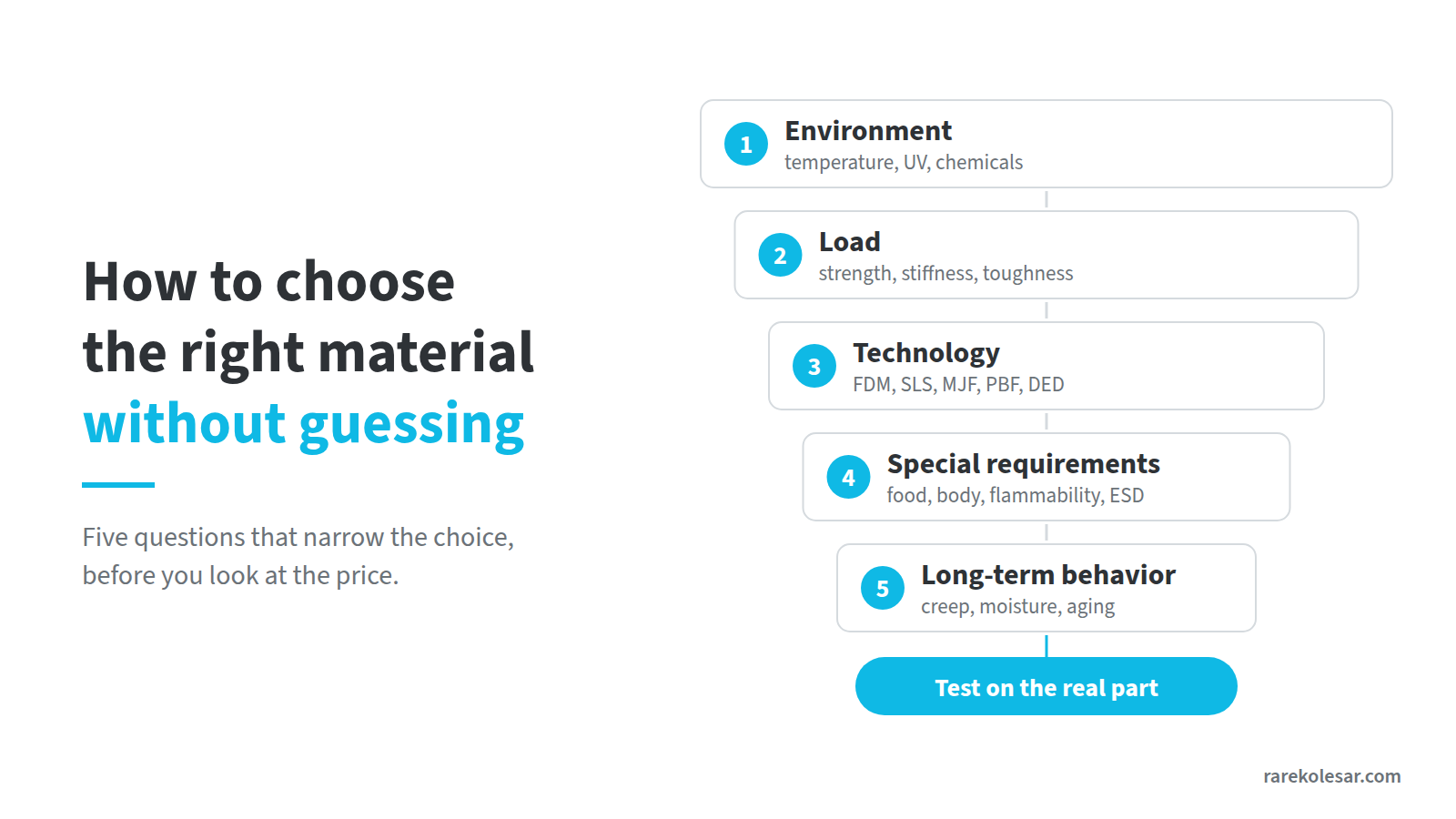
The biggest mistake in choosing a material is looking at its name instead of its purpose. The easy answer is to say take PEEK or steel, but for most parts that is an overpaid solution. The goal is a material that is good enough for the real operating conditions, at the lowest reasonable price. You get there through five questions, environment, load, technology, special requirements and long-term behavior. Datasheets help, but they often cannot be compared directly. The final answer comes from testing a part printed the way it will actually be produced.
Question one, what environment does the part work in?
Temperature, wear, vibration, UV radiation, oils, fuels and chemicals. This is the fastest filter and immediately rules out a large number of materials. If the part works at elevated temperature, PLA and PETG are no longer an option. But PEEK is not an automatic answer either, because it is overpaid for most applications. In between there are nylons, filled nylons, PC and other engineering polymers that often give the best balance of properties and price. PLA is not a bad material. For prototypes, visual models and some assembly aids at room temperature, it is perfectly fine. It is not for parts that get hot, sit in the sun or carry a load over a long time.
Question two, what does the part really have to withstand?
People mix up three properties. Strength is how much force a part withstands before it gives way. Stiffness is how much a part bends under load. Toughness is how much energy a part absorbs before it breaks, for example on impact. A part can be strong but brittle. It can be tough but too flexible. That is why you need to understand what the part really goes through. Sometimes the best choice is nylon with carbon fibers. Sometimes PC. Sometimes TPU. Sometimes the part should not be polymer at all, but metal.
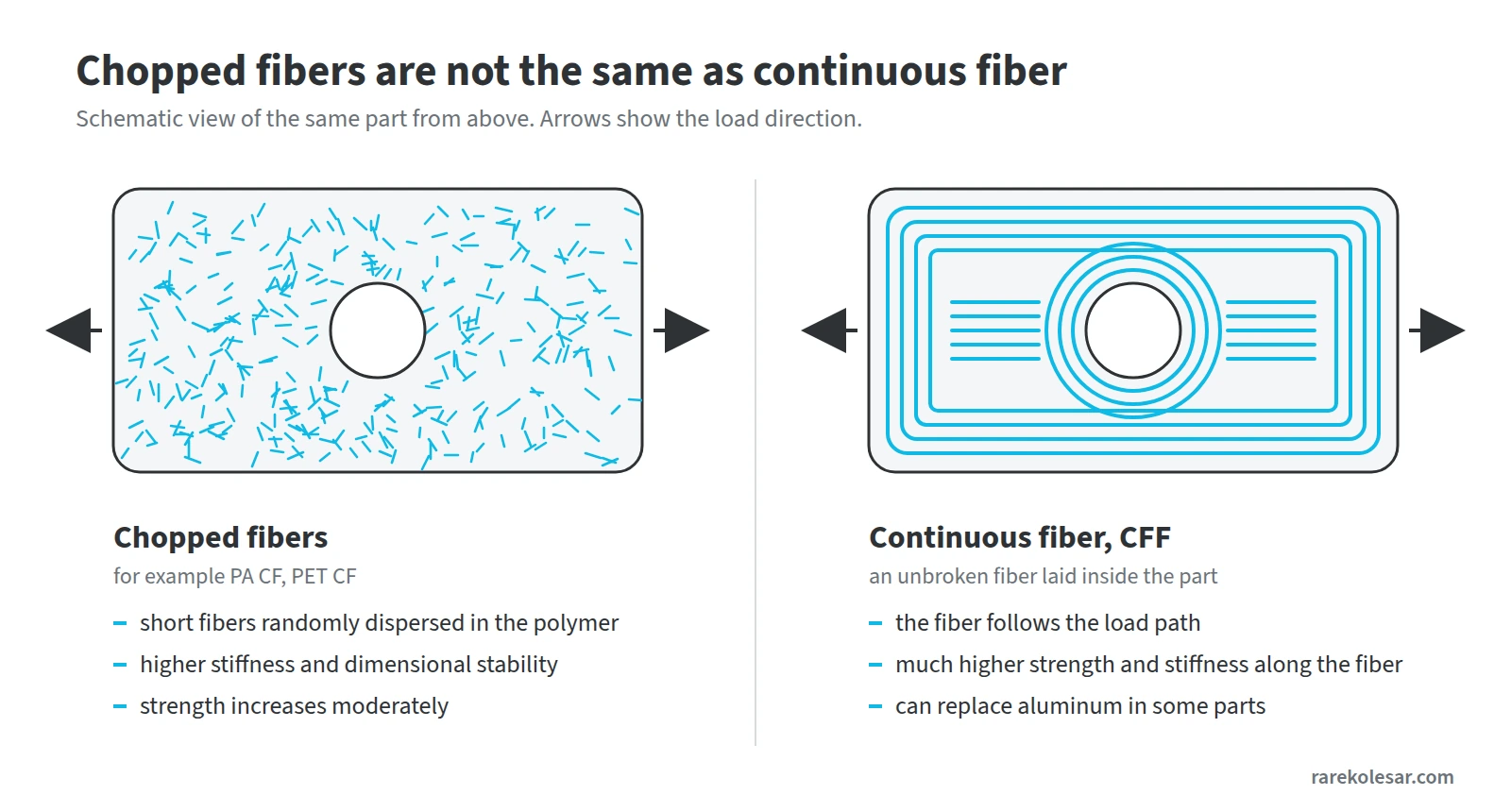
Chopped fibers are not the same as continuous fiber
These are constantly confused in practice. A material labeled CF, for example PA CF, contains finely chopped carbon fibers mixed into the polymer. They increase stiffness and dimensional stability, but raise strength only moderately.
CFF, continuous fiber printing, is something completely different. An unbroken fiber is laid inside the part along the load path, and strength and stiffness in that direction rise to a level chopped fibers cannot reach. If you need a part that replaces aluminum, the difference between these two approaches is decisive.
Question three, which technology can process that material?
Material and technology are chosen together. The same polymer behaves differently in FDM, SLS and MJF. In metal, the same alloy gives different properties in PBF and DED, and different again after heat treatment. Sometimes the technology determines the material, and sometimes the other way around. If a part must be titanium or PEEK, that requirement alone narrows the choice of technologies. So the order is always the same, first the part's requirements, then the pair of material and technology that meets them. The framework for choosing a technology is in How to Choose Industrial 3D Printing Technology, and for metal in Comparing alloys in metal additive manufacturing.
Question four, does the part have special requirements?
Food contact, body contact, flammability, protection against static electricity. These requirements are not solved by picking a material with the right label. A material certificate does not transfer automatically to the finished part, because geometry, surface and post-processing affect the result. More on this in Food-Contact Certification for 3D Printed Parts: What It Actually Means, and What Just Looks Like It Does and Biocompatible Materials and Real Surgical Applications: What "Biocompatible" Actually Means, and Where 3D Printing Really Stands Today.
Question five, how will the part behave a year from now?
A short test in the workshop does not show everything. Polymers under constant load slowly give way, which is called creep. Some materials age under UV radiation. Nylons absorb moisture, which changes both dimensions and properties. Some materials only reach better properties after annealing, controlled heating after printing. If a part has to last, these questions should be asked before the choice, not after the first complaint.
Why datasheets often cannot be compared
This is the biggest trap in material selection. Manufacturers do not always test to the same standard. Some publish values for injection molded specimens, not printed ones. Some report results only for the most favorable orientation. In FDM printing, a part is weakest across the layers. The datasheet value can be several times higher than what the part withstands when the load goes across the layers. That is why a datasheet is for narrowing the choice, not for the final decision. The final decision comes from testing a part printed in the orientation and with the profile it will actually be produced with. I wrote about why the profile matters as much as the material in Why factory profiles are not enough for serious work.
Material price is not part price
A more expensive material sometimes gives a cheaper part. If it allows thinner walls, fewer supports, shorter post-processing or fewer rejected parts, the difference in price per kilogram quickly disappears. Calculate the cost of a finished, good part, not the cost of a spool or a kilogram of powder.
Frequently asked questions
What is the best material for 3D printing? There isn't one. There is a material that is best for a specific part, in specific conditions, at a reasonable price. Is PEEK always the safest choice? No. For most applications it is overpaid, and it is also harder to print. It makes sense when temperature, chemicals or special requirements really call for it. What is the difference between PA CF and CFF? PA CF contains chopped fibers that mainly increase stiffness. CFF lays an unbroken fiber along the load path and gives much higher strength in that direction. Can I trust the datasheet? As a starting point, yes. For the final decision, check which standard and which orientation the values were measured in, and test your own part. When is polymer no longer the answer? When temperature, load or durability requirements exceed what even the best engineering polymers can withstand long term. That is when you move to metal.
Solution selection based on the product and planned production volume →