Summary
Process qualification is not paperwork to fill in. It is proof that a company can deliver the same result batch after batch, with controlled parameters and tolerances defined in advance.
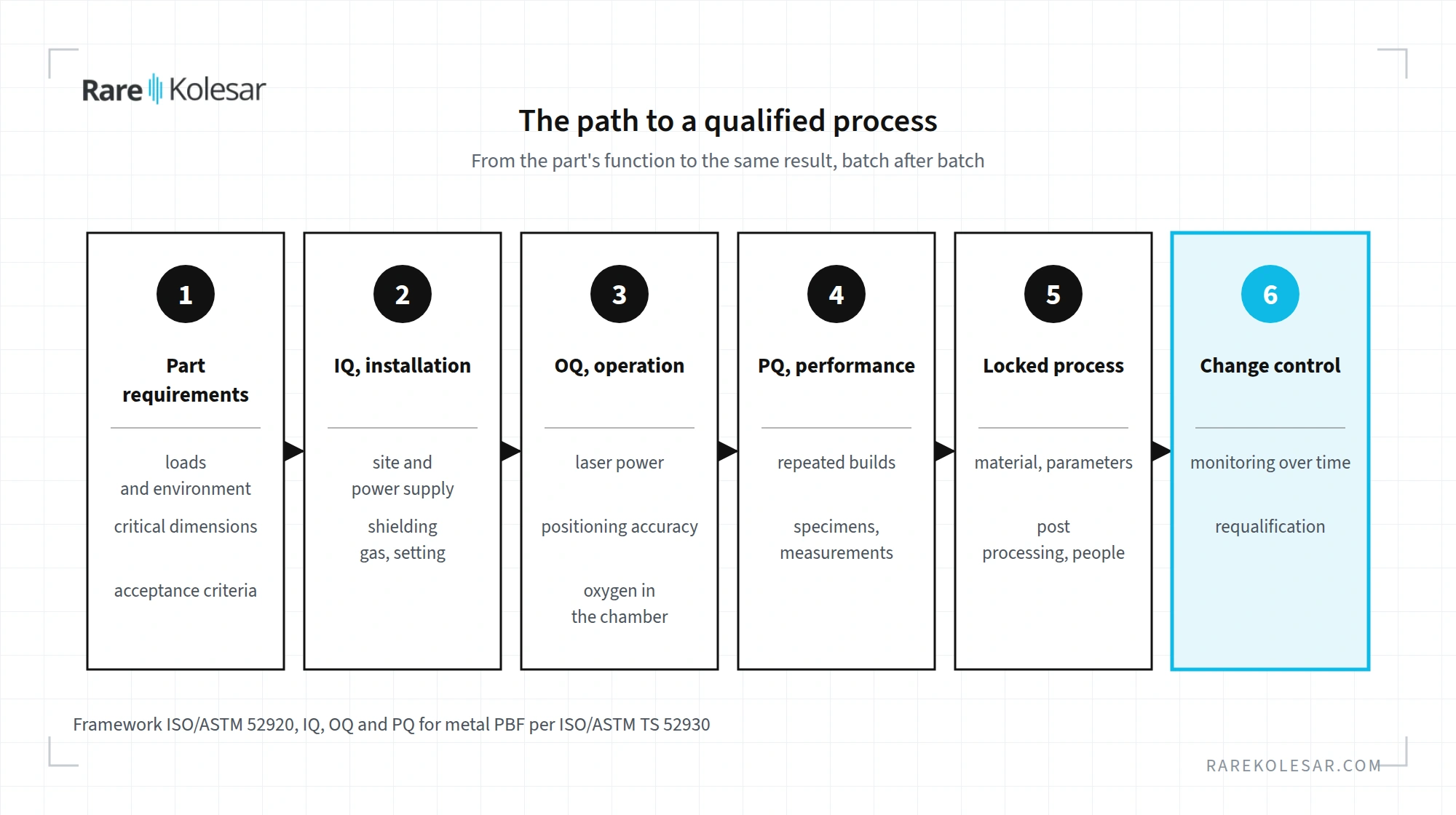
It starts with the function of the part, not with the machine. It covers four things, the machine, the material, the process and the people. The machine goes through three steps, installation qualification (IQ), operational qualification (OQ) and performance qualification (PQ). The end result is a locked, documented process that does not change without a reason and without a record.
Most companies do not get stuck because they cannot solve the problems. They get stuck because they do not see the problems until they start measuring.
What qualification actually proves
One good part proves nothing. The proof is when the same part, made on the same machine, from the same material, with the same parameters, always comes out within the limits you defined in advance. Process qualification is the path from "it worked" to "it always works, and we know why".
It is also the line between an experiment and production. A customer from the automotive, aerospace or medical industry is not buying a part. They are buying confidence that the next thousand parts will be the same as the first one.
It starts with function, not technology
Qualification starts with understanding the function of the part. Not the technology, not the machine brand, but the function. What loads the part carries, what environment it works in, which dimensions are critical and what the acceptance criteria are.
The first step is therefore always a list of non negotiable requirements. Without it, there is no yardstick against which the process could be qualified. This is usually where you see the difference between a company that is really adopting additive manufacturing and a company that wants to look like it is.
Four things that must be under control
Machine. The machine is qualified in three steps, known as IQ, OQ and PQ. For laser metal PBF (laser powder bed fusion), these steps are described in the technical specification ISO/ASTM TS 52930. The details are in the table below.
Material. A powder or filament specification that drives purchasing, rather than price. Inspection of every new batch, rules for storage, drying and powder reuse, and a record of which part was made from which batch. For metal powders, ISO/ASTM 52907 describes what gets checked, from particle size distribution and chemical composition to flowability, contamination and storage, for both new and used powder.
Process. A locked set of parameters, orientation, supports, build layout, and all post processing steps, heat treatment, support removal, machining and cleaning. Post processing is part of the process, not an add on. A change in the heat treatment cycle can change part properties as much as a change in print parameters. How much heat treatment affects the result for individual alloys is covered in Comparing alloys in metal additive manufacturing.
People. The operator who prepares the job, handles the powder and removes the parts is part of the process. A qualified process with an untrained operator is not a qualified process. Training and authorizations are documented just like machine parameters. For aerospace applications there is also a dedicated standard for qualifying operators of laser metal PBF machines, ISO/ASTM 52942.
An important note. ISO/ASTM TS 52930 deals with the machine itself and explicitly excludes feedstock qualification and post processing beyond powder removal. That is why a qualified machine is not yet a qualified process. Material, post processing and people are qualified separately.
IQ, OQ and PQ, the three steps of machine qualification
| Step | Question it answers | Example checks |
|---|---|---|
| IQ, installation qualification | Is the machine installed correctly? | site conditions, power supply, shielding gas, environment |
| OQ, operational qualification | Does the machine run within its declared limits? | laser power, positioning accuracy, oxygen level in the chamber |
| PQ, performance qualification | Does it produce parts that meet requirements in real production? | repeated builds, test specimens, measurement of dimensions and properties |
The order matters. OQ makes no sense before IQ, because a machine that is not installed correctly cannot reliably show its limits. PQ makes no sense before OQ, because you cannot tell whether a bad result comes from the machine or from the parameters.
Controlled tests reveal reality
Once the requirements are defined, controlled tests follow. Building test specimens and test parts, repeated builds, mechanical testing, measuring dimensions and density, and comparing results between batches, machines and positions in the build chamber.
This is where the unexpected shows up. Parameters give different results in different areas of the chamber. Properties depend on orientation. Powder from different batches behaves differently, because it was bought on price rather than to a specification. Moisture in filament or powder changes the result. Most companies stop here, not because they cannot solve the problems, but because they had not measured them until then.
The same applies to polymers. In SLS and MJF production, the refresh ratio of the powder, the part layout in the chamber and the cooling time affect dimensions and properties, and they must be part of the qualified process.
Documentation and change control
Industry does not trust anyone's memory, only a documented process. Once the process is defined and confirmed, it is locked. Every parameter, every software version and every post processing step is recorded. Why a locked profile is worth more than a good profile is explained in Why factory profiles are not enough for serious work.
After that, every change must be justified and assessed. Typical triggers for full or partial requalification are:
- machine replacement or major service, for example replacing the laser or optics,
- a new supplier or a new material specification,
- a change in parameters, build preparation software or support strategy,
- a change in heat treatment or other post processing,
- moving the machine to another location.
ISO/ASTM 52941, written for laser metal PBF machines in aerospace, provides acceptance tests not only for initial qualification but also for requalification, periodic inspection and verification after maintenance. It is the same principle, a machine after service is not automatically the same machine.
During production, the process is monitored. Results from control specimens and measurements are recorded and tracked over time, so a drift is visible before it becomes a bad part.
Process qualification is not part qualification
A qualified process is a prerequisite, but not a guarantee that every part is good. Every part has its own geometry, its own critical features and its own acceptance criteria.
Process qualification answers the question of whether the company can produce consistently. Part qualification answers the question of whether this specific part does its job. Criticality classes, part acceptance stages and witness specimens are covered separately in How a single part gets qualified for production.
Standards that describe process qualification
There is no single standard that covers everything. There is one general framework and several narrower standards for metal PBF.
| Standard | What it covers | Applies to |
|---|---|---|
| ISO/ASTM 52920:2023 | requirements for industrial AM processes and production sites | all AM technologies, independent of material |
| ISO/ASTM TS 52930:2021 | IQ, OQ and PQ of the machine | laser metal PBF |
| ISO/ASTM 52941:2020 | machine acceptance tests, including after maintenance | laser metal PBF, aerospace |
| ISO/ASTM 52942:2020 | machine operator qualification | laser metal PBF, aerospace |
| ISO/ASTM 52904:2024 | machine operation and production control for critical applications | metal PBF, laser and electron beam |
| ISO/ASTM 52907:2019 | characterization of new and used metal powders | metal powders |
ISO/ASTM 52920 is the starting point, because it applies to all technologies defined in ISO/ASTM 52900 and to any material. It does not replace a quality management system. It complements it with requirements specific to additive manufacturing.
Industry quality systems provide the wider framework, ISO 9001 as the base, AS9100 in aerospace, IATF 16949 in automotive and ISO 13485 for medical devices.
It starts with machine selection
Qualification only makes sense if the machine was chosen from the start for the real requirements of the part, not from a catalogue. A machine that cannot hold the required parameters consistently will not become consistent through documentation. That is why equipment selection should be independent of the seller, as explained in What vendor neutral means in machine selection.
Frequently asked questions
Is process qualification needed for prototypes too? No. For prototypes and visual models, a good, repeatable workflow is enough. Process qualification makes sense when a part goes into production, and especially when the customer or regulation requires it.
What is the difference between machine qualification and process qualification? Machine qualification, through IQ, OQ and PQ, proves that the machine is installed correctly and runs within its limits. Process qualification also covers the material, parameters, post processing and people. ISO/ASTM TS 52930 explicitly excludes feedstock and post processing, so a qualified machine is not the same as a qualified process.
How long does process qualification take? It depends on the part, the material and the industry. In my experience, for simple parts in unregulated applications it can take weeks. In aerospace and medical, count on months.
Can the machine manufacturer qualify the process for us? They can help with installation and operational qualification of the machine. Qualifying the process for your part, your material and your post processing remains your responsibility.
Does ISO/ASTM 52920 apply to polymers as well? Yes. ISO/ASTM 52920 is written for part manufacturers regardless of material and process, so it applies to SLS, MJF and other polymer technologies too. Narrower standards such as ISO/ASTM TS 52930 and ISO/ASTM 52904 apply only to metal PBF.
When does a process need to be requalified? After every significant change to the machine, material, parameters, software, post processing or location. The scope of requalification depends on how much the change can affect the part.
Does a qualified process mean every part is good? No. A qualified process reduces risk, but critical parts are still checked individually against their own acceptance criteria.
Sources
- ISO/ASTM 52920:2023, Additive manufacturing, Qualification principles, Requirements for industrial additive manufacturing processes and production sites, ISO, 2023
- ISO/ASTM TS 52930:2021, Additive manufacturing, Qualification principles, Installation, operation and performance (IQ/OQ/PQ) of PBF-LB equipment, ISO, 2021
- ISO/ASTM 52941:2020, Acceptance tests for laser metal powder bed fusion machines for metallic materials for aerospace application, ASTM International, 2020
- ISO/ASTM 52942:2020, Qualifying machine operators of laser metal powder bed fusion machines and equipment used in aerospace applications, ISO, 2020
- ISO/ASTM 52904:2024, Additive manufacturing of metals, Metal powder bed fusion process to meet critical applications, ISO, 2024
- ISO/ASTM 52907:2019, Additive manufacturing, Feedstock materials, Methods to characterize metal powders, ISO, 2019