Based on more than ten years of working with companies in the region, my estimate is that around 90 percent of companies make 3D-printing decisions the wrong way. Not because the technology is bad, but because the decision is made on the basis of impressions instead of numbers. There are three paths: stay with the existing process, use contract manufacturing, or bring the equipment in-house. Each is right for someone, and none is right for everyone. This article gives you a decision framework, real figures from the automotive industry, and a calculator at the bottom of the page where you can enter your own data.
Where does the 90 percent figure come from?
It is my estimate, not a statistic from a report, and it is important to say that upfront. But the estimate is not isolated. Through its Global Lighthouse Network, the World Economic Forum found that more than 70 percent of companies investing in advanced analytics, artificial intelligence, or 3D printing never move from the pilot phase into real production. McKinsey calls this "pilot purgatory", and its research says only around 30 percent of manufacturers successfully turn a pilot into something used every day.
In 2023, Materialise surveyed 327 large manufacturing companies in the United States, Germany, and Japan. The result: 98 percent faced barriers to adopting 3D printing, and only half had even reached the stage where they should be assessing project feasibility. Put simply, most companies buy equipment before calculating whether they need it.
The latest Wohlers Report 2026, the industry's most authoritative annual overview, describes a market that is "adjusting to tighter capital conditions, more selective investments, and higher expectations for utilization and return". In other words, the industry itself has stopped selling enthusiasm and started asking for a calculation.
Three mistakes I see repeatedly
First, equipment is bought because the technology is impressive. Someone sees a printer at a trade show, sees a part come out of it, and the decision is made before anyone asks how many parts the company actually makes per year.
Second, nobody calculates utilization, and this is where most of the mistakes happen. An industrial SLS printer costing about €160,000, paid off over five years, means the repayment alone is about €32,000 per year. Add maintenance, space, energy, and labor, and the machine's total annual cost rises to about €110,000. If the machine runs 2,000 hours per year, around 55 percent of working time, an hour of operation costs about €55. When it sits idle, that same hour costs up to €200. An idle machine is the most expensive machine you can own.
Third, nobody asks whether anything should be changed at all. For large runs of identical parts, conventional tooling is amortized down to pennies per part, and a 3D printer will never pay off there. An industry analyst put it most clearly: volume is additive manufacturing's enemy; complexity is its friend.
The three paths you can take
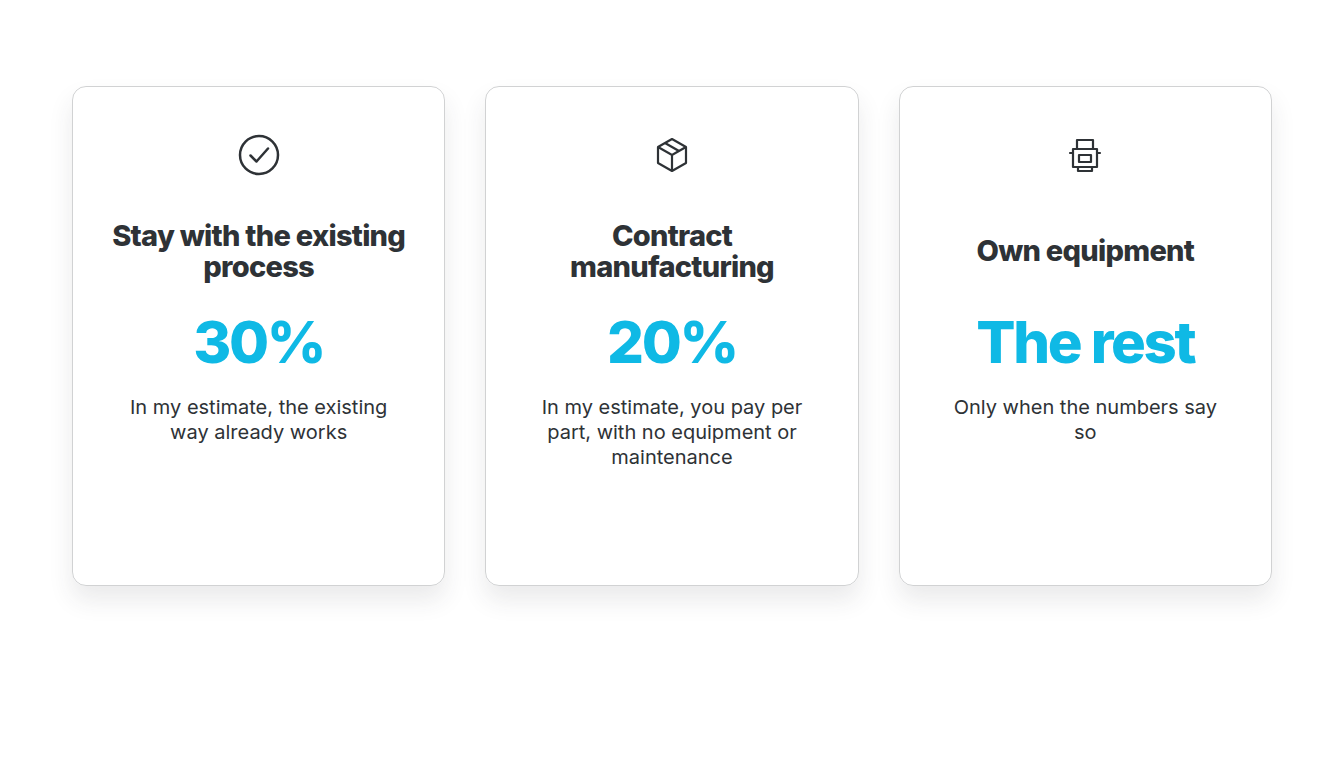
This is my working framework. These percentages are my estimate from practice, not figures from a report.
| Stay with the existing process | Contract manufacturing | In-house equipment | |
|---|---|---|---|
| Who it fits | In my estimate, about 30 percent of companies | In my estimate, about 20 percent of companies | The rest, but only when the numbers say it should |
| What it means | Change nothing; the analysis shows the current method already works | Pay per part or project; no equipment or maintenance | Buy and operate your own equipment |
| What you gain and lose | No investment, but no new gain either | Less control over deadlines, but no machine to manage | Most attractive on paper, most often chosen incorrectly in practice |
| What you decide on | Annual part volume, current production cost, bottlenecks | Contract price per part versus in-house cost, required lead time | A full ROI calculation, not excitement about the technology |
The industry data shows the direction of travel. In the Materialise survey, 71 percent of companies plan to expand their own capacity, while only 8 percent plan to use more contract manufacturing. According to Jabil's 2023 research, the share of companies using 3D printing for tooling, jigs, and production aids rose from 30 percent in 2017 to 58 percent. The market is moving toward in-house, but that does not mean in-house is the right choice for you.
When contract manufacturing wins
At its South Carolina plant, BMW uses a network of contract manufacturers for assembly jigs and production aids. Savings on those parts reached 25 percent, the rate of errors when using the tools fell from 10 to below 4 percent, and engineers got back up to 10 hours per week previously lost to procurement. They did not buy a single machine for this work. It was a deliberate decision by a major manufacturer not to go in-house for this category of parts.
Contract manufacturing usually wins when volumes are small or irregular, when capital is needed elsewhere, or when you need a process you could not realistically run yourself: metal, large formats, or specific materials.
When in-house equipment wins
In Portugal, Volkswagen Autoeuropa used seven desktop printers to bring 93 percent of the tools it had previously ordered from outside suppliers in-house. Tool-development cost fell 91 percent, development time fell 95 percent, and the initial investment paid back in two months. Savings were about €150,000 in the first year and €325,000 in the second. A wheel-protection template fell from €800 to €21. A window gauge fell from €180 to €35.
Pankl Racing Systems in Austria, a supplier to the automotive and motorcycle industries, introduced its own printing for jigs and production aids. Production time fell 90 percent, from two to three weeks to less than one day, cost fell by 80 to 90 percent, and savings were about €150,000, all in the first year.
In-house equipment wins when you have many different parts in small quantities, when you need fast iteration, and when the machine actually runs instead of sitting idle.
The example that best explains why
A global automotive-parts manufacturer introduced eight SLS Fuse 1+ systems to print tooling for its own production, with a total investment of about half a million euros. Its factories are in Serbia and several other countries, consuming 1,500 to 8,000 tools per month per location.
Before that, the tools were ordered through contract manufacturing at about €100 per part, with a two-month lead time and all the associated paperwork and technical documentation. Now the same tool costs about €20 and arrives within 24 hours at most, depending on size and quantity.
The price saving is significant, but the real change is that engineers can now iterate freely. Previously they had to get the solution right in advance, because a mistake meant another two-month procurement cycle. Now they make one, test it, make another if it does not work, and once they reach the final version they print a full run of around fifty pieces. Logistics are simpler, and engineers prefer working this way.
Pay attention to what decided the outcome. It was not the technology; it was the number of parts per month. With 1,500 to 8,000 tools per month per location, the machines run constantly and the calculation is clear. The same equipment in a company making 30 tools per month would be an expensive mistake.
Your calculation
You do not need a consultant to take the first step; you need five numbers.
Multiply the number of parts per month by the difference in price per part: contract-manufacturing price minus in-house price. That is your monthly saving. Divide the machine price by that saving to get the payback period in months. If the payback period is shorter than two to three years and the machine will actually run, in-house makes sense. If not, use contract manufacturing or change nothing.
The calculator below is pre-filled with realistic figures for a medium-sized manufacturer, with a payback period of about six months. Replace them with your own.
Frequently asked questions
Does 3D printing make sense for large production runs?
Rarely. For large runs of identical parts, conventional tooling is amortized down to a very low cost per part and 3D printing loses. Additive manufacturing wins when there are many different parts in small quantities, and for parts that need to be changed frequently.
How much machine utilization is needed for in-house to pay off?
As a rule of thumb, if the machine runs at least half of the working time, the calculation usually works. Below that, the cost per hour rises quickly and contract manufacturing becomes cheaper, even with its margin.
Can I start with contract manufacturing and then move to my own equipment?
Yes, and that is often the smartest path. Contract manufacturing gives you real data on how many parts you make per year and what they cost, which are exactly the numbers you need to decide whether to buy.
Which technology is best for tooling and production aids?
It depends on the part. For most assembly jigs and production aids in automotive manufacturing, polymer technologies such as SLS or FDM are sufficient and the least expensive. Metal makes sense only when the part is exposed to loads or temperatures that polymer cannot withstand.
What if I have already bought equipment that sits idle?
First measure how much it actually runs. Then look for parts in your own production that you currently order through contract manufacturing: tools, jigs, holders, and protective caps. An underused machine is most often rescued by shifting it from prototypes to tooling.
If you already know a mistake is possible and want a framework for making the right decision, read How to Choose Industrial 3D Printing Technology.
Consulting for industrial additive manufacturing adoption →
Sources
- Wohlers Report 2026, Wohlers Associates, ASTM International, 2026.
- Materialise, survey on additive manufacturing adoption, 327 companies, 2023.
- Jabil, Global Survey on 3D Printing Technology Trends, 2023.
- McKinsey, Digital manufacturing, escaping pilot purgatory, 2018.
- World Economic Forum, Global Lighthouse Network.
- Ultimaker, Volkswagen Autoeuropa case study, 2017.
- Formlabs, Pankl Racing Systems case study.
- Xometry, BMW Group, Spartanburg case study.
- The example with eight SLS systems has been anonymized and is based on a real case from the region.