Implementation and qualification of additive manufacturing processes
Summary
A purchased machine is not the same as a process that works. I introduce additive manufacturing into a company so that it runs predictably: with material standards, validated profiles, quality control and documentation that people actually use.
In my experience, implementation takes about six months. The goal is a process that keeps working after I leave, with one person in the company who runs it.
Why a process does not work on its own
The most common problem is not the machine. The problem is that everyone works in their own way, material is stored however someone gets to it, manufacturer profiles are used without checking, and results cannot be compared. The consequences are failed prints, delays and parts that nobody trusts.
Why manufacturer profiles are not enough, I explained in the article why factory profiles are not enough for serious work. Without one person who runs the process, even the best equipment does not work, and you can read more in the article the human factor in additive manufacturing.
What I introduce
| Element | What the company gets |
|---|---|
| Material standards | the same material is always used in the same way |
| Moisture and storage control | material does not lose its properties before printing |
| Profile validation | verified parameters for each technology and material |
| Quality control | clear criteria for when a part is good and when it is not |
| Process and part qualification | proof that the process gives the same result every time |
| Documentation | procedures that engineers and operators work by |
How implementation works
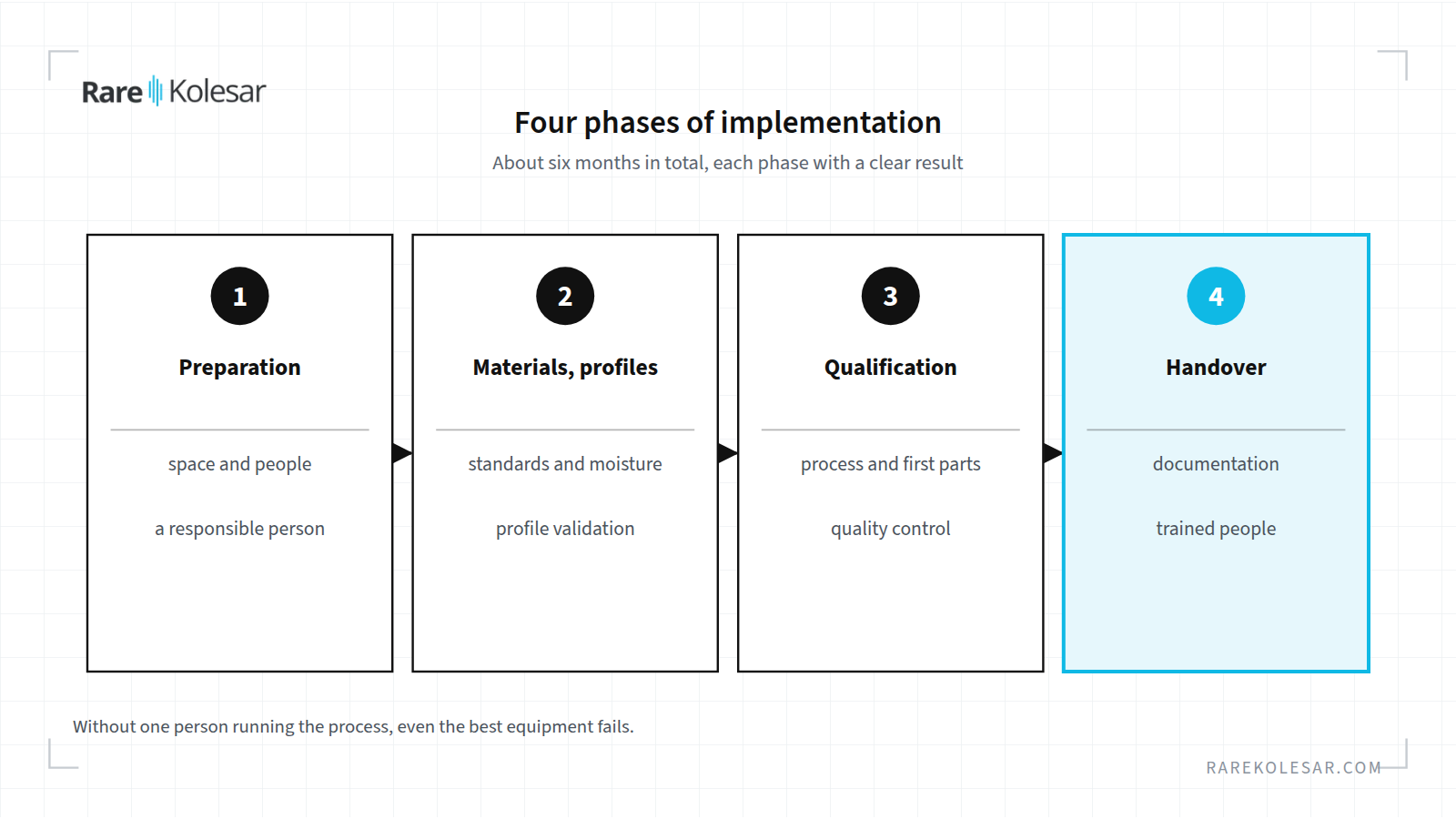
I work in phases, and each phase has a clear result. First the space, the people and the responsible person are set up. Then material standards are introduced and profiles are validated. After that, the process and the first parts are qualified. In the end, the company receives documentation and trained people, and I step back. Pricing is a fixed price per phase.
How qualification looks in practice, I described in the articles process qualification in practice and how a single part gets qualified for production. The international framework for this is the ISO/ASTM 52920 standard, which sets requirements for the qualification of industrial processes and production sites.
Example from practice
At the Faculty of Technical Sciences in Novi Sad, different laboratories worked with different methods, and the results were not consistent. We introduced standards for all materials, moisture control, profile validation for FFF, SLA and SLS, uniform quality control and documentation for students, assistants and researchers. The laboratories now work predictably. The full example is in the case studies.
Frequently asked questions
How long does implementation take?
In my experience about six months, from preparation to handover of documentation. It depends on the number of technologies and materials.
Do you also work with equipment that you did not choose?
Yes. I introduce the process on the equipment the company already has, regardless of the manufacturer.
What is process qualification?
Proof that the process gives the same result every time, within set limits. Without it, a 3D printed part cannot be trusted in production.
Who runs the process after implementation?
One person in your company, whom I train during implementation. Without that person, even the best equipment does not work.
Do you introduce multiple technologies at once?
It is possible. At the Faculty of Technical Sciences in Novi Sad we introduced validated profiles for FFF, SLA and SLS in the same project.
How is it priced?
As a fixed price per phase. Each phase has a clear result and is paid when it is completed.
Sources
Have equipment, but the process does not work as it should?
Describe the situation through the production analysis. For training your people, see training, and for the other services see the consulting page.