Summary
Additive manufacturing (AM) today does not primarily have a technology problem. Machines, materials and processes work reliably when they are properly controlled. Projects usually stall because of people, since staff see AM as a set of separate disciplines rather than as one system.
In practice I see the same three failure patterns. The design engineer draws a part with the logic of conventional machining. The materials specialist ignores how layer by layer building affects part properties. Management decides without anyone who can check what the supplier is actually promising.
The fix is not a new machine or another conference. The fix is a knowledge owner, a person or small team inside the company who runs the process from design to regulation and is accountable for it.
Machines work, people do not see the whole
In recent years the additive manufacturing industry has resolved most of the technical uncertainties that once held it back. Machines are more reliable, materials are more consistent, and processes deliver repeatable results when they are properly controlled. Yet production still stalls in the same places, and not because of the equipment.
It stalls because staff do not understand additive manufacturing as a system.
Traditional technical and engineering education produces good specialists in individual disciplines. One person is good at design, another at materials, another at quality. With conventional technologies this mostly works, because the boundaries between stages are clear and well understood.
Additive manufacturing is seven things at once:
- part design,
- material,
- the build process,
- post processing, meaning everything done to the part after the build (support removal, heat treatment, machining),
- measurement,
- quality,
- regulation.
Whoever understands only one part of that whole makes mistakes in the others. In AM an error rarely stays local. A design decision changes how the material behaves, and the material behavior changes what quality control has to verify.
This gap is not just my impression. The European SAM project (Sector Skills Strategy in Additive Manufacturing), funded through Erasmus+ from 2019 to 2023, named as one of the sector's main problems exactly this: existing design and engineering courses do not contain enough additive manufacturing knowledge, and the sector develops faster than education systems can adapt.
Three failure patterns I see everywhere
These patterns repeat regardless of whether it is a small team or a large industrial organization.
The engineer designs a part that does not use AM. The geometry is carried over directly from the logic of conventional machining. The advantages of layer by layer building, such as topology optimization or part consolidation, meaning merging several parts into one, are not used. The result is a part that can technically be built but does not justify the choice of technology.
The materials specialist does not see the effect of layer building. A part built in layers does not have the same properties in every direction. This is called anisotropy. The part's orientation in the machine and the thermal history of the process directly change strength and elongation. A 2025 review of research on 316L steel made by laser powder bed fusion (PBF-LB) shows that horizontally built specimens usually have higher strength and vertically built ones higher elongation. This link is often ignored until it shows up as a problem in quality control or, worse, at the customer.
Management decides without verification. Management buys the technology, or rejects it, without the knowledge to check what suppliers actually promise. A specification on paper and the real behavior of the process in production are not the same. Without internal competence that knows how to ask the right question, the decision is based on marketing, not on data.
| Role | Typical mistake | Consequence |
|---|---|---|
| Design engineer | Geometry carried over from machining | Part gets built but does not justify AM |
| Materials specialist | Anisotropy and orientation ignored | Problem found in inspection or at the customer |
| Management | Supplier specification not verified | Decision based on marketing, not data |
None of these three patterns is caused by poor equipment. All three come from the fact that no single discipline, on its own, covers what AM requires.
A case from practice, when nobody owns the process
One of the most expensive examples I have seen was in metal additive manufacturing. The company had a laser wire metal deposition system mounted on a CNC platform. The technology was good. The integration was sound.
The problem was that there was no single accountable person. People kept changing, and knowledge was lost with every departure. The result was poor regardless of the quality of the equipment.
From projects like this I took a simple rule. If there is no one person who runs the process, the project will not work. A serious implementation takes about six months and includes part analysis, technology selection, prototyping, validation, process building, training and standardization. Six months is too long to rely on the goodwill of people doing this on top of their regular jobs. I described the full case and the order of steps in How to choose a technology for industrial 3D printing.
Why enthusiasm and conferences are no longer enough
For years the industry relied on enthusiasm, conferences and trial and error as the main way of passing on knowledge. That was enough while AM was mostly a prototyping tool. Back then the consequence of a mistake was one failed part.
That phase is behind us. When additive manufacturing becomes part of series or qualified production, the cost of not knowing rises. A mistake no longer stops at one part. It spreads through the batch, through quality and through customer complaints.
How often companies enter this phase unprepared, and what happens when they buy a machine before defining the problem, I described in Why 90 percent of companies introduce 3D printing the wrong way.
What system knowledge means in practice
System knowledge is not an abstract requirement. It shows in concrete steps that can be checked.
The first step is documentation. The process must be written down so that someone else can repeat it, not only the person who first set it up.
The second step is discipline. The organization has to carry process qualification through to the end, instead of skipping the slow and demanding part because the prototype turned out well. It is exactly this attitude of people toward procedures, and not only knowledge of the technology, that decides whether AM use will be serious and repeatable. I wrote about this in Process qualification in practice.
The third step is formal competence of people. For metal AM there is now the ISO/ASTM 52926 series from 2023. It defines operator qualification, in general (Part 1) and per process, for example for laser powder bed fusion, PBF-LB (Part 2). It is a useful framework, but you should know its limit. The standard qualifies the machine operator, not the person who connects design, material, quality and regulation. That role still has to be defined inside the company.
Who should own the knowledge
In our region this problem has one more dimension. Initiatives by individuals in smaller companies often end up without support, because they depend on one person's enthusiasm rather than on a system. In large organizations the situation is different, but not necessarily better. There you need a clear management decision, a budget and institutional capacity, not just the goodwill of engineers on the shop floor. I wrote about how this looks in practice in The real state of additive manufacturing in the region, an inside view.
The conclusion is simple, but rarely put into practice. Additive manufacturing needs a knowledge owner inside the organization. That is a person or small team who understands design, materials, process, quality and regulation as one whole. It is not five separate responsibilities spread across five people who rarely talk to each other.
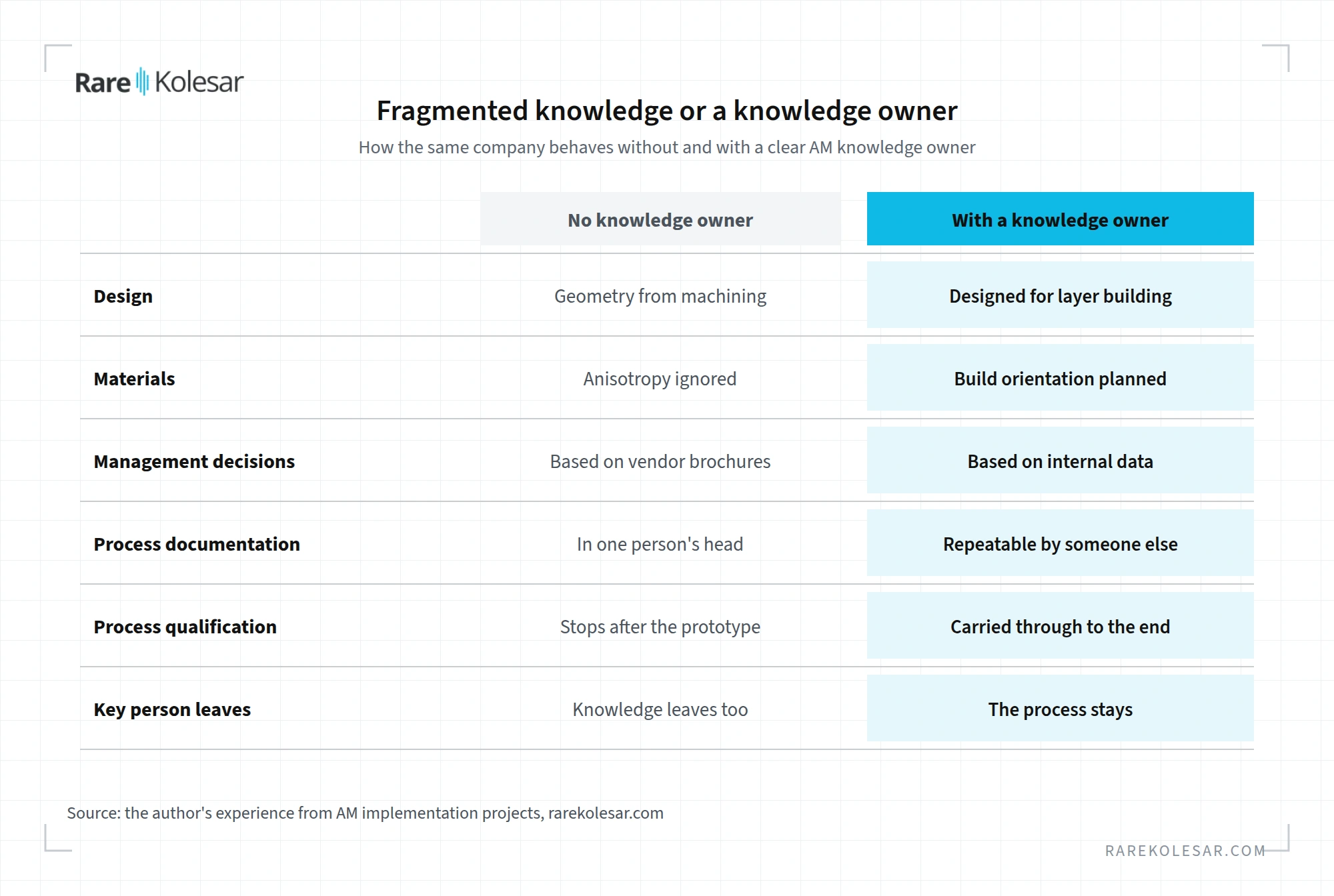
The knowledge owner does not have to do everything alone. Their job is to know how a decision in one stage affects the others, to keep the process documentation and to have the authority to stop a decision that has no data behind it. Without that ownership, every new machine just repeats the same problem in new packaging.
Frequently asked questions
Is the human factor a bigger problem than technology in additive manufacturing? In most cases I see, yes. Machines and materials today work reliably when properly controlled. Mistakes most often come from the fact that nobody in the organization has a view of AM as a whole, from design to regulation.
Why is traditional engineering education not enough for additive manufacturing? Because it is organized around individual disciplines such as design, materials or quality. AM requires those disciplines to be understood together, as one connected process in which a mistake in one stage affects all the others. The European SAM project pointed to the same gap between education and industry needs.
How does a company know whether it has this problem? The most common signal is that AM decisions are made on the basis of supplier specifications or one person's enthusiasm. A second signal is that only one person knows the process and nobody can repeat it when they are absent. A third is that process qualification stops after a successful prototype.
What exactly does an additive manufacturing knowledge owner do? The knowledge owner connects design, material, process, quality and regulation into one flow. They keep the process documentation, carry qualification through to the end and have the right to stop a decision that is not based on data. They do not have to do everything alone, but they must understand how decisions carry over from one stage to the next.
Is it enough to certify machine operators? No. The ISO/ASTM 52926 series from 2023 defines operator qualification for metal AM and it is useful. It covers work on the machine, but not the role of the person who connects design, materials, quality and regulation. The company has to define that role itself.
How long does a serious introduction of additive manufacturing into a company take? In my experience about six months. That period covers part analysis, technology selection, prototyping, validation, process building, training and standardization. That is why one person should run the whole process from day one.
What happens when the person who knows the process leaves the company? If the process is not documented, the knowledge leaves with them and the company practically starts over. I saw this with a laser wire metal deposition system on a CNC platform, where the equipment was good but people kept changing and knowledge was lost.
Sources
- ISO/ASTM 52926-1:2023, Additive manufacturing of metals, Qualification principles, Part 1: General qualification of operators, ISO, 2023
- ISO/ASTM 52926-2:2023, Part 2: Qualification of operators for PBF-LB, ISO, 2023
- Sector skills strategy in additive manufacturing (SAM), Cedefop, 2023
- SAM launches European Skills Strategy Roadmap to tackle 3D printing skill gaps, 3D Printing Industry, 2021
- Review of tensile anisotropy in laser powder bed fusion 316L stainless steel, Journal of Materials Research and Technology, 2025