Why industrial know-how must enter education
Summary
Industry holds an enormous amount of knowledge, yet very little of it ever reaches professors and students. My idea is to transfer industrial know-how to educational institutions in a way that is not superficial, but substantial and long term.
Instead of seminars, presentations and equipment promotions, I propose a steady flow of real production cases. A company provides a problem with its numbers and mistakes, the case is adapted for teaching, and a professor brings it into the course and uses it for years.
The biggest obstacle is not knowledge, it is that there is no clear investor. So besides the idea itself, I describe here how it works step by step, what already exists in the world, what is needed to start and where I see the risks.
Introduction
Over years of working with different companies, industries, universities and technical schools, I keep seeing the same thing. An enormous amount of knowledge exists in industry, but very little of it ever reaches the people who should receive it most. Professors and students.
What is completely clear to me today is that education and industry speak two different languages, and that both sides are convinced they are right. Yet in fact nobody is wrong on purpose. The problem is that the system works in such a way that the most valuable knowledge stays locked where it was created, instead of becoming part of a wider educational ecosystem.
And that is where the idea lies that I still consider one of the most important in my work, transferring industrial know-how to educational institutions in a way that is not superficial, but substantial and long term.
Where the gap between industry and education is largest
Industry sees reality, deadlines, breakdowns, logistics, mistakes that cost money, iterations that happen within a day, not within a semester. Education sees theory, properly written definitions, generic examples, standardized courses.
Both have their place. But the problem arises when there is no flow of knowledge between these two worlds, only occasional encounters.
Industry knows:
- how problems are solved under pressure
- why a process makes sense in theory, but never succeeds in practice
- what production optimization means outside the classroom
- which materials work well, and which work only on paper
- what responsibility looks like when a mistake has a price
- which real skills young engineers must have on their first day at work
Education rarely has access to that experience. It is nobody's fault. Just the structure of the system.
In additive manufacturing, my field, this gap is especially visible. AM is design, materials, process, post processing, measurement, quality and regulation all at once. I wrote about this in the post on the human factor in additive manufacturing.
Who has this problem
This is not only a school problem. All three sides have it.
- Companies. They hire engineers and spend months teaching them the basics of production practice. With new technologies such as additive manufacturing, there is often nobody in the company who can check what a supplier promises.
- Professors. They have motivation and knowledge, but no access to real cases, numbers and mistakes from production. Without that, teaching stays at generic examples.
- Students. They finish their education with good theory, but without a feel for deadlines, costs and the consequences of decisions.
The problem is not only local. In 2024 Deloitte and The Manufacturing Institute estimated that US manufacturing could need up to 3.8 million new workers by 2033, and that 1.9 million of those jobs could remain unfilled. As many as 65 percent of surveyed companies named attracting and retaining talent as their primary business challenge. If the gap exists where cooperation between industry and education is well developed, here it is even wider.
Why previous attempts at knowledge transfer do not work
Almost all attempts in the region look alike, one day seminars, presentations, equipment promotions, open day events. It all looks nice in photos, but in essence, it is just marketing dressed up as education.
Nobody transfers real engineering experience. Nobody talks about mistakes, iterations, failed production, real problems. Nobody offers professors materials they can build into a course, repeat year after year and improve. Nobody builds a structured system that survives when people leave.
And that is why it always ends the same way. The event passes, a photo gets posted, nothing changes.
I see something similar with equipment. Some faculties have additive manufacturing machines that are not being used, which is no longer a story about a lack of funds, but about unused potential. More on that in the post on the real state of additive manufacturing in the region.
What this idea tries to do differently
My intention is completely different. This is not an idea about a seminar, a workshop or an equipment donation. It is an idea about a long term bridge between industry and education.
That means:
1. Substantial industrial examples, not marketing
The professor does not receive a lecture, but a real production case that can be turned into an exercise, an exam or a course.
2. Materials teachers can use for years
Not an event, but an archive of knowledge, case studies, protocols, models, analyses, process flows, notes from practice.
3. Know-how transferred in a form that fits the educational system
The professor does not need to become an industry engineer. The professor needs to know how industry thinks.
4. Focus on experience, not technology
Technologies change. The way of thinking remains.
5. A model in which professors become carriers of change
If change does not come from within, there is no long term effect.
How the idea works step by step
The bridge is built through a clear, repeatable flow. Every case goes through the same five steps.
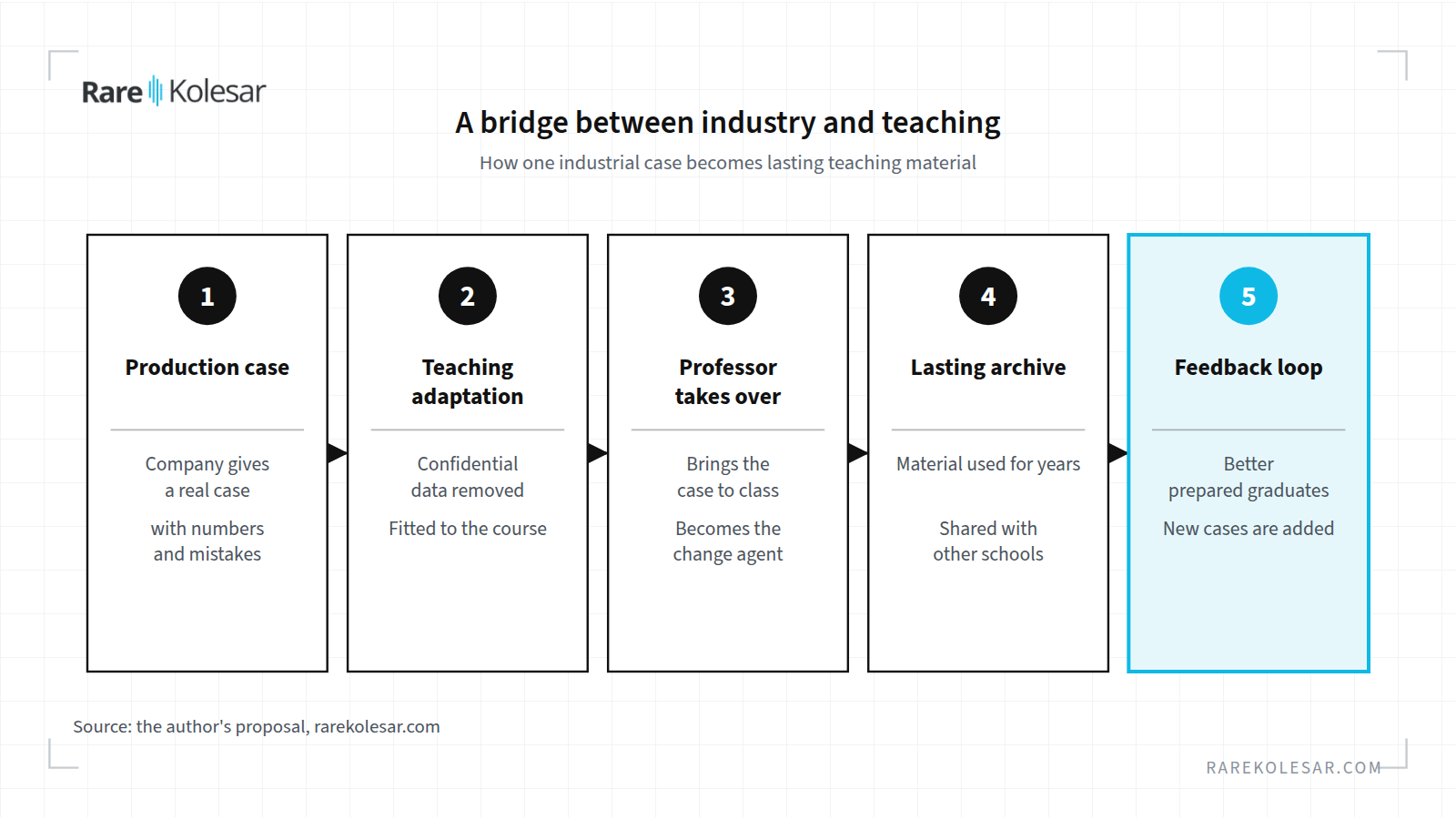
- Production case. A company provides a real problem it has solved or is still solving, with numbers, the options considered and the mistakes made.
- Teaching adaptation. Confidential data is removed or changed, and the case is written so a professor can fit it into a specific course. Nobody does this part of the work systematically today.
- The professor takes over. The professor brings the case into teaching as an exercise, an exam task, a project or a thesis topic, and gets a contact in the company for questions.
- Lasting archive. The case stays in a shared archive, tagged by field, level and duration, so other schools can use it too.
- Feedback loop. The company gets better prepared candidates and feedback from students, and the archive grows with new cases.
What already exists in the world
The idea is not entirely new, but in our region it does not exist in a systematic form. There are models to learn from.
| Model | How it works | Real industrial problem | Duration |
|---|---|---|---|
| One day seminar | Lecture or promotion | Rarely | One day |
| Learning Factory | Simplified replica of production in a lab | No, a didactic scenario | Ongoing, within the lab |
| Teaching Factory | Link between factory and classroom, knowledge flows both ways | Yes | Regular sessions during a course |
| Dual study model in Serbia | 450 hours of classes and 450 hours of learning at an employer | Yes, for the student | During studies |
| My proposal | Archive of real cases for professors | Yes, adapted for teaching | Years, through the archive |
Teaching Factory. EIT Manufacturing describes the Teaching Factory as a two way exchange, practitioners bring experience from the factory to students, while students and faculty bring knowledge from the classroom to practitioners. The TF KnowNet network began scaling this model in 2020. It is the model closest to my idea.
Learning Factory. The same source clearly distinguishes the Learning Factory, where students work on simplified replicas of production in a lab, not on real challenges. It is useful for skills, but it does not transfer real industrial decisions.
SAM, Sector Skills Strategy in Additive Manufacturing. A European project led by the European Welding Federation (EWF), with 16 partners and 32 associated partners, ran from January 2019 to June 2023. It developed 12 competence units for additive manufacturing, an international AM qualification system and a skills observatory. In the pilot trainings of 2020 and 2021, most participants were experienced professionals from aerospace, defense and automotive.
America Makes and NOCTI. In the US, the Essentials of Additive Manufacturing credential for high school students was developed in 2021, funded by NIST. Its starting point was standards defined by industry.
Dual study model in Serbia. The Law on the Dual Model of Studies in Higher Education was adopted in 2019. It provides for 450 hours of classes and 450 hours of learning at an employer, with student pay of at least 50 percent of the base salary for similar work. It is a good framework for students, but it does not solve the problem of professors and teaching materials.
The biggest obstacle, no clear investor
Honestly, this is the hardest part. Nobody has a natural reason to pay:
- companies see no direct commercial benefit
- schools have no budgets
- the grant system is slow and unpredictable
- professors want the knowledge, but have no formal mechanisms to invite it in
And so it all comes down to the enthusiasm of a few individuals. Which is not sustainable.
One way to start is through European programmes. Erasmus+ funds small scale partnerships (KA210) with a lump sum of 30,000 or 60,000 euros, lasting 6 to 24 months, with at least two organizations from two different countries. Serbia is a third country associated to the programme and can take part in all its actions.
Along these lines, together with the Automotive and Mobility Cluster of Serbia, I am considering a project idea under the working name AM Skills Bridge, to transfer practical additive manufacturing knowledge to engineers working in the automotive supply chain. For now the project is only a plan. No application has been submitted and the project is neither approved nor funded. I mention it as an example of how the idea could get its first framework.
What is needed to start
A pilot does not need a new laboratory. It needs people and an agreement.
| What | Who or what exactly | Role |
|---|---|---|
| Companies providing cases | Two or three manufacturers willing to share a real problem | Source of knowledge |
| Professors | Two or three professors from technical faculties or vocational schools | Bring the case into teaching |
| Case editor | A person who understands both production and teaching | Adapts the case for teaching |
| Framework partner | A cluster, chamber or association | Brings companies together and gives legitimacy |
| Archive | A simple online database with access for teachers | Keeps the material permanently |
| Pilot funding | A grant, cluster membership fees or company sponsorship | Covers case adaptation |
My role in this model
Here I no longer see myself as an operator who tours institutions and runs workshops. That is exhausting and it does not scale.
My role is different:
- to define the structure of knowledge
- to determine what industry really knows and education does not
- to create a framework that others can carry out
- to help professors build courses that have real value
- to connect industry and education at a level that lasts, not at the level of events
I do not want the trenches. I want strategy.
Risks and open questions
- Confidentiality. Companies are afraid to reveal mistakes and numbers. The answer is anonymization and a clear agreement on what may be published, but that requires trust.
- Sustainability after the pilot. A grant can launch the archive, but not maintain it. Who pays the case editor after the first year is still an open question.
- Acceptance in teaching. Accredited programmes change slowly. A case has to fit into an existing course, not require a new one.
- Case quality. A poorly adapted case is just another presentation. A standard for how cases are written is needed.
- Vendor neutrality. A case must not become an advertisement for a machine or a material. The focus has to stay on the decision and the reasons, not on the brand.
Why I still believe this idea makes sense
Because in every country that moves forward there is the same thing. Industry and education work together. Not through ceremonies, but through the transfer of experience that otherwise nobody would pass on.
If this is done right, the result is not one course. The result is a generation that thinks like industry. From day one.
Let's talk about applying it
Are you interested in this idea or would you like to talk about applying it?
If you run a company, teach at a university or a vocational school, or work in a cluster or chamber, contact me. We can talk about how the first cases can enter the classroom. You can read more about how I work on the consulting page, and a similar logic of knowledge transfer stands behind the idea of a center for reverse engineering and additive manufacturing.
Frequently asked questions
How is this idea different from the seminars companies already hold at universities? A seminar lasts one day and usually presents a product. My proposal is a permanent archive of real production cases, adapted for teaching, that a professor uses for years as part of the course.
Why is the professor at the center of the idea, and not the student? Students graduate and leave, while professors stay in the system. When a professor changes the way they teach, the change passes to every next generation without additional investment.
What does a company gain by sharing its case? It gets better prepared candidates, contact with professors and students who already know its typical problems, and less time spent onboarding new engineers. Confidential data is removed before a case enters teaching.
Is the idea tied only to additive manufacturing? No. The examples come from additive manufacturing because that is my field, but the same model works for machining, quality, logistics or any field where there is a gap between theory and practice.
Is there funding for a project like this? There is no permanent mechanism. To start, European programmes can be used, for example Erasmus+ small scale partnerships with a lump sum of 30,000 or 60,000 euros, but in the long run a model in which companies or clusters take part is needed.
Has the AM Skills Bridge project been approved? No. It is a project idea I am considering with the Automotive and Mobility Cluster of Serbia. No application has been submitted, and the project is neither approved nor funded.
Sources
- Teaching Factory, EIT Manufacturing
- Learning Factory, EIT Manufacturing
- Sector Skills Strategy in Additive Manufacturing (SAM), Cedefop
- Sector Skills Strategy in Additive Manufacturing, Brunel University London
- Skills for Additive Manufacturing, EWF reveals first results of SAM pilots, 3D ADEPT Media, 2021
- Additive Manufacturing Credential with America Makes, NOCTI, 2021
- US Manufacturing Could Need as Many as 3.8 Million New Employees by 2033, Deloitte and The Manufacturing Institute, 2024
- Law on the Dual Model of Studies in Higher Education, Paragraf, 2019
- Small-Scale Partnerships 2026, CMEPIUS, 2026
- Erasmus+ Programme Guide, eligible countries, European Commission