Reverse Engineering and Additive Manufacturing Center, Serbia
Summary
The idea is simple. A center in Serbia that delivers precise SLA and SLM parts to European customers faster, at lower cost and with more flexibility than is possible inside the EU itself. The advantage comes from combining three things: a European way of working, Serbian flexibility and easier access to Chinese equipment and materials.
The center does more than print. It takes in a part without a drawing, scans it, builds a usable CAD model, decides how the part should be made, inspects it after production and keeps its digital record for the next order. Deliveries to the EU go through a consolidation point near the border, in regular runs.
This is a concept I developed over years of work with industrial clients. I am not launching it on my own. I am looking for a company or an investor who wants to build it, and I can contribute the structure, technology selection and team building.
The problem the center solves
European industry runs a lot of equipment that has been in service for years and no longer has usable documentation. The machine builder has ended support, the drawing is lost or no longer matches the real part, yet the machine still runs and nobody plans to replace it. When such a part fails, the customer has nowhere to order it from.
Another common case is a part that fails too often. Here the customer does not want a copy but a better solution, through a different shape, a different design approach or a better material.
The third case is small batches and urgent parts. For automotive, research institutes and maintenance, lead time often matters more than price. In my experience, lead times for metal parts at European service providers are often measured in weeks, not days.
All three situations share the same entry point, which is reverse engineering. I wrote in detail about the method itself, scanning methods and the EU legal framework in the post reverse engineering and 3D scanning as an entry point to additive manufacturing, so I will not repeat it here.
Why Serbia
Serbia has several conditions that matter for a center like this.
- Same time zone as most of the EU, so calls, agreements and deadlines happen within the same working day.
- Understanding of how European customers work. A large part of our industry has supplied European companies for years.
- Lower labour costs. The average net wage in Serbia in December 2025 was about 1,060 euros, 434 euros less than in neighbouring Croatia. The average hourly labour cost in the EU in 2025 was 34.9 euros, and even the lowest cost members, Bulgaria, Romania and Hungary, were between 12 and 15 euros.
- A new wave of young engineers. In my work with universities I see more and more young people who know CAD, scanning and additive manufacturing.
- Easier access to Chinese equipment and materials. The free trade agreement between Serbia and China has applied since July 2024, and cooperation with Chinese specialists involves less administration than in the EU.
- Geography. From Belgrade, a truck reaches the borders of Croatia, Hungary, Romania and Bulgaria within one day.
Energy prices call for caution. The average electricity price for non-household consumers in the EU in the second half of 2025 was about 18 cents per kWh, excluding VAT. Whether and by how much it is cheaper in Serbia depends on the specific contract and location, and that is an item to verify in the feasibility study.
| Factor | Center in Serbia | Service provider in the EU |
|---|---|---|
| Labour cost | considerably lower | higher, especially in Western Europe |
| Time zone | same | same |
| Access to Chinese equipment | free trade agreement since 2024 | standard import procedure |
| Customs toward EU customer | required, handled by consolidated shipping | not required |
| Customer trust | must be built | already exists |
What this center does differently
1. Industrial parts, not a hobby service. The focus is on parts for automotive, scientific equipment, tooling, metal parts, replacement components and assemblies.
2. SLA as the core platform. SLA delivers precise, stable and predictable resin parts with fine detail and good surface quality. The goal is for standard SLA parts to be ready within 48 to 72 hours.
3. SLM for metal. Metal parts are where customers wait the longest and pay the most. At the same time, metal is the most demanding area for contract manufacturing, because every new shape needs new preparation and verification. That is why the center builds a library of proven parts and parameters from day one, so every repeat order runs faster and more reliably than the first. Before sending a part to SLM, it is useful to check its geometry with the SLM DFAM Checker.
4. Reverse engineering included. Scanning, modelling, corrections, optimisation, production, finishing and inspection under one roof. The customer has one contact from the old part to the new one.
5. Inspection and testing as part of the service. Every part is checked after production by 3D scanning and comparison with the CAD model. Industrial CT is used for parts with internal channels. Destructive testing is done when the client or the engineer decides a part can no longer be used, so as much data as possible is taken from it. I wrote more about how a part is verified before use in how a single part gets qualified for production.
6. Direct link to Chinese manufacturers. Professional equipment and materials at prices that are hard to reach for European service providers, with the rule that every machine and every material first passes our own verification.
7. A digital system with tracking and a parts library. Through a portal, the client sees a part preview, tracks its status through every stage, from planning, preparation, printing and finishing to inspection and packing, and reorders. Production uses the same system. For larger clients, the system exchanges data with their ERP or MES through an API, without interfering with their systems. Every scanned part becomes a digital record, so the next order does not start from zero. Many smaller European service providers have no such tracking, or only a superficial one.
How the center works, step by step
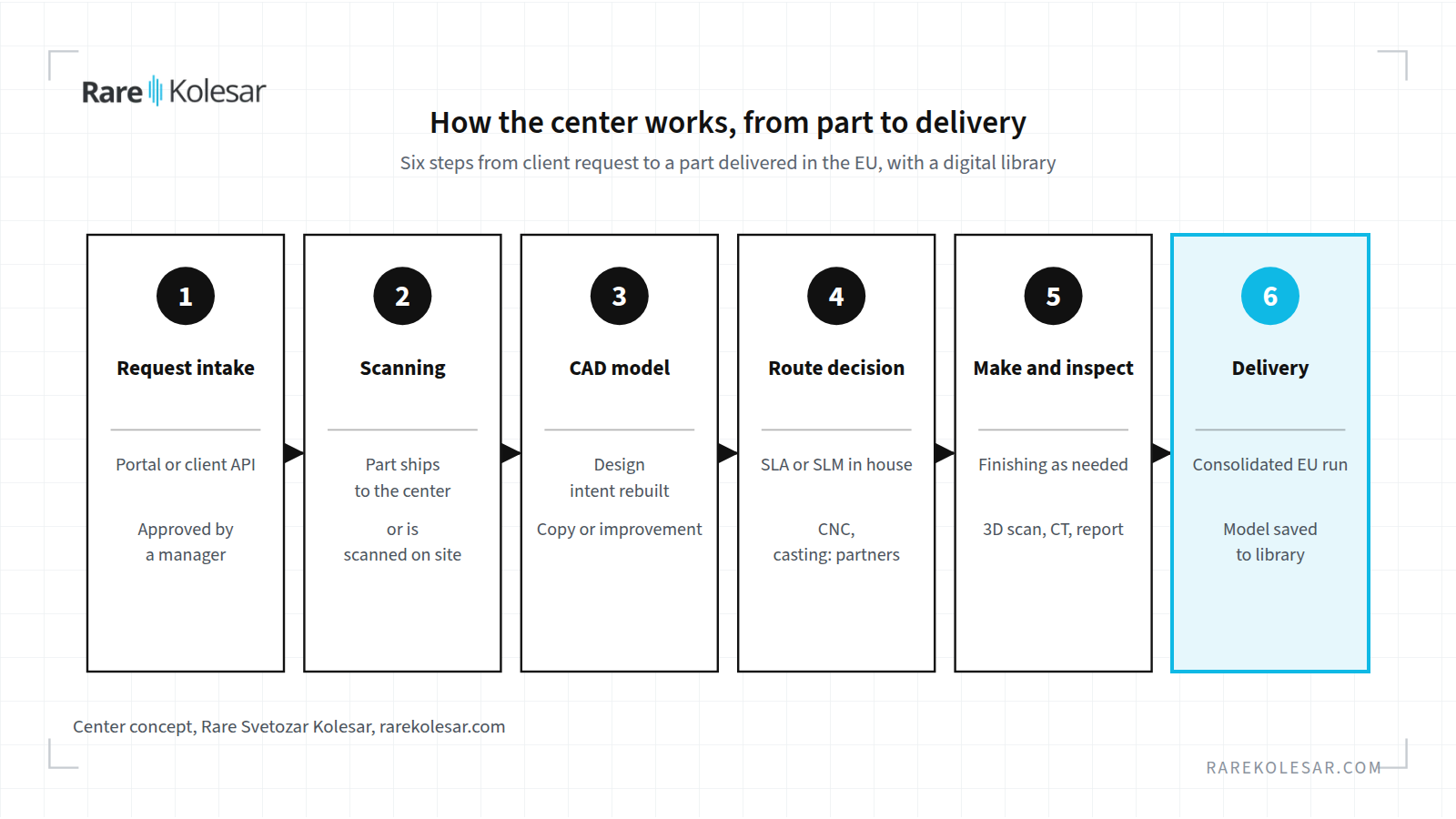
- Request intake. The order arrives through the portal or from the client's ERP system. For larger clients, an authorised person creates the order and a manager approves it.
- Scanning. The part physically ships to the center, or it is scanned on site when it cannot be removed from the machine.
- CAD model. The designer's intent is rebuilt from the scan, not just the surface. This is where the decision is made whether to copy the part faithfully or improve it.
- Route decision. An engineer, supported by the system, decides how the part will be made. SLA and SLM are done in house. If CNC machining or casting is the better answer, the part goes to a partner in the network. The center has only additive capacity and does not try to do everything.
- Production, finishing and inspection. Printing, heat treatment where needed, support removal, finishing of surfaces with tight tolerances, then 3D scanning and a deviation report.
- Delivery and library. The part goes into a consolidated run to the EU, while its model, parameters and reports stay in the digital library for next time.
Later, once the part history is large enough, the system can suggest improvements, for example topology optimisation or a better material for a part that keeps coming back. The final decision still rests with the engineer.
Where the logistics advantage lies
The center is planned in Belgrade or in the industrial zone of Zemun. The key part of the model is a consolidation point on the other side of the border, in Croatia, Hungary or Romania.
All orders travel together in regular runs. Frequency is set by volume, for a start for example once or twice a week. Customs clearance is done once for the whole run, not for each parcel. From the consolidation point, individual parcels go out through local EU delivery, which is faster and cheaper than shipping each parcel from Serbia.
| Single shipment from Serbia | Consolidated run via an EU point | |
|---|---|---|
| Customs procedure | for every parcel | once for the whole run |
| Cost per parcel | high | low, shared across all shipments |
| Lead time predictability | depends on courier and border | fixed run schedule |
| Delivery to customer | international courier | local EU delivery |
Who the center is for
- Automotive industry. Small batches, fast iterations, part validation, assembly fixtures and inspection gauges.
- Research institutes. Precise parts with complex geometry and experimental components.
- Tool and mould industry. Inserts, repairs and replacement components.
- Startups. Product development and prototypes ready for testing.
- MRO sector (maintenance, repair and operations). Replacement parts for aviation, energy and oil and gas, where plant downtime costs far more than the part itself.
What already exists in the world
The idea of digital spare parts is not new, and that is good news, because it shows the model works.
Deutsche Bahn has produced spare parts additively for years, based on reverse engineering of parts for which documentation no longer exists. I described that example in detail in the post on reverse engineering.
In 2022, Daimler Buses opened an online shop for 3D printing licences for spare parts. Service partners buy an encrypted licence and print the part themselves, and the licence expires after printing. At launch more than 100 parts were available, out of about 7,000 planned for digitisation. In early 2025 the system was extended through a partnership with 3D Systems, with a claimed delivery time reduction of up to 75 percent for critical parts. That figure comes from the companies themselves.
There is also a quality standard. ISO/ASTM 52920 from 2023 sets requirements for industrial additive manufacturing processes and production sites, beyond what ISO 9001 covers. For a center that wants to work for European customers, it is the natural framework for certification. I described what process qualification looks like in practice in process qualification in practice.
What is missing is a center that brings all of this together in one place, with the labour costs and flexibility of the region, and the standards and lead times a European customer expects.
What is needed to start
It starts with a single location. The concept is designed so it can later be replicated, fully or partly, at more locations, depending on market analysis.
| Area | What is needed |
|---|---|
| People | reverse engineering and CAD engineers, SLA and SLM operators, a quality lead, a logistics and customs person |
| Production equipment | several SLA machines, an SLM system with powder handling equipment, a heat treatment furnace, equipment for removing parts from the build plate and finishing |
| Measurement and inspection | handheld laser scanner, structured light scanner, access to industrial CT |
| Software | CAD, reverse engineering software, print preparation and optimisation software, a client portal with order tracking |
| Partners | CNC shops and foundries for parts that should not be printed, a lab for destructive testing, a logistics partner with a consolidation point in the EU |
| Certification | ISO 9001 as the base, then ISO/ASTM 52920 |
A particularly important part is selecting engineers and training them over the long term. Equipment can be bought in a few months, but a team that knows how to use it takes years to build. I wrote about this in the human factor in additive manufacturing.
Later phases can add DED technology for repair and cladding of expensive metal parts. The part value threshold at which repair pays off is still to be defined.
Main challenges and open questions
- Machine utilisation. SLA and SLM machines must run constantly for the investment to pay back. Without a steady flow of orders, the center is expensive.
- Initial investment. The largest item is the SLM system with its peripheral equipment. No figures should be given without a feasibility study.
- Proving quality. A European customer asks for proof first and orders later. The first reference projects and certificates are critical.
- Variability of metal parts. When shape, supports and material change from order to order, consistent print success is hard to maintain. That is why the library of proven parts is the heart of the model.
- Customs and origin of goods. The customs status of parts made in Serbia from imported materials, and the exact procedure on entry to the EU, must be verified.
- Chinese equipment in sensitive sectors. Some customers, especially in aviation and defence, may have rules about equipment origin. This needs to be known before machines are chosen.
- The legal side of reverse engineering. Patents, protected designs and contracts with manufacturers must be checked for every part. The EU legal framework is covered in the post on reverse engineering.
These are all serious but systematically solvable problems. The demand already exists, and that is the hardest part that other models still have to prove.
Let's talk about implementation
If you are a company, an investor or an institution and this concept makes sense to you, I will be glad to talk. I can help with a feasibility study, technology selection without ties to any manufacturer, process organisation, and the selection and training of the team. I described a similar approach to digital documentation in the idea central laboratory for digital documentation, and for metal batches in the idea small batch production of metal parts.
Get in touch through the consulting page or directly through contact.
Frequently asked questions
Does this center already exist? No. This is my concept, developed through work with industrial clients. I am looking for a company or an investor who wants to build it, and I can help with planning, technology selection and team building.
Why SLA and SLM, and not other technologies? SLA delivers precise resin parts with fine detail and short lead times, which covers a large share of needs for prototypes, inspection gauges and scientific equipment parts. SLM covers metal parts, where lead times at European service providers are the longest and the added value is the highest. Other technologies can be added later, based on demand.
How are customs and delivery to EU customers handled? All orders travel together in regular runs to a consolidation point in Croatia, Hungary or Romania. Customs clearance is done once for the whole run, and individual parcels then go out through local EU delivery. The exact customs status of the parts should be verified before launch.
What if there is no drawing for the part and the material is unknown? That is exactly the case the center is designed for. The part is scanned, the material is determined by analysis, and a CAD model describing the designer's intent is built from the scan. The full five step method is described in the post on reverse engineering and 3D scanning.
How can a European customer trust the quality of a part made in Serbia? Through the same system European industry uses. That means ISO 9001, then ISO/ASTM 52920 for additive processes, full traceability of every part and a dimensional inspection report with every delivery.
What happens to a part after the first order? The model, print parameters and reports stay in the digital library. The next order for the same part does not start from zero, so it is faster, cheaper and more predictable.
Sources
- EU hourly labour costs ranged from €12 to €57 in 2025, Eurostat, 2026
- Non-household electricity prices in 2nd half of 2025, Eurostat, 2026
- Wages in Serbia Rise Sharply, but the Average Worker Earns €434 Less Than in Croatia, raditi.eu, 2026
- Has the China Free Trade Agreement paid off for Serbia?, MERICS, 2025
- Daimler Buses is revolutionizing parts service, Daimler Truck, 2022
- 3D Systems and Daimler Truck, Daimler Buses innovations maximize vehicle uptime, 3D Systems, 2025
- New ISO/ASTM standard for qualification of industrial additive manufacturing processes and production sites, Metal AM, 2023