Summary
Additive manufacturing in the region, meaning Serbia, Bosnia and Herzegovina, Montenegro, North Macedonia and Kosovo, is far more modest than what is discussed globally. Generative design, assembly consolidation, process qualification and specialized software are not yet used here to their full extent. This is not an outside assessment, it is my own experience from hundreds of conversations and projects over the past ten years.
The problem is not people. Every company and institution has individuals who know the technology and want to use it. The problem is that initiative here has to come from below, that companies rarely apply LEAN and MES and so cannot see their bottlenecks, and that institutions lack the capacity to run European projects. The only real growth is in FDM, and the only serious industrial user is the automotive industry, because global players bring the knowledge.
The gap with EU neighbors is not that we are excluded from European research programs. Serbia and the other Western Balkan countries have been associated to Horizon Europe since 2021. The gap lies in cohesion funds and the recovery facility, which are available only to member states, and in the institutional capacity to write and run applications.
Where the region stands compared to global practice
When additive manufacturing is discussed globally, most of the energy goes into generative design, assembly consolidation, DfAM principles and advanced process qualification. Then there is the specialized software that supports all of it, from print preparation and optimization tools to the broader layer of MES and ERP systems that track production in real time. I wrote about this class of software separately, in Software that makes the difference in additive manufacturing.
When I look at the region I work in, the reality is far more modest. None of these advanced capabilities is yet used here to its full extent.
Individuals carrying the system on their backs
In every company, every university and every institute I have worked with, there are individuals of exceptional knowledge and motivation. People who understand the technology, follow it and want to bring it into practice. The problem is never an individual's knowledge. The problem is the environment, the procedures and the lack of support that would turn that knowledge into systemic change. I wrote about this earlier, when I explained why industrial know how must enter education.
The difference between large systems and smaller companies or institutions is not the quality of people, it is where the initiative comes from. In large, globally connected systems, initiative arrives from above, from headquarters or a global partner. Adopting additive manufacturing then becomes a management obligation, with a budget and a deadline. In smaller companies and universities, that same initiative has to come from below, from an individual, and that is usually where it stalls. I wrote more about how people and organization decide the success of adoption in The human factor in additive manufacturing.
Why companies cannot see their bottlenecks
There is also a deeper, structural problem that precedes additive manufacturing itself. LEAN is a set of principles for removing waste in production. MES is a system that tracks what happens on the shop floor in real time. Small, medium and even large enterprises in the region rarely apply them to their full capacity. It often feels as if all of this landed on them at once, without the time or the framework to genuinely master it.
My conclusion is that this is the biggest problem. Not the lack of new technology as such, but the fact that without these basic principles, companies do not even see where their production bottlenecks are, where real opportunities for improvement exist, or where risks are hiding. Additive manufacturing only becomes a logical next step once a company already knows where that step is needed. That knowledge is often missing here, which is why I see most companies introduce 3D printing the wrong way.
Universities, equipment that exists and equipment that gets used
The picture at universities and institutes is not uniform. Some have no additive manufacturing equipment at all. Some have it but do not use it. That may be the hardest finding to accept, because it is no longer a story about lack of funds, but about unused potential. Others have FDM equipment and use it regularly in teaching and research.
I hold my own, perhaps unpopular, position here. The question often comes up whether universities and institutes even need equipment such as SLS printers, or any other machine that is genuinely industrial. My honest opinion is that few educational or research institutions in the region can fund such equipment in the long term, along with the people who operate it and the regular maintenance these technologies require.
Instead of donating equipment that ends up idle after a few years, a more sensible path is a public private partnership with clearly defined obligations for both sides. The private sector provides continuity of service and expertise, and the institution provides its research and teaching capacity.
FDM as the driver of trust in 3D printing
FDM is a technology in which a plastic filament is melted and deposited layer by layer. It is the only technology showing real, measurable growth in the region. In recent years, trust in 3D printing has been rising precisely because FDM has become reliable, fast and affordable in a way it was not before.
I personally believe one manufacturer played the role of a genuine revolution here. Not just as a successful brand, but because it changed the understanding of what 3D printing can be, the breadth of applications it enters, and the numbers the industry around it achieves. This is a general phenomenon of trust in the technology, but it is hard to deny how much one manufacturer drove it.
Where the region surprises, positively and negatively
Some segments outside the automotive industry deserve a mention. Embedded electronics in Serbia shows surprisingly good development, with real use of additive manufacturing in prototypes and small batch production of enclosures and mounts.
The biggest negative surprise for me personally is how little it is used in the food and beverage sector, even at companies that are global brands. Some of them still have no additive manufacturing strategy here at all. Others lag as much as six years behind what their sister factories do in other countries. Defense technologies are similar, where use exists but is very small in scale and concentrated in just a few institutions.
The automotive industry as the exception
The automotive industry remains the segment where additive manufacturing is used at the most serious, industrial level. The reason is not local initiative, but the presence of global players, who bring knowledge and sometimes the equipment itself, as part of their global strategy.
The sector is large. According to an EY Parthenon analysis, the automotive industry in Serbia consists of around 130 companies, which exported about 8 billion euros worth of goods in 2024 and employ more than 100,000 people. This shows the region has the capacity to absorb advanced technology, as long as someone else provides the first push.
Overview by sector
This is my assessment from practice, not statistics. It serves as a quick orientation.
| Sector | State of use | Where the initiative comes from |
|---|---|---|
| Automotive | Most serious, industrial level | From above, from global companies and headquarters |
| Embedded electronics | Good development, prototypes and small batches of enclosures and mounts | From development teams in companies |
| Universities and institutes | Uneven, from no equipment to regular FDM use | From below, from individuals |
| Defense technologies | Present, but small in scale and concentrated | A few institutions |
| Food and beverage | Weak, even at global brands | Often no strategy, lag of up to six years |
Why EU neighbors still pull ahead
It is easy to assume the difference is simply that we are not in the EU, and therefore lack access to European research funding. That is not true, and it is worth being precise.
Serbia applied for EU membership in 2009, has been a candidate since March 2012, and formally opened accession negotiations in 2014. It has taken part in European research programs since 2007 and was associated to Horizon 2020 until that program ended in 2020. According to the European Commission, Serbia has quadrupled its performance in these programs since 2014 and is the most successful Western Balkan country.
For a long time I was convinced that after 2020 we spent two to three years unable to apply. When I checked the documents, the picture is more precise. The agreement associating Serbia to Horizon Europe was signed in December 2021, but it applies retroactively from 1 January 2021. Until then, a transitional arrangement allowed applicants from Serbia and the other Western Balkan countries to apply under the same conditions as associated countries. The Serbian parliament ratified the agreement only on 9 February 2023. Formally, then, we were not excluded. In practice, for almost two years after signing, the agreement had still not been ratified here, and that kind of uncertainty does not help institutions that already lack experience with European projects.
The real difference lies elsewhere, and it has two parts.
The first part is money for infrastructure. Cohesion and structural funds, as well as the Recovery and Resilience Facility, worth about 648 billion euros, are available only to member states. These are exactly the funds that build laboratories and technology parks. One example is Sofia Tech Park in Bulgaria, built through two EU operational programs with a total of about 47.6 million euros, including a lab for rapid prototyping and 3D printing.
The second part is the role in consortia. For most calls we are formally allowed to coordinate a project. But large European consortia rarely choose a Western Balkan partner as coordinator, because institutions from here lack a track record of trust, a network and proven administrative capacity. A good example is the SIRAMM project on the reliability of materials produced by additive manufacturing, in which the Faculty of Mechanical Engineering of the University of Belgrade took part. The coordinator was the Politehnica University of Timisoara, from Romania. We are, at best, a partner in a project someone else leads, and we stay on the side lines of the budget.
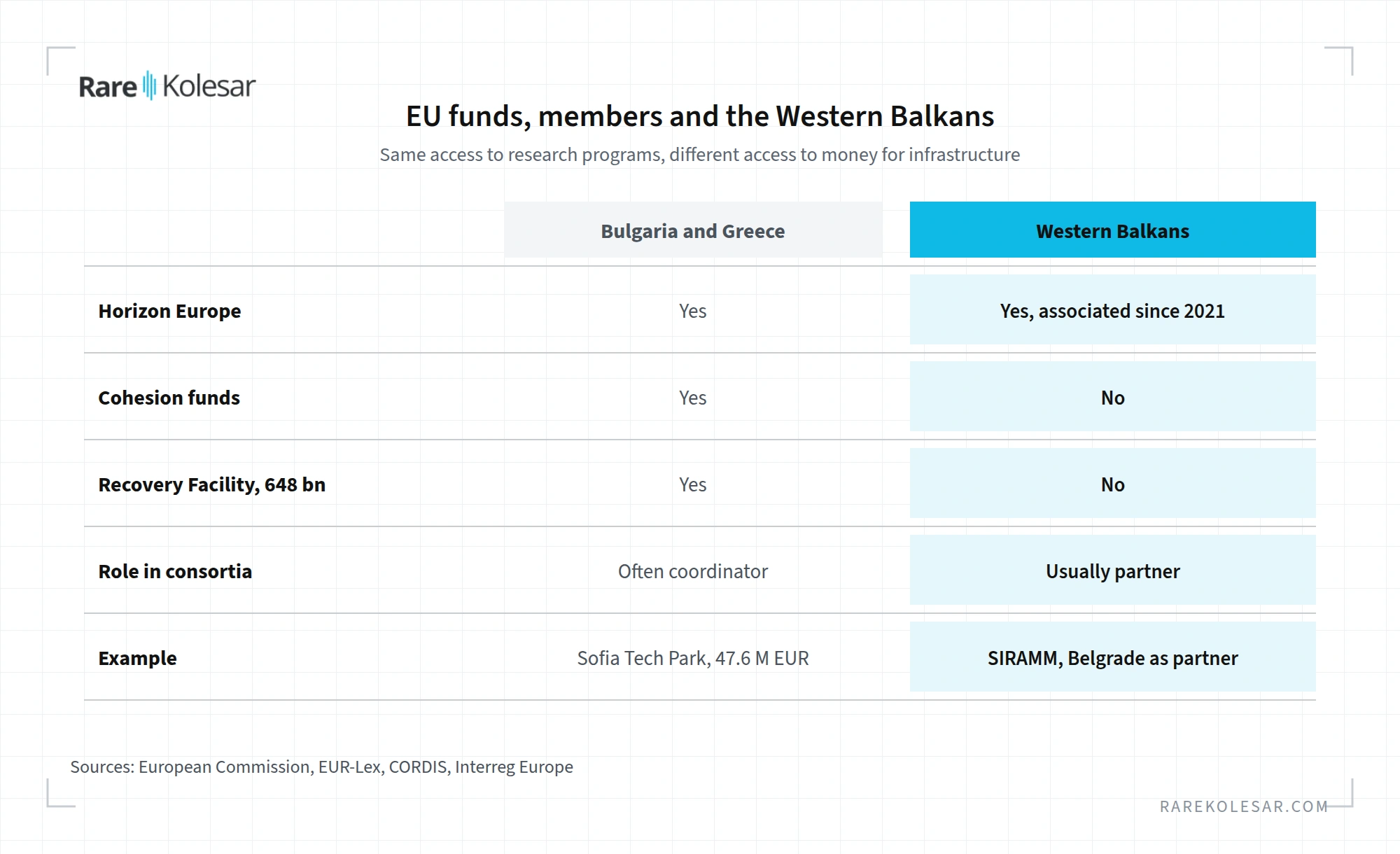
| Question | Bulgaria and Greece, EU members | Western Balkan countries |
|---|---|---|
| Horizon Europe | Yes | Yes, as associated countries since 2021 |
| Cohesion and structural funds | Yes | No |
| Recovery and Resilience Facility | Yes | No |
| Typical role in a consortium | Often coordinator | Usually partner |
| Capacity to write and run applications | Built over years of membership | Insufficient, relies on individuals |
Even if we could formally lead a larger project, two things are missing. People who know how to write applications in a way European reviewers recognize as serious. And institutions that can run project administration quickly and efficiently, from signing to reporting. This is not a lack of intelligence or will among individuals, but a lack of the institutional machinery that turns that intelligence into results.
A solution that costs two salaries
This is a solvable problem, and a relatively cheap one. For years I have been proposing to chambers of commerce in the region that each of them hire two people whose only job would be tracking and applying to a few specific European calls.
Experience accumulates quickly. After a couple of successful applications, that capacity grows much faster, because each new project goes more smoothly than the previous one. This is not an impossible demand for a large institution. It is an investment the size of two salaries, with a potentially huge return.
Realistic context, not an excuse
We should also be realistic about ourselves. The Western Balkan countries are not countries for which the lack of developed additive manufacturing is the biggest problem. Institutions are weak at much more basic levels, and there is a long queue of more urgent and larger problems ahead of the question of whether a university has an industrial metal printer.
That is the honest context for why things move this slowly, and why comparing us with countries that have long been in the EU, with a completely different and more stable institutional framework, is not a comparison of equals.
What needs to change
The region has people. It has motivation at the level of individuals. What is missing is a systemic framework that would connect that motivation with real resources, through partnerships with clear obligations, measurable results and long term sustainability, instead of one off equipment donations that end up unused after a few years.
All of this is also an opportunity. Fields that are only emerging in more developed countries are exactly where the region can invest relatively little and gain relatively much, because almost no one else in the region is investing there. That is what happened in 2016 with additive manufacturing itself, when I founded 3D Republika with the idea of bringing the new technology closer to the region while the window on the global scene was still open. I would not say I fully succeeded, but the principle holds. Whoever first recognizes the opportunity in an emerging field gains the most.
If you work in a company, a university or an institute and recognize yourself in any part of this text, I would be glad to hear your view, whether you agree or not. If you want an independent assessment for your company, see consulting.
Frequently asked questions
Which countries does the region I write about include? Serbia, Bosnia and Herzegovina, Montenegro, North Macedonia and Kosovo. That is the wider region I write about; as an independent consultant, I work without territorial limits, anywhere in the world, remotely and on site.
Which industry in the region uses additive manufacturing the most? The automotive industry. The reason is global companies that bring knowledge, and sometimes equipment, to their plants in the region as part of their global strategy.
Does Serbia have access to Horizon Europe? Yes. Serbia is associated to Horizon Europe, and the agreement applies from 1 January 2021. Applicants from Serbia apply under the same conditions as other associated countries, while cohesion funds and the recovery facility are available only to EU member states.
Why do neighboring EU countries have more developed additive manufacturing? Because of infrastructure funds available only to member states, which build laboratories and technology parks, and because of built up capacity to run European projects. Institutions from the Western Balkans are usually partners in consortia, not coordinators.
Do universities need industrial 3D printing equipment? In my opinion, rarely. Few institutions in the region can fund equipment, people and maintenance in the long term, so a public private partnership with clear obligations for both sides is a more sensible path than an equipment donation.
Which 3D printing technology is growing fastest in the region? FDM. It has become reliable, fast and affordable, and it is what builds general trust in 3D printing in companies and institutions.
What is the cheapest step that would speed up development? Chambers of commerce hiring two people each who would work only on tracking and applying to European calls. It is an investment the size of two salaries, and experience and success grow with every new project.
Sources
- Association to Horizon Europe, Serbia, European Commission, 2021
- Agreement between the EU and the Republic of Serbia on the participation in Horizon Europe, EUR-Lex, 2022
- List of Participating Countries in Horizon Europe, v1.3, European Commission, 2021
- Horizon Europe agreement adopted in the Serbian parliament, Ministry of Science, Technological Development and Innovation, 2023
- Serbia, EU enlargement, European Commission, 2025
- Recovery and Resilience Facility, European Commission, 2024
- SIRAMM, Eastern European twinning on additive manufacturing, CORDIS, 2023
- Sofia Tech Park, science and technology park, Interreg Europe, 2018
- EY Parthenon Serbia Business Pulse, Automotive sector, EY, 2025