Food-contact status is not a property of a material, it's a property of a finished part made through a proven, documented process. A certificate on a powder or filament does not automatically carry over to the printed part, because geometry, surface roughness, post-processing, and cleaning procedure determine whether anything migrates out of the part into food. The most common mistake in the industry is conflating biocompatibility (USP Class VI, ISO 10993) with food-contact compliance (FDA 21 CFR 177, EU 10/2011), two different standards with different tests and different limits. Existing regulation is deliberately process-neutral, it evaluates the finished material and part, not how it was made, which is why additive manufacturing doesn't yet have its own guideline, and why no independent, peer-reviewed migration dataset exists for printed parts themselves. Real-world use is genuine but niche, mostly tooling, fixtures, and line components, not mass production of parts in permanent direct food contact.
Why this topic deserves a serious look
Over the past year, several announcements have appeared about certified food-contact materials and workflows for 3D printing, from SLS polyamides to silicones and FDM filaments. Most of these announcements come from equipment manufacturers and contract manufacturers. That's not a problem in itself, but a reader considering a 3D printed part for a food production line rarely gets an answer to the three questions that actually matter, what exactly is certified, against which standard, and does it apply to the material or to the finished part. This piece tries to answer all three, without favoring any single manufacturer.
The regulatory framework, briefly and without dressing it up
In the United States, food-contact materials are regulated by the FDA under 21 CFR part 177, where the most relevant provisions for us are 177.1500 (nylon resins, covering PA11 and PA12) and 177.2600 (rubber and silicone). It's worth understanding that the FDA doesn't "approve" a material by issuing a certificate, the manufacturer or supplier declares compliance, if needed through the Food Contact Notification process. Alongside this sits NSF/ANSI 51, a standard for food equipment materials in commercial settings, which is more relevant for equipment and tooling than the FDA polymer provision alone, since it evaluates the part in the context of its actual use, not just the material's composition.
In the European Union, the framework consists of Regulation 1935/2004 (the general framework for all food-contact materials), Regulation 10/2011 (specific to plastics), and Regulation 2023/2006 on good manufacturing practice. For plastics, a Declaration of Compliance is mandatory, and that's the document a reader should ask a supplier for, not a generic "certificate."
Regulation 10/2011 also gives concrete numbers, worth remembering because any "food grade" claim can be measured directly against them. Overall migration must not exceed 10 mg per square decimeter of food-contact surface, equivalent to 60 mg per kilogram of food. For polyamides, the limit on primary aromatic amines is particularly important, these arise from certain pigments, the sum must not exceed 0.01 mg per kilogram, and individually listed amines must not be detectable above 0.002 mg per kilogram. This is why colored nylon parts, including blue "food grade" variants, require a dedicated migration test, not just a certificate for the base powder.
The most common confusion: biocompatible is not the same as food-contact
This is probably the most important part of this piece. USP Class VI and ISO 10993 are biocompatibility standards, they assess how tissue, skin, or an organism reacts to a material. The tests are cytotoxicity, sensitization, irritation, systemic toxicity, implantation. They're intended for medical devices. FDA 21 CFR 177 and EU 10/2011 assess something entirely different, how much substance migrates from the material into food, under defined food simulants (for example 3 percent acetic acid for acidic food, vegetable oil for fatty food, 10 to 50 percent ethanol for alcoholic beverages), at defined temperatures and exposure times.
A material can pass one standard and fail the other, in either direction. Independent labs and suppliers of silicone and medical polymers themselves explicitly flag this as a common customer mistake.
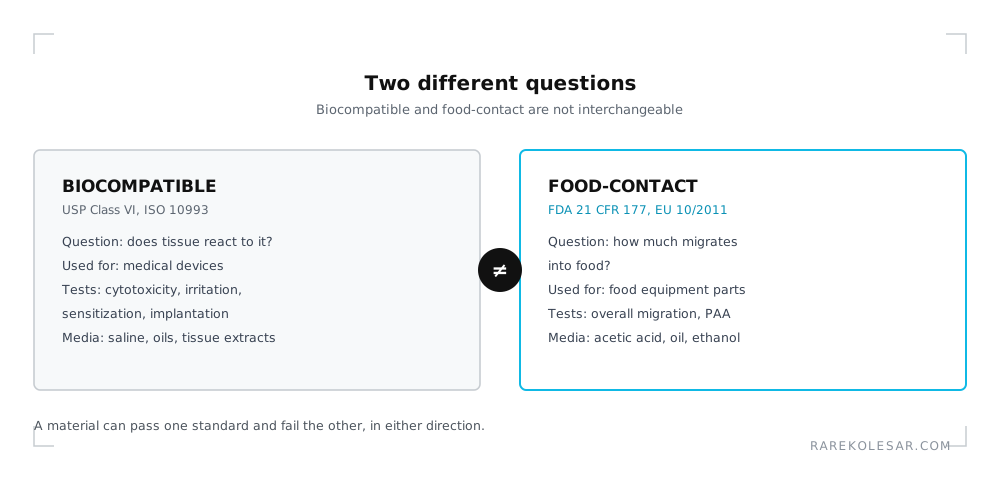
A concrete example from the AM world. Standard PA12 for HP Multi Jet Fusion is certified biocompatible under USP Class I through VI, which covers skin contact, not food. For actual food-contact use on the same machines, a separate material exists, Evonik VESTOSINT 3D Z2773, FDA compliant specifically for food contact. Same machine manufacturer, two different materials, two different statuses, and in the offerings of many contract manufacturers that distinction gets lost because both are mentioned as "biocompatible" in the same breath as food applications.
It's worth noting that the sharpest warnings on this point don't come from regulators, but from SLS equipment manufacturers themselves. Sinterit, the Polish SLS printer manufacturer, states on its own site that PA12 can be food safe as a material, but that a 3D printed PA12 part is not automatically food safe, and that certification usually applies to the raw powder, not the printed part. Independent industry commentators put the same rule even more concisely, food safety cannot be assumed for a biocompatible dental resin, and biocompatibility cannot be assumed for a food-grade polyamide.
Contact zones, a framework that resolves half the confusion
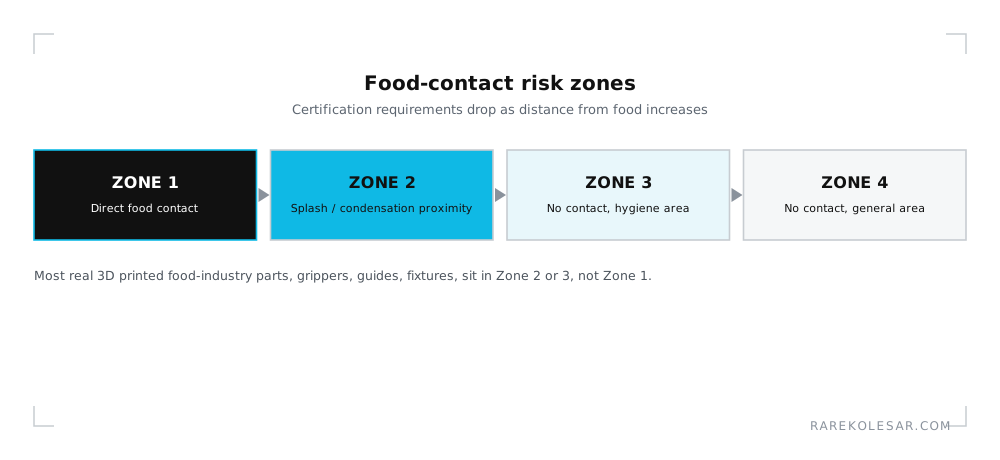
The food industry has long used a zone classification. Zone 1 is direct food contact, Zone 2 is close proximity where a part may contact food through splashing or condensation, Zones 3 and 4 involve no direct contact but still fall under hygiene requirements for cleaning and disinfectant resistance.
This distinction matters because most real applications of 3D printing in the food industry aren't in Zone 1 at all. Grippers, guides, pushers, fixtures, and replacement line parts are most often in Zone 2 or 3, where requirements differ, are often achievable, and where AM makes the most sense due to small batch sizes and custom geometry. Before even asking the certification question, one should ask the zone question.
Polymers, two approaches to the same problem
Certifying the material alone. Several suppliers offer powder or filament with documentation of compliance with the FDA provision or EU 10/2011, without a defined post-processing step. Examples include Sculpteo PA12 Blue, Oceanz PA12 Food Grade with a declaration under 1935/2004, the FABULOUS BLUECARE line distributed through Farsoon, BASF Ultrasint PA11 with food-contact documentation available through contract manufacturers, and EOS PA2200. With EOS materials, one detail is worth watching, part of the publicly available documentation still references the old 2002/72/EC directive, which has been replaced by Regulation 10/2011, so an updated declaration should be requested.
This approach is legitimate, but it leaves the key question with the buyer. An SLS part is porous and rough, food particles and bacteria get into that porosity, and the powder itself can be perfectly compliant while the finished part isn't suitable for cleaning under HACCP requirements.
Certifying the entire workflow. In April this year, FABULOUS and AMT announced validation of a complete SLS process, DETECT PA11 powder plus PostPro Pure vapor smoothing, tested by an independent accredited laboratory against FDA 21 CFR 177.1500 and EU 10/2011. The difference from the previous approach is fundamental, vapor smoothing closes the surface porosity, so what gets certified is the part as it actually comes out of the process, not the powder that goes in. As far as I'm aware, this is the first case where the entire chain, material plus post-processing, has been validated together.
The same direction of development shows up in metal-detectable materials. The Danish Technological Institute developed a blue nylon powder with metal detectability and visual traceability, approved for food contact in both Europe and the US, with the logic that the blue color lets a broken-off fragment be seen in the food on lines that lack a metal detector. A known application is robotic grippers at a major food processing equipment manufacturer, where AM consolidated a 40-part assembly into one. Contract manufacturers today offer PA12 variants colored throughout the material, meaning blue all the way through the part's cross-section, not just on the surface, and metal-detectable, specifically for HACCP environments, with vapor polishing as a standard step.
Beyond SLS
Markforged offers Nylon White FS filament certified to NSF/ANSI 51, with a published use case where an equipment manufacturer replaced a conventional tool with a gripper that directly handles cookies on the line. Stratasys publishes food-contact declarations and NSF/ANSI 51 listings for select FDM materials when used as specified, and for its DLP technology offers a low-migration resin, an exception in a world of resins that are otherwise rarely suitable for food. Ultimaker machines are used by ERIKS, a large industrial distributor, in a dedicated production space for food-safe parts. Lynxter has SIL-004, a 3D printed silicone with FDA 177.2600 compliance, opening a third material class alongside polyamides and FDM plastics.
The common thread across all these examples is that certification applies to a defined material under defined conditions, and that the manufacturers themselves, read carefully, state that responsibility for the finished part rests with the user.
Metal, 316L in additive manufacturing
For metal, there's no separate regulation for additively manufactured food-contact parts. The same framework applies as for conventional 316L, which has been the standard food-grade steel for decades due to its corrosion resistance and non-porosity, with NSF/ANSI 51 and 61 and 3-A Sanitary Standards as the relevant references.
The problem is that additively manufactured 316L isn't automatically as non-porous and smooth as rolled or forged steel. The LPBF process introduces three risks that conventional manufacturing doesn't have. The first is surface roughness, an untreated part has micro-cracks that trap particles and bacteria. The second is internal porosity, which can trap unmelted powder and reduce corrosion resistance. The third, and the sneakiest, is residual powder in internal channels, exactly the channels AM is often chosen for in the first place. Peer-reviewed literature on internal channels in LPBF parts documents defects in unsupported channels, and cleaning complex channels requires vibration, gas flow, ultrasound, or abrasive flow machining, which in turn carries its own risk of leftover abrasive media.
Solutions exist and are well known, electropolishing that smooths and seals the surface, passivation that removes free iron, and validated cleaning of internal channels. Then there's HIP, short for hot isostatic pressing, a process in which the part is exposed simultaneously to high inert-gas pressure and high temperature, physically closing internal pores so the part becomes nearly fully dense. None of these solutions comes automatically with the choice of alloy.
Manufacturers of metal systems are aware of the market. EOS introduced a 316L variant ahead of Formnext 2025 explicitly positioned for chemical processing, food production, and water treatment. Desktop Metal states that its customers have qualified their own parts to NSF 51 and 61. Some contract manufacturers claim DMLS 316L parts comply with FDA and EU 1935/2004 with CIP and SIP compatibility. It's worth carefully distinguishing these three types of claims, marketing positioning of the alloy, qualification the customer performed themselves, and a contract manufacturer's claim, since none of them is the same as a certificate for the finished part issued by the equipment manufacturer. For the mechanical properties of 316L itself in additive manufacturing, by manufacturer and with independent verification, see comparing alloys in metal additive manufacturing.
What independent sources say, and what they don't
This is where the picture gets most sober. Neither the FDA nor European bodies have a dedicated guideline for additive manufacturing of food-contact materials, but that shouldn't be read as an oversight. Existing regulation was built over years to be deliberately neutral to the manufacturing process, it evaluates the finished material and its behavior, not the machine or technique that produced it, and that logic in principle applies equally to injection molding, machining, or 3D printing. The closest document touching on this is FDA's 2014 guidance on assessing the effects of significant manufacturing process changes, including emerging technologies, on the safety and regulatory status of food-contact substances. It doesn't name 3D printing, but the principle is clear, a process change can alter a material's actual behavior and require a new review, even when the chemical composition stays the same. The European Food Safety Authority and the Commission apply the same logic, a general framework, with no dedicated section for AM.
The European Union has a shared system, RASFF, through which national inspection agencies report food or materials found unsafe during checks, so the alert is immediately visible across all member states, not just where the problem was found. Of all these reports, only about 5 percent, roughly 180 per year, relate specifically to food-contact materials rather than to food itself. Of those 180, three-quarters are products from China, and the most common findings are migration of primary aromatic amines and formaldehyde, along with occasional metal elements. I found none of these reports tied to a 3D printed part, which more likely means the application is still too young and too rare for inspections to have had a reason to specifically check for it, rather than the problem being genuinely absent.
Academic literature exists, but not the kind that would settle the main question. The most relevant study from this year examines the chemical resistance of SLS PA12 parts, with and without vapor smoothing, in food-industry cleaning agents, and finds mass loss below 3 percent, with better color-change resistance for smoothed parts. That's a useful durability data point, but not a migration data point, and the authors themselves call for future research into long-term food interaction. Several studies on FDM parts made from PLA and PETG show that ordinary soap washing removes over 90 percent of pathogens and that layer lines, under electron microscopy, are far larger than bacteria, which challenges the myth of unremovable porosity, while still recommending food-safe coatings for liquids and additional soaking in diluted bleach.
What doesn't exist, and this is the key finding of this review, is an independent, peer-reviewed dataset on overall migration, in milligrams per square decimeter, from actual SLS, MJF, or FDM printed parts into standard food simulants. Every "food safe" claim circulating today rests either on a certificate for the raw material, or on tests commissioned by the manufacturer itself. That doesn't mean the claims are false. It means no one has independently confirmed them yet, and a reader should treat them as declared, not as proven.
How much this is actually used
Market reports appearing under the label "3D food printing" mostly measure printing of edible food itself, not AM equipment parts, and shouldn't be used as evidence of adoption. For food-contact AM parts specifically, independent quantitative data barely exists.
The realistic picture from the industry is consistent. The most mature use is in tooling, fixtures, guides, and line components, in other words Zone 2 and 3, where small batches and custom geometry justify AM and the requirements are achievable. Zone 1, in permanent contact with fatty or acidic food, remains the domain of conventional 316L and certified injection-molded plastic, until AM validation is proven for a specific case. The limiting factors are per-part cost, speed, regulatory complexity, and the need to validate each part individually. Skepticism from the food industry itself centers on cleanability, detectability of broken-off fragments, and the lack of independent confirmation, and based on everything above, that skepticism is warranted.
What to actually ask a supplier
If you're considering a 3D printed part for a food production line, these are the questions that separate a serious offer from marketing.
First, determine the zone. If the part isn't in Zone 1, the requirements are probably different and easier to meet, and that's worth telling the supplier.
Second, ask for a Declaration of Compliance for the finished part in a defined workflow, not for the powder or filament. The declaration should state the simulants used, the test conditions, and the overall migration result. If what you get is a material certificate, that's the start of the conversation, not the end of it.
Third, for polymers, choose a workflow with post-processing that seals the surface, vapor smoothing for SLS and MJF, a coating for FDM. For colored polyamides, specifically ask for a primary aromatic amine migration test in an acidic simulant.
Fourth, for metal, don't rely on the alloy's reputation alone. Ask for electropolishing, passivation, HIP if needed, validated cleaning of internal channels, and part qualification to NSF/ANSI 51 or 61. I've described what that qualification looks like in practice in what process qualification looks like in practice.
Fifth, separate the terms. Food grade is a regulatory status under a specific regulation. Food safe is a practical, non-regulatory description. Biocompatible is a medical status for tissue contact and never proves food-contact compliance. A supplier who uses these three words as synonyms isn't necessarily dishonest, but isn't a reliable source either.
Conclusion
Food-contact certification in additive manufacturing is real and advancing, but it's currently at the point where the gap between declared and proven is at its widest. The best workflows already certify the part, not just the material, and that's the direction the field is heading. Independent migration data for the printed parts themselves still doesn't exist, and the industry's most common mistake, conflating biocompatibility with food-contact compliance, isn't a technology problem, it's a understanding problem, the same one that accompanies AM adoption in other regulated applications.
For the reader, that translates into a simple rule. Ask for evidence for the finished part, in your zone, under your cleaning conditions, and treat every other claim as something still to be verified, not as a finished answer.
Frequently Asked Questions
Is a material with a USP Class VI certificate safe for food contact? Not automatically. USP Class VI assesses tissue reaction to a material, not substance migration into food. Food contact requires compliance with FDA 21 CFR 177 or EU 10/2011, which are separate tests with separate limits.
If a powder is certified for food contact, is the printed part certified too? No, unless the entire workflow, including post-processing, has been validated for the finished part. SLS and MJF parts are porous and rough without smoothing, and that changes how the part behaves in food contact and during cleaning.
Is there a special regulation for 3D printed metal parts in the food industry? No. The same framework applies as for conventional 316L, but an additively manufactured part has porosity, roughness, and possible residual powder in channels, so food-contact status depends on post-processing and validation, not on the alloy alone.
What numbers should I look for in a declaration of compliance? Under EU 10/2011, overall migration below 10 mg per square decimeter, equivalent to 60 mg per kilogram of food, and for colored polyamides, a sum of primary aromatic amines below 0.01 mg per kilogram. The declaration should state the simulants and conditions under which the test was run.
Where does 3D printing make the most sense in the food industry today? In tooling, fixtures, guides, and replacement line parts in Zone 2 and 3, where small batches and custom geometry justify the technology and the requirements are achievable without permanent direct food contact.