Summary
The biggest misconception in the market is that 3D printing is always better, faster or cheaper. It isn't. The question is not whether the technology is good. The question is whether it is good for this specific part, in this specific quantity.
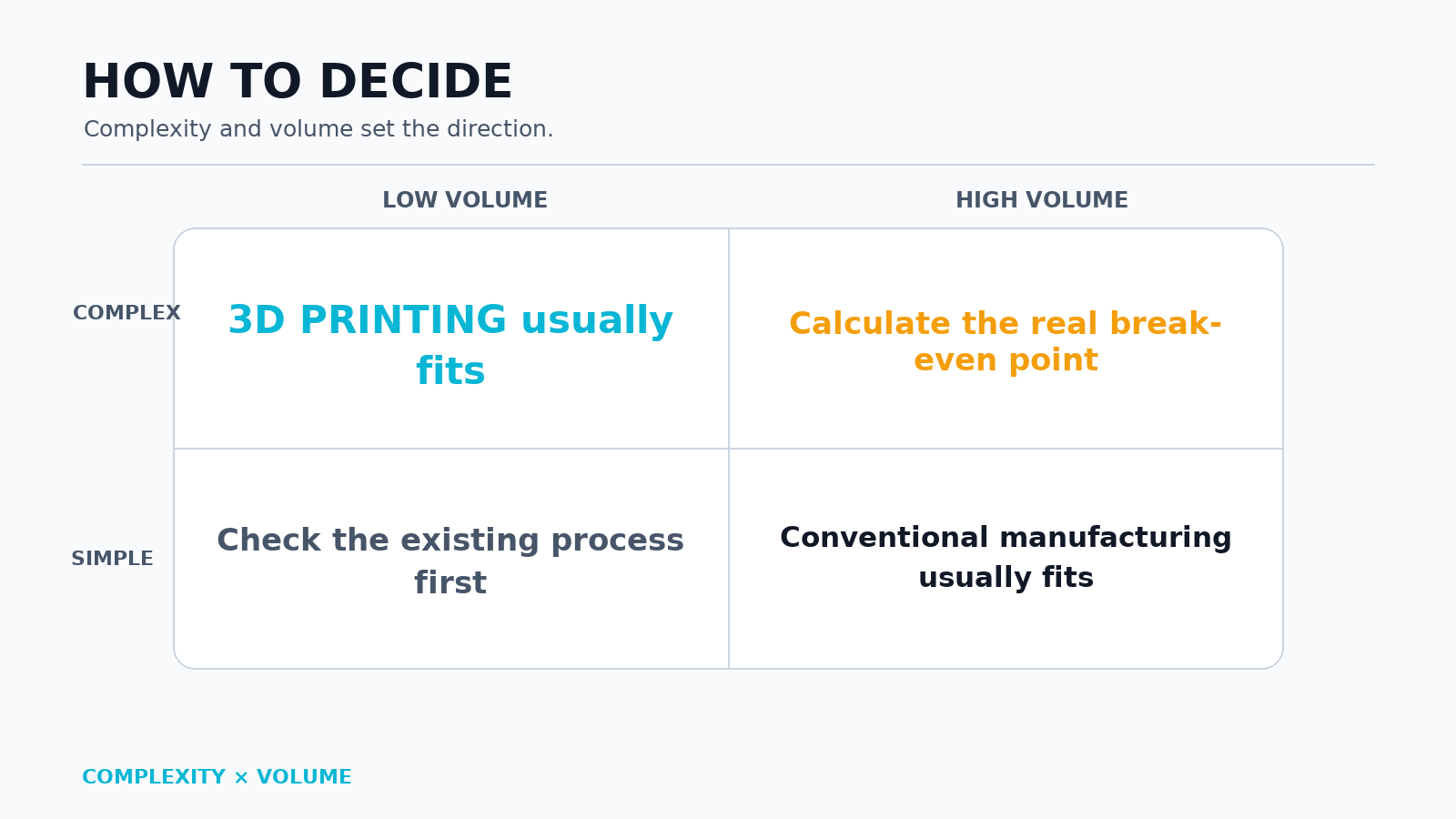
Two questions give the answer, how complex the part is and how many pieces you need. A small number of complex parts almost always points to 3D printing. A large number of simple parts almost always points to conventional manufacturing. Everything in between needs a calculation, one that includes all costs, not just the price of the machine.
The only valid criterion is a measurable improvement that can be verified. Everything else is cost.
Two questions before every decision
Before doing the calculation, ask two questions. How geometrically complex is the part? How many pieces do you need now and over the next year? A small number of complex parts almost always points toward 3D printing. A large number of simple parts almost always points toward conventional manufacturing. The difficult cases are in the middle. That is where you need the real calculation.
The break-even point versus plastic injection molding
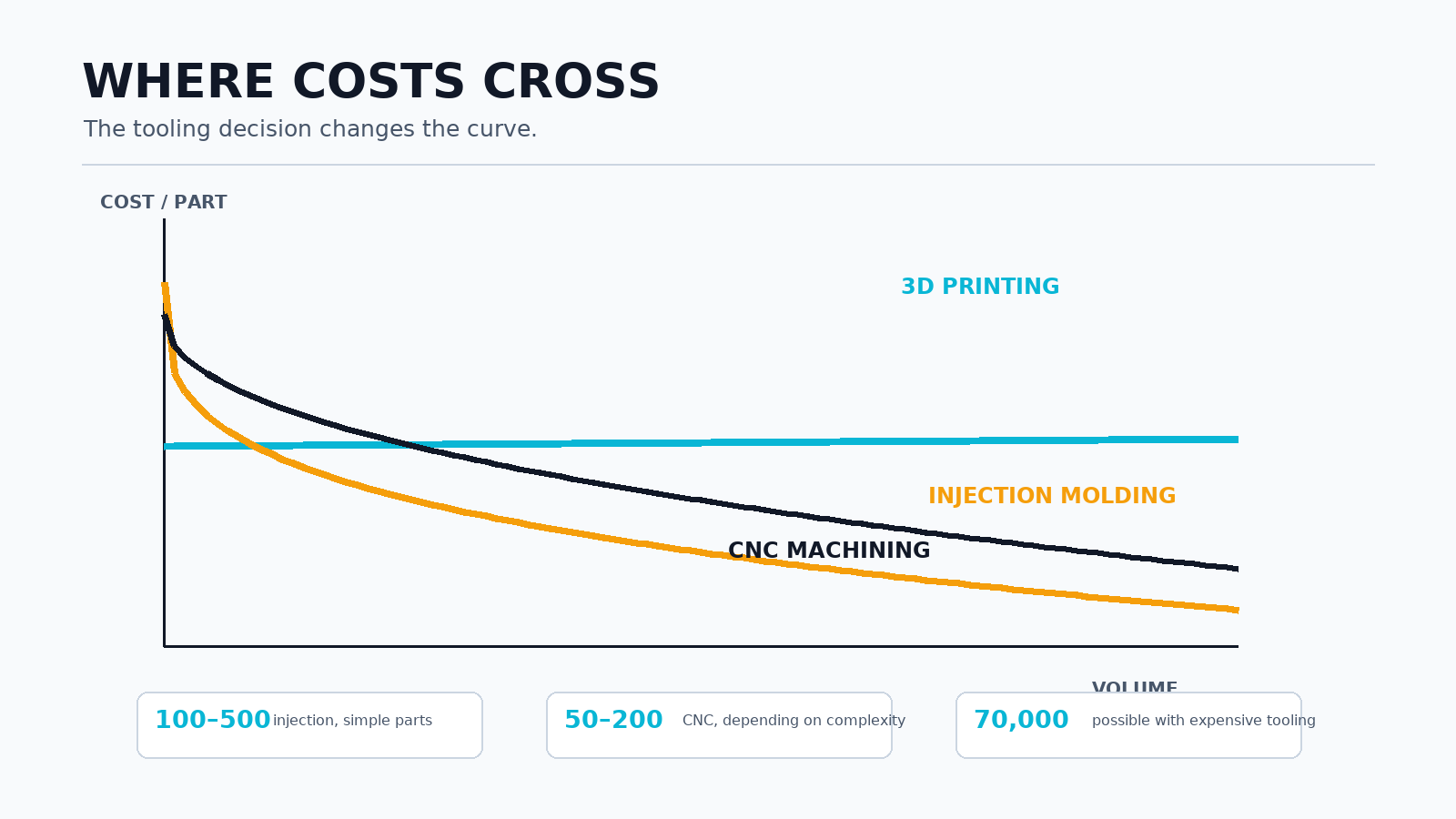
In injection molding, the main cost is the tool, the mold. With 3D printing, the price per part is almost fixed, regardless of quantity. For simpler geometry, the break-even point is often between 100 and 500 parts. For a moderately complex part, the numbers can go above 10,000 parts. Once the cost of making the mold is included, the break-even point can reach 70,000 parts for simple, stable components. That is why 3D printing works well for short runs and frequent design changes. It loses its advantage as soon as you move into high-volume production with an unchanged design. With injection molding, the price per part falls with every additional part. With 3D printing, it barely falls at all. For a speed comparison, an eight-cavity mold can produce almost 2,000 parts per hour. 3D printing the same part produces between 5 and 30 parts per hour, depending on the technology. That is why injection molding wins at large, stable volumes.
This does not mean 3D printing has no place in large series. It does, but only where geometry, personalization or combining several parts into one gives an advantage the conventional process cannot. I wrote about this in High-Volume Production of 3D Printed Parts That Ship in the Final Product. Who's Already Doing It, at What Scale, and Who Didn't Want to Admit It Until Recently?.
The break-even point versus CNC machining
With CNC machining, the break-even point is lower, usually between 50 and 200 parts depending on complexity. For a simple part with tight tolerances, CNC often wins even for a single part. The reason is straightforward: a 3D-printed part would need expensive post-processing to meet those tolerances. Complexity changes the picture. In CNC machining a complex part, a large share of the material can end up as chips, sometimes more than 90 percent. In 3D printing, only support material is lost, usually 5 to 15 percent of the part mass. The more complex the part, the more the advantage shifts toward 3D printing.
How to measure part complexity
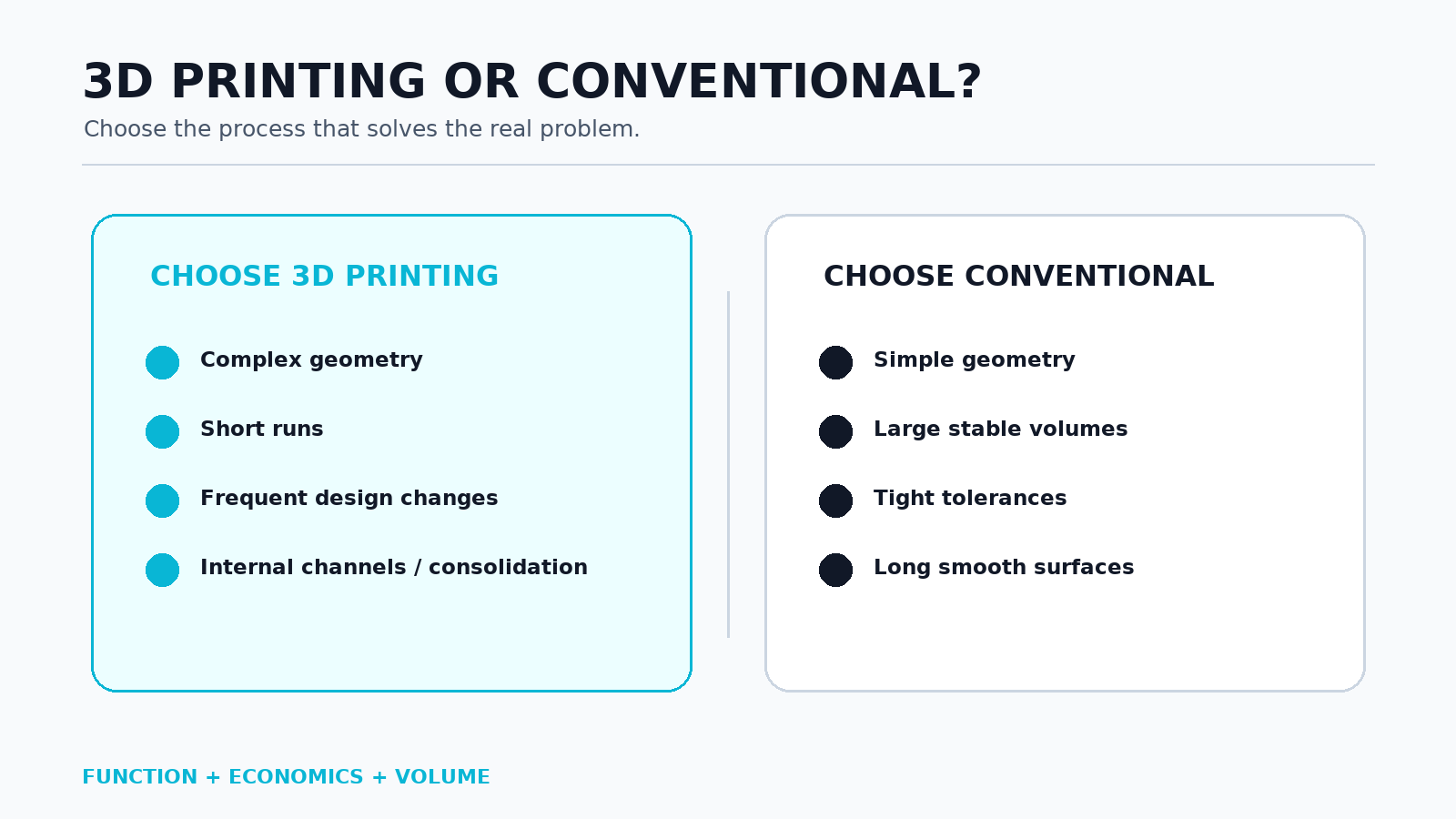
There are several academic metrics for measuring part complexity, generally based on the relationship between the part's volume and surface area and the volume and surface area of its bounding box, as well as the number of holes or channels. For practical use, you do not need to calculate a formula. Ask three questions. Does the part have internal channels that cannot be machined conventionally? Does it combine the functions of several previously separate parts? Does it have an organic shape adapted to the load? One positive answer is enough to make the part a good 3D-printing candidate.
The tooling cost you don't pay
The greatest economic advantage of 3D printing is not the price per part. It is the tooling cost that simply does not exist. A mold for a complex automotive or aerospace micro-cast part costs between 8,000 and 30,000 euros. A company ordering three new tools per month at 12,000 euros each spends around 430,000 euros a year on tooling alone, before making a single part. 3D printing has none of that tooling cost. If you know the design will change before the tool could pay for itself, 3D printing is a rational choice even with a higher price per part.
Costs people don't count
People look at the price of the machine and the price of the material. They rarely look at everything else, and that is exactly where the calculation usually breaks. A part that looks profitable on paper often stops being profitable once all costs are added up.
In polymer printing, this means unused and aged powder in SLS and MJF, cooling time, cleaning and blasting of parts, support removal in FDM and SLA, and surface finishing when appearance matters.
In metal printing, the list is longer. Powder, inert gas, removing parts from the build plate, heat treatment, support removal, CNC machining of functional surfaces and quality control, often including CT scanning. For parts going into certified production, there is also process qualification, which can cost more than the machine itself.
Common to all technologies are the operator, maintenance, software licenses, rejected parts and learning time. For the first few months, the machine runs slower and with more errors than the brochure says.
When 3D printing does not make sense, even in small quantities
Some parts are poor candidates regardless of quantity. Large, flat, simple parts without internal geometry gain nothing from 3D printing; they only take up space in the build chamber.
Parts without a clear functional advantage. If 3D printing does not solve a problem that another technology cannot solve, there is no economic argument either. In industry, a part is judged by its function, not by its looks.
Parts with sharp internal corners concentrate stress, are difficult for the technology to reproduce accurately, and need to be replaced with radii. Parts that require tight tolerances and a smooth surface over a long distance start with a rough as-printed surface; achieving a smooth finish requires additional machining, and the advantage of 3D printing disappears. Metal safety-critical parts that are already mass-produced would need their production cost to fall by 70 to almost 100 percent before 3D printing became economical.
A redesign example that beats 3D printing
3D printing is not always the final answer. For one metal part with an internal channel, engineers split the part through the middle of the channel, conventionally machined both halves, and vacuum-brazed them together instead of using DMLS. The result was functionally identical to the DMLS part at one third of the cost. This does not work for every part, only where the position of the channel allows splitting and rejoining without compromising function. Before choosing 3D printing, check whether an intelligent redesign for conventional manufacturing solves the same problem more cheaply.
What a good decision looks like in practice
Step one, check whether the part can be made in a single operation on a three-axis CNC. Step two, assess the complexity of the part. Step three, calculate the break-even point, taking into account the tooling cost you don't pay, the real cost per part including all post-processing, and the expected annual quantity. Step four, check the technical requirements, strength, tolerances, surface and size. Step five, answer honestly what measurable improvement 3D printing brings to this part. If there is no answer, there is no reason.
The broader framework for choosing the technology itself is described in How to Choose the Right Technology for Industrial 3D Printing, and why companies most often get the adoption itself wrong, in Why 90 Percent of Companies Get 3D Printing Wrong.
Your calculation
Enter the machine price, monthly part volume, alternative per-part price, in-house per-part price, and annual maintenance. The calculator uses the following logic.
Monthly saving = (parts per month × (alternative price − in-house production price)) − (annual maintenance / 12)
Payback period in months = machine price / monthly saving
Frequently asked questions
What is the lowest quantity at which 3D printing pays off?
It depends on tooling cost and complexity. For simple parts, it can be as low as around one hundred pieces.
Does 3D printing pay off for large series?
Rarely for simple, stable parts. For complex parts, personalized products or assemblies combined into a single part, it can pay off even at tens of thousands of pieces.
Which costs are most often forgotten?
Post-processing, quality control, rejected parts, the operator and learning time. For metal, also inert gas, heat treatment and removal from the build plate.
Does part size affect the decision?
Yes. Large, simple parts are rarely a good choice for 3D printing.
How do I know whether my part is complex enough?
Ask three questions about channels, consolidation, and organic geometry. Does the part have internal channels that cannot be machined conventionally? Does it combine the functions of several previously separate parts? Does it have an organic shape adapted to the load?
Can a redesign be better than 3D printing?
Yes. Before deciding, check whether a redesign for conventional manufacturing solves the same problem more cheaply.
What if the tolerances are tight?
Plan for additional CNC finishing, and include it in the cost per part.
Sources
- Yun Ji et al. 2026.
- Kazmer et al., Polymer Engineering & Science 2023.
- BigRep 2024.
- 3DPCasting 2025.
- MDPI Machines 2025 (DfAM Expert System).
- Protolabs 2023+.
- ScienceDirect 2025.
- Anonymized redesign example (Yicen Precision, 2026, client name withheld).