Chinese print farms prove that ordinary FDM printers can be a factory. One plant in Shenzhen runs 5,600 Bambu Lab printers, and the company behind it has bought around 15,000 printers for several locations. It prints toys and decorative items, 80 percent of them for export to Europe and North America. Yet that same factory uses only 50 to 60 percent of its capacity on average, prices are falling and the parent company is losing money. The printer has become a commodity, and the value has moved into the model. That is why official CAD files from manufacturers, digital spare parts warehouses and AI modelling are an industrial topic, not a hobby. Whoever owns the model owns the product.
A factory made of desktop printers
When people talk about 3D printing in production, most of them think of expensive industrial systems. The most interesting news of this year came from a completely different direction.
Huafast, known in Chinese media as Jinshi Huasu, operates in the building of the listed company Huina Technology in the Guangming district of Shenzhen. A journalist from 3D Printing Industry toured the plant in August 2026 and counted 5,600 Bambu Lab printers. According to the founder, that is part of around 15,000 printers the parent company has bought for several locations in China. The larger number is a company statement and should be read as such.
What this factory does is serial production, not prototyping. The founder describes a toy order of more than 50,000 pieces completed in seven days on 1,000 to 2,000 printers. He also describes an industrial order of 60,000 small PLA parts delivered in seven days on 100 printers, roughly 600 parts per machine per week. The customers are mostly traders selling through their own websites, Amazon and TikTok shops. According to the Chinese newspaper Nanfang Zhoumo, 80 percent of the output goes abroad, mainly to Europe and North America.
The logic is simple. An injection mould takes time and money before the first part exists. A farm can put hundreds of machines on one design immediately and move them to another one afterwards. For a product that spreads through social media and disappears within two weeks, speed is worth more than the lowest cost per piece. Some customers make 300 to 500 pieces of each of around twenty designs, put them on sale and only then see what sells. It is an A/B test with physical products.
The share of industrial orders, by the founder's estimate, has grown from about 10 to about 30 percent of the business in three years. These are housings and covers for electronics, made of PETG, ABS, ASA and carbon fiber filled filament. Asked where injection moulding becomes more economical, the founder refused to give a single number. For one example he said above 10,000 units, but stressed that everything depends on whether the product will keep selling.
Where is the real bottleneck?
Here comes the part that is rarely mentioned. The same factory with thousands of printers uses on average 50 to 60 percent of its fleet, with peaks of 80 to 90 percent. The founder says orders are growing but prices are falling, because small family run farms can work cheaper. The parent company Huina Technology reported a net loss of around 78 million yuan, roughly 10 million euros, for the first half of 2026.
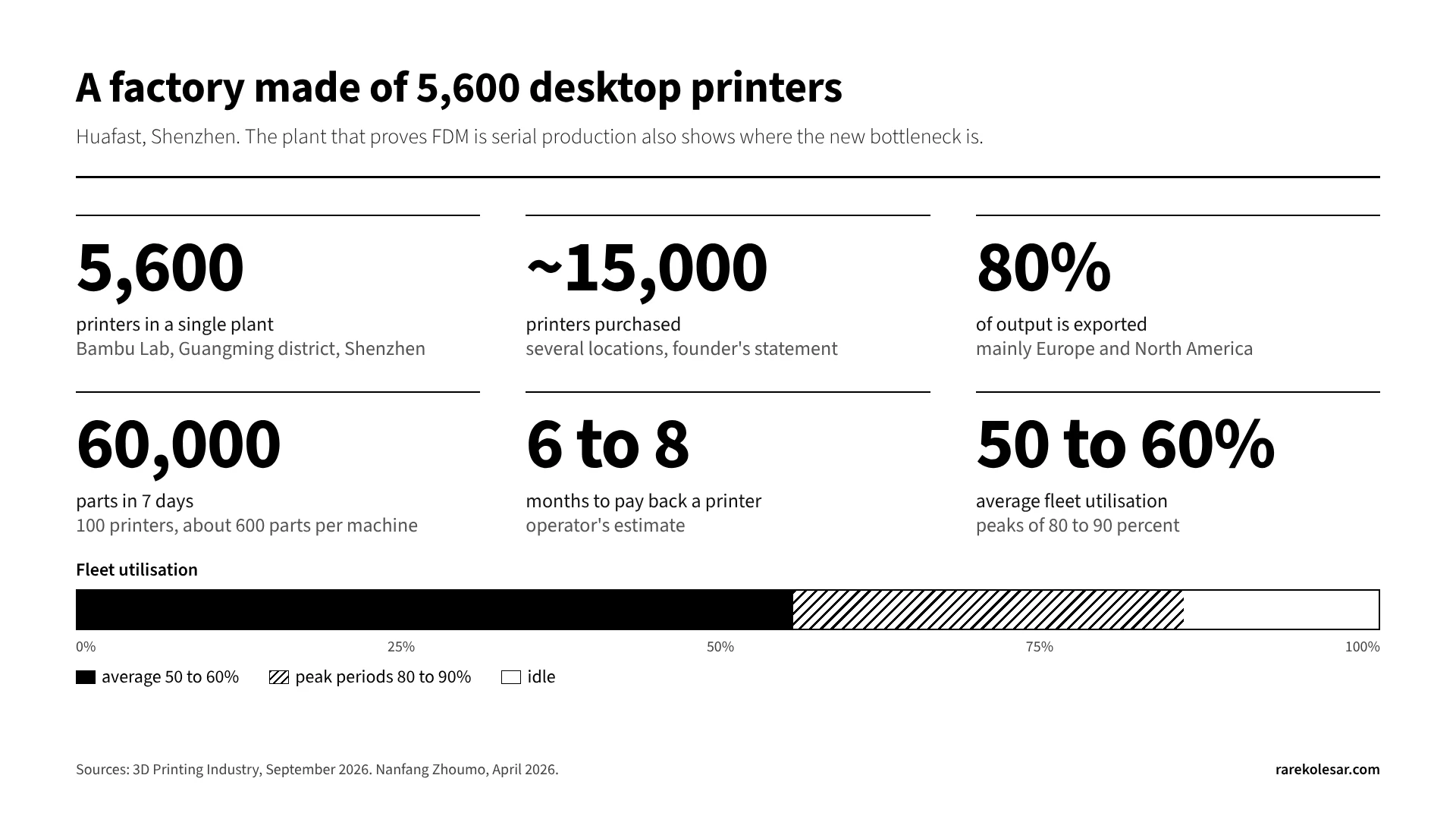
This means machines are no longer the problem. A printer, by the operator's own estimate, pays for itself in six to eight months. What cannot be bought so easily is a model somebody wants to buy and the right to produce it. Founder Li Jian told Nanfang Zhoumo that the farm of the future, besides sales channels, must have its own original designs and create its own intellectual property.
The scale is large. According to the portal Nanjixiong, quoted by Securities Times, more than a thousand print farms with close to 200,000 printers have appeared in China in the last two to three years. When that many machines chase the same trends, the model becomes the only thing that separates one farm from another.
That is why the model has also become the most contested part of the chain. Pop Mart, owner of the Labubu brand, sued Bambu Lab in early March 2026 over files that users had uploaded to the MakerWorld platform. The hearing was scheduled for 2 April in Shanghai, but on 16 March Bambu Lab announced a settlement, apologised publicly and removed all disputed content. A platform with close to 10 million monthly active users had to acknowledge that the model has an owner.
A farm without models is a hall full of idle machines.
Manufacturers have already understood this
More and more manufacturers publish 3D models and CAD files of their own products. Some do it for marketing, some for serious business reasons.
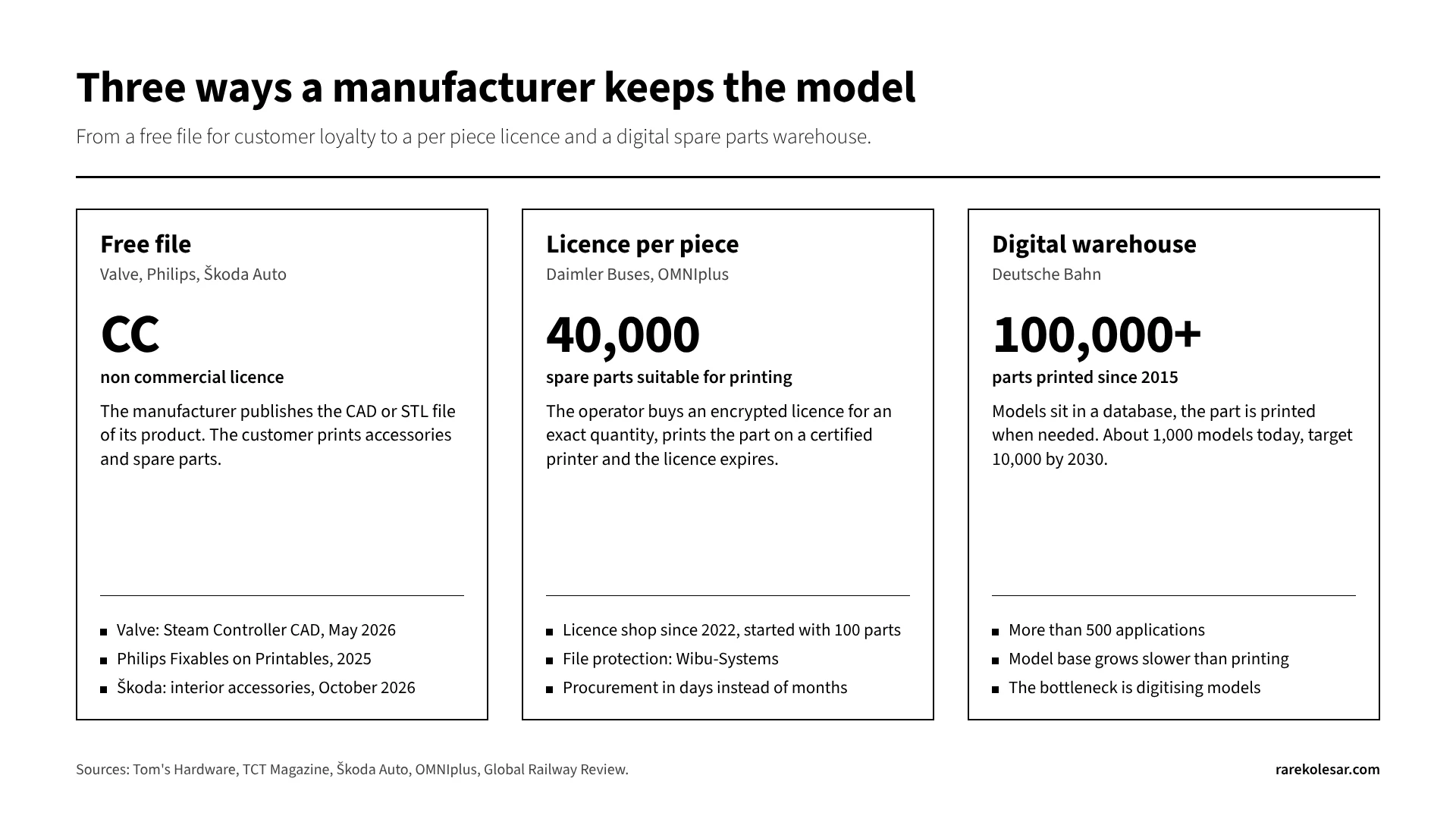
- Valve released CAD files of the outer shell of the new Steam Controller and its Puck on 6 May 2026: STP, STL and an engineering drawing with keep out zones. The files are on GitLab under a Creative Commons BY NC SA 4.0 licence, and commercial use requires a separate agreement. Valve did the same for the Steam Deck in 2022.
- Framework, the maker of modular laptops, keeps CAD files of its devices on GitHub and has an official profile on Printables.
- Philips launched the Philips Fixables programme on Printables in May 2025 together with Prusa Research. The pilot started in the Czech Republic with a single part, a comb for the OneBlade trimmer, plus a form through which users request new parts.
- Škoda Auto has been on Printables since 2024, and on 19 October 2026 it published a collection of free functional interior accessories: cupholders, console organisers, inserts for storage compartments. Some were made specifically for the Epiq and Peaq models. Škoda says it is the first carmaker to offer this through a dedicated platform, and user feedback decides what gets made next.
Prusa Research openly says it wants publishing models alongside products to become the norm. What a manufacturer loses on selling small accessories, it gains in loyalty and in the ecosystem that others build around its product.
But a free file is not the same as a free product. Valve allows only non commercial use. A farm cannot take those files and sell parts.
The industrial version: selling the right to the model, not the part
Consumer examples are interesting, but the real story is in industry. There the model is not given away but licensed.
Daimler Buses has used 3D printing for spare parts since 2016. In 2022 it opened a 3D printing licence shop through its service brand OMNIplus. Around 40,000 spare parts for Mercedes-Benz and Setra buses have been assessed as suitable for printing, and the shop started with the first 100. An operator registers its certified printer, buys an encrypted licence for an exact number of pieces, prints the part and the licence expires. The file is protected by Wibu-Systems technology and the equipment comes from Farsoon. Daimler says procurement takes a few days instead of several months. This is the cleanest example of this article's thesis: the manufacturer sells the right to the model, not the physical part.
Deutsche Bahn printed 100,000 spare parts for more than 500 applications between 2015 and May 2023. The hundred thousandth part was a 570 kilogram gearbox housing for a shunting locomotive, cast in a 3D printed mould. The digital warehouse holds around 1,000 models, and the target is 10,000 by 2030. Notably, the model base is growing more slowly than the number of printed parts. Even for a company of that size, the bottleneck is digitising models, not printing.
Digital warehouse platforms do exactly this: they connect a manufacturer that owns a model with a network of qualified suppliers who print it close to the customer. Replique from Mannheim expanded its cooperation with Alstom worldwide in January 2026, with a network of more than 350 suppliers and a single audit that is valid for the whole network.
Can AI solve the shortage of models?
Partly, and it depends on what you are making.
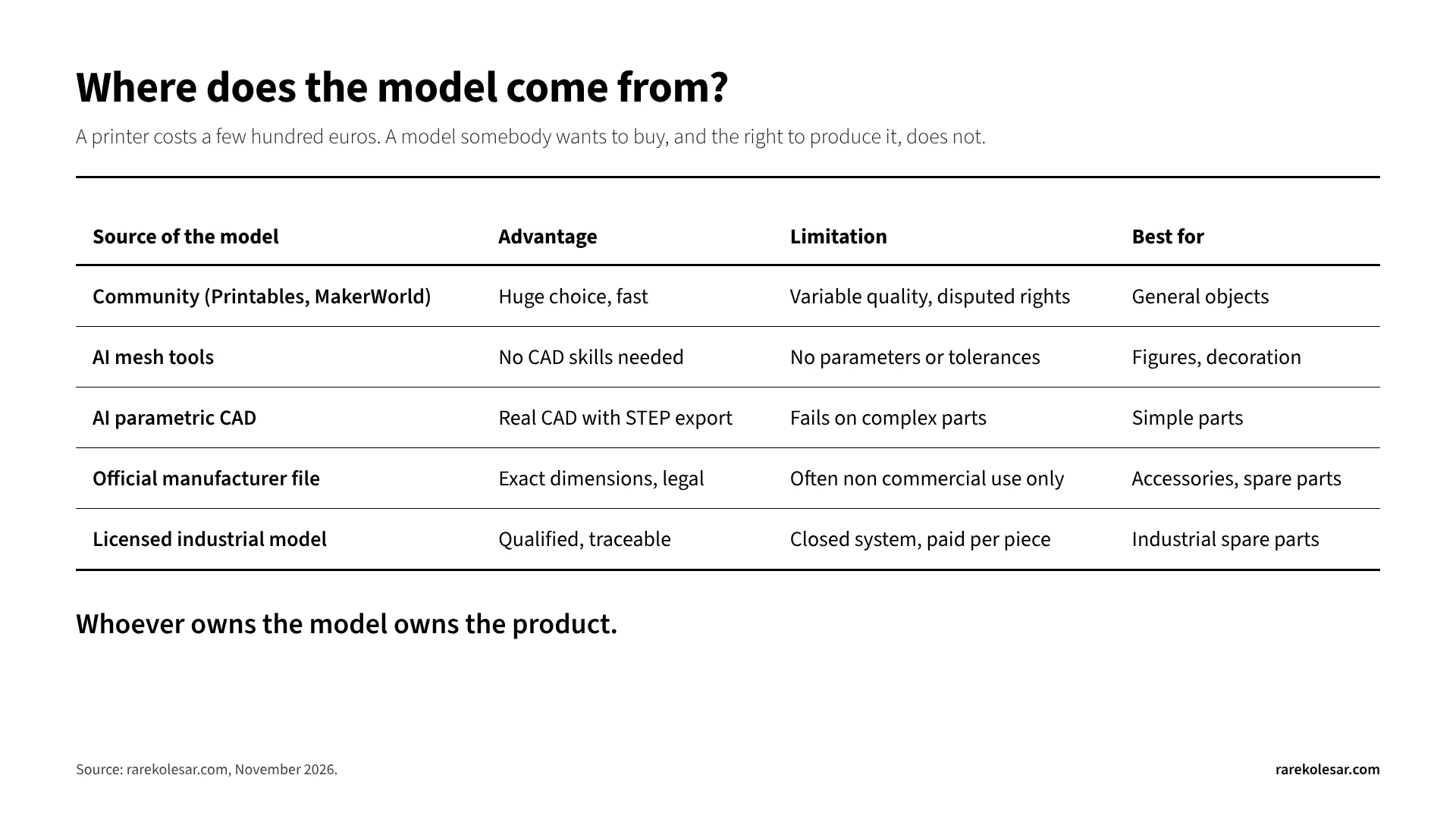
There are two kinds of tools. The first generate a mesh from text or a photograph. They are excellent for figures and decorative objects, which is exactly what Chinese farms print. But they deliver an STL without parameters, dimensions or tolerances.
The second generate parametric CAD. Xometry Pro tested seven such tools in August 2025. Zoo Text-to-CAD produced an accurate 20 millimetre cylinder, but failed on a 24 tooth gear and could not generate a manifold block with internal channels at all. Some other tools in the same test produced the gear correctly. The tools improve month by month, but the message of the test stands: they work for simple parts and not for complex ones.
For industry, the more useful AI right now is the one that digitises existing knowledge rather than inventing new shapes. The French company Spare Parts 3D developed Théia, a tool that reconstructs a 3D model in STEP format from a 2D technical drawing, developed with the French Defence Innovation Agency and the LURPA laboratory. Factories have thousands of old drawings in their archives, and without 3D models they cannot bring them into a digital warehouse.
A functional part still needs tolerances, fits, print orientation, wall thickness and the right material. That is DfAM, and AI does not yet do it in place of an engineer.
| Source of the model | Advantage | Limitation | Best for |
|---|---|---|---|
| Community (Printables, MakerWorld) | Huge choice, fast | Variable quality, disputed rights | General objects |
| AI mesh tools | No CAD skills needed | No parameters or tolerances | Figures, decoration |
| AI parametric CAD | Real CAD with STEP export | Fails on complex parts | Simple parts |
| Official manufacturer file | Exact dimensions, legal | Often non commercial use only | Accessories, spare parts |
| Licensed industrial model | Qualified, traceable | Closed system, paid per piece | Industrial spare parts |
The right to repair helps, but does not open the files
EU Directive 2024/1799 on the right to repair was adopted on 13 June 2024, and member states apply it from 31 July 2026. Article 5 prohibits manufacturers from preventing independent repairers from using spare parts made with 3D printing, provided the parts comply with the regulations. But the directive does not oblige manufacturers to publish CAD or STL files, the repair obligation applies only to the product groups in Annex II, and intellectual property rights remain untouched. In other words, the directive opens the door, but the manufacturer still holds the model.
Serbia is not an EU member and the directive does not apply here directly. But every local manufacturer exporting to the EU works for customers who will increasingly expect exactly this.
What does this mean for our factories?
In the region, 3D printing is still mostly seen as a tool for prototypes and the occasional production aid. In China the same desktop printers have been turned into production lines, and in Germany 3D models have been turned into digital warehouses.
A local farm without its own models can only compete on price, and that against China, where 50 to 60 percent utilisation is already pushing prices down. That is a bad position.
Better questions for a local factory are:
- Which spare parts or production aids do you wait weeks for today, but could have as a file?
- Do you have 3D models of your own parts, or only old 2D drawings?
- Who in your company owns and maintains those models?
- Could you sell your customers a licence for a part instead of the part itself?
Machines have become available to everyone. The advantage will go to those who have the models, the rights to them and the knowledge to turn them into a qualified part.
The printer is a tool. The farm is a factory. The model is the product.
Frequently asked questions
How many printers does the largest print farm in China have? The largest documented operation, Huafast in the Huina Technology building in Shenzhen, has 5,600 Bambu Lab printers in a single plant. According to the founder, the parent company has bought around 15,000 printers for several locations (3D Printing Industry, September 2026).
Is FDM printing real serial production today? For light, short lived consumer products it is. Chinese farms deliver tens of thousands of pieces a week without moulds. For engineering parts, qualification, material and the model decide, not the number of machines.
Why do manufacturers publish CAD files of their products for free? For customer loyalty, an ecosystem of accessories, longer product life and smaller spare parts inventories. Industrial manufacturers such as Daimler Buses go a step further and sell a printing licence instead of the physical part.
Can AI create a model for a functional industrial part? Partly. Parametric CAD tools deliver a usable model for simple parts, but in an independent test from 2025 they failed on a gear and a manifold block. Tolerances, fits and DfAM still require an engineer.
Does the EU right to repair oblige manufacturers to publish 3D files? No. Directive 2024/1799 prohibits preventing the use of 3D printed spare parts, but does not oblige manufacturers to publish CAD files, and intellectual property rights remain an exception.
Sources
- 3D Printing Industry, What Happens When 15,000 Desktop 3D Printers Become a Factory?, September 2026: https://3dprintingindustry.com/news/what-happens-when-15000-desktop-printers-become-a-factory-255060/
- Nanfang Zhoumo via Tencent News, April 2026: https://news.qq.com/rain/a/20260424A08X5T00
- Securities Times (STCN), November 2025: https://www.stcn.com/article/detail/3515534.html
- Science and Technology Daily, November 2025: https://www.stdaily.com/web/gdxw/2025-11/27/content_438640.html
- Huina Technology (300609), financial indicators: https://quote.cfi.cn/quote_300609.html
- Sixth Tone, Pop Mart sues Bambu Lab, March 2026: https://www.sixthtone.com/news/1018258/pop-mart-sues-chinese-3d-printer-company-over-labubu-copies
- Tom's Hardware, Bambu Lab settles with Pop Mart, March 2026: https://www.tomshardware.com/3d-printing/bambu-lab-settles-with-pop-mart-over-labubu-ip-theft-publicly-apologizes-problematic-content-fully-removed-from-makerworld-3d-printing-platform
- Tom's Hardware, Valve Steam Controller CAD, May 2026: https://www.tomshardware.com/peripherals/controllers-gamepads/steam-controller-and-puck-cad-files-officially-released-under-a-creative-commons-license-valve-encourages-users-to-create-accessories-for-the-device
- Printables, Steam Controller CAD Files: https://www.printables.com/model/1712436-steam-controller-cad-files
- TCT Magazine, Philips Fixables, May 2025: https://www.tctmagazine.com/philips-fixables-3d-print-own-replacement-parts/
- Škoda Storyboard, press release of 19 October 2026: https://www.skoda-storyboard.com/en/press-releases/3d-printable-accessories-take-simply-clever-to-the-next-level/
- 3Dnatives, Škoda 3D files, October 2026: https://www.3dnatives.com/en/skoda-3d-files-personalize-your-car-01102026/
- 3D Printing Industry, Printables Brands: https://3dprintingindustry.com/?p=219138
- OMNIplus, 3D printing of spare parts: https://www.omniplus.com/uk/parts/3d-printing/
- Mercedes-Benz Buses, press release, May 2022: https://www.mercedes-benz-bus.com/en_GB/brand/news/2022/daimler-buses-is-revolutionizing-parts-service.html
- 3DPrint.com, OMNIplus eShop: https://3dprint.com/295299/daimler-truck-tackles-spare-part-challenges-with-e-shop-for-3d-printed-parts/
- Global Railway Review, Deutsche Bahn 100,000 parts, May 2023: https://www.globalrailwayreview.com/news/144352/db-use-3d-printing-to-transform-train-maintenance/
- DB Cargo, digital spare parts warehouse: https://www.dbcargo.com/rail-de-en/logistics-news/spare-parts-from-3D-printer-sustainable-and-efficient-10788052
- TCT Magazine, Replique and Alstom, January 2026: https://www.tctmagazine.com/replique-expands-alstom-partnership-globally/
- VoxelMatters, Spare Parts 3D Théia, March 2024: https://www.voxelmatters.com/spare-parts-3d-unveils-2d-drawing-to-3d-model-software/
- Xometry Pro, test of seven Text-to-CAD tools, August 2025: https://xometry.pro/en/articles/text-to-cad-tools-test/
- Bird & Bird, Directive 2024/1799: https://twobirds.com/en/insights/2024/germany/recht-auf-reparatur-richtlinie-veroeffentlicht-auswirkungen-fuer-wirtschaftsakteure-in-der-eu
- Directive (EU) 2024/1799, EUR-Lex: http://data.europa.eu/eli/dir/2024/1799/oj