In short
Major carmakers no longer use additive manufacturing only for prototypes. BMW has produced more than 1.6 million parts at its campus, Hyundai and Kia opened the first center built solely for 3D printing, and GM develops printed parts in house and then hands their production over to suppliers. The common denominator is qualification, not equipment. For suppliers in the region this means new requirements for documentation and process repeatability, but also an opportunity, above all in tooling, jigs, fixtures and spare parts.
What has changed
Over the past year, a quiet but deep shift has taken place at major carmakers. Additive manufacturing (AM), better known as 3D printing, is no longer a tool of the development department. It is becoming part of production infrastructure. OEMs (Original Equipment Manufacturers) are building dedicated centers, appointing dedicated leaders, installing automated lines and putting printed parts into the vehicles they sell.
For automotive suppliers in Serbia, Bosnia and Herzegovina and the wider region, this is more than interesting news. Once an OEM builds a technology into its own production, the next step is almost always the same. The same capability starts to be required from suppliers, through new specifications, material qualification and process documentation.
Hyundai and Kia, the first dedicated center
Hyundai and Kia opened the Additive Manufacturing Solution Center (AMSC) at their Namyang R&D Center in Hwaseong, South Korea. It is the group's first facility built exclusively for additive manufacturing, almost 30 years after the group installed its first industrial 3D printer in 1996.
The center brings polymer and metal under one roof, with more than six processes. DLP and SLA handle fine details and prototypes, while polymer PBF (Powder Bed Fusion) is used for larger and more robust parts. For metal, the center runs LPBF (Laser Powder Bed Fusion) and DED (Directed Energy Deposition), including WAAM (Wire Arc Additive Manufacturing), where an electric arc melts steel, stainless steel, aluminum or titanium wire. The center showed an electric motor housing printed with WAAM and then finish machined on a CNC machine, which is exactly the hybrid workflow that is realistic for machine shops in our region.
An important detail for suppliers is that the AMSC has a dedicated quality control cell. Every part is checked against the same benchmarks as series parts, including dimensional accuracy, tensile strength, bending stiffness and impact resistance. The center recently added two large HSS (High Speed Sintering) printers for full scale polymer parts. Applications range from prototypes to spare parts for discontinued models, including the reconstruction of a side sill component for the Hyundai Pony, the first car Hyundai ever built.
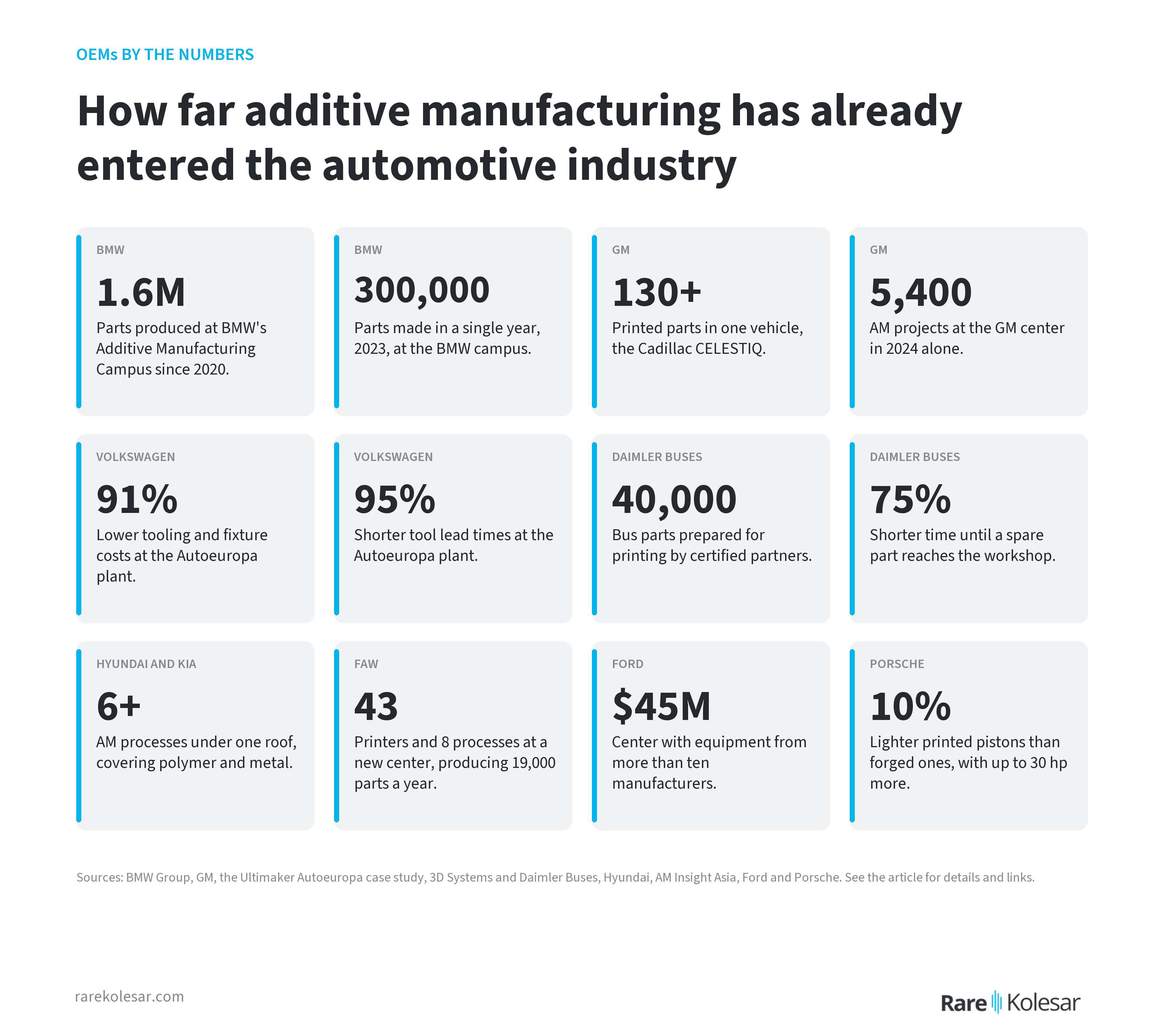
Hanwoo On, Senior Manager of the Additive Manufacturing Solutions Team, said the group is rapidly internalizing the technology and expanding its use beyond vehicle parts into equipment consumables and manufacturing tooling. That this is not an isolated case is shown by China's FAW, which opened its own center soon afterward, with 43 printers and eight processes, for around 19,000 parts a year.
BMW, the most advanced example in the industry
If you are looking for a benchmark of how seriously an OEM can take additive manufacturing, it is BMW. The Additive Manufacturing Campus in Oberschleißheim near Munich, opened in 2020 after an initial investment of 15 million euros, has produced more than 1.6 million parts. In 2023 alone the campus made around 300,000 parts, with roughly another 100,000 a year produced decentrally in vehicle plants worldwide. The split between plastic and metal is about 90 to 10. BMW has used additive manufacturing since 1990 and 1991, introduced its first series polymer parts in 2012 for the Rolls-Royce Phantom, and its first series metal parts in 2017 for the BMW i8 Roadster.
Through the IDAM project, completed in 2022, BMW and its partners set up fully automated, digitally connected metal LPBF lines, one at the campus and one at GKN in Bonn, with a capacity of around 50,000 identical parts and more than 10,000 individual parts a year. Mobile build chambers are moved by driverless transport vehicles. This is not a lab, it is a factory.
Since 2025 the campus has been led by Timo Göbel, who comes with a background in materials engineering and application development, including his time at Rolls-Royce, where he championed additive processes. His move from the industry with the strictest culture of AM process qualification says a lot about where BMW is heading. At AM Forum Berlin 2026 he said BMW needs automation, high productivity, robust operational reliability and acceptable cost per part, and that no one will pay more to use AM just because it is nice. That sentence is worth remembering before any conversation with an OEM.
The next step is WAAM for large metal components. Vehicles with WAAM parts have been in testing since 2025, with series production planned from 2027. Perhaps the most important message for suppliers is BMW's public commitment to open material systems and open interfaces. Closed single brand ecosystems are losing ground to qualified, verifiable production. I wrote about what this means for equipment selection in What vendor neutral means when choosing a machine.
Volkswagen, two different chapters
Volkswagen shows the whole path, from simple savings to production use.
The first chapter is well known in the industry. The Autoeuropa plant in Palmela, Portugal, introduced desktop 3D printers in 2014 to make tools, jigs and fixtures, and according to the case study cut the cost of those tools by 91 percent on average and lead time by 95 percent compared with outsourcing, with 93 percent of tools produced in house. One example from that study shows the math better than the average. A wheel protector for assembly, previously ordered from outside for 800 euros with a 56 day lead time, was printed in house for 21 euros in 10 days. Autoeuropa still uses in house printing for spare parts and for assembly verification before new model launches.
The second chapter is more serious. In 2021 in Wolfsburg, together with HP and Siemens, VW started using metal binder jetting in a production environment and stated at the time that it was the only carmaker using this technology in its production process. The first parts were A pillar components for the T-Roc Cabriolet, around 50 percent lighter than sheet steel parts, and were sent to Osnabrück for certification. The target was up to 100,000 printed parts a year by 2025, and publicly available data does not show whether it was reached. I explained the difference between binder jetting and laser powder bed fusion in Comparing PBF and binder jetting.
What started as tooling savings in one plant has grown into a production technology for the whole group.
GM, Ford, Daimler Buses, Porsche, Toyota and Honda
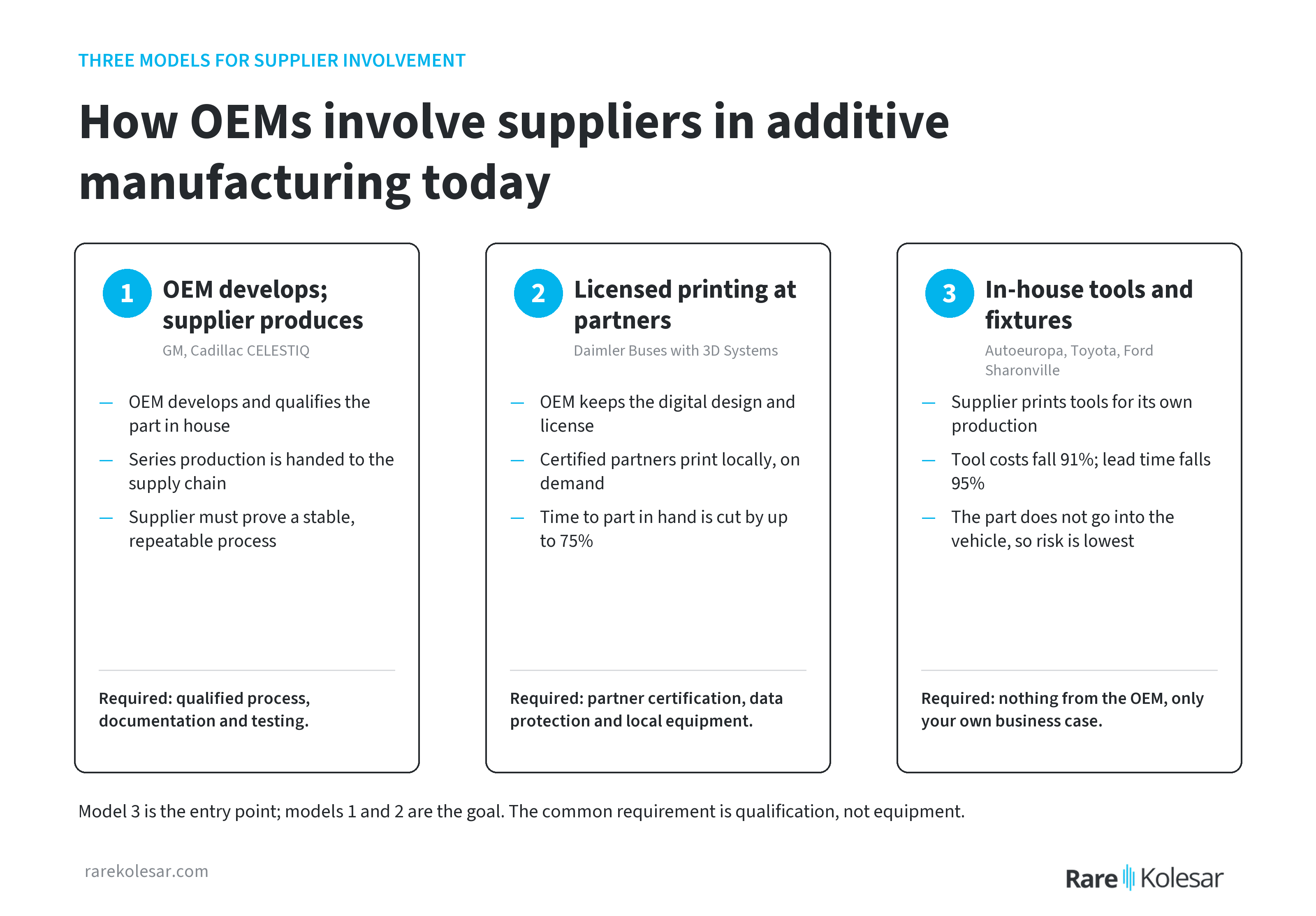
GM. The Additive Industrialization Center in Warren, Michigan, has been running since December 2020 and handled around 5,400 projects in 2024 alone. The Cadillac CELESTIQ, a hand built electric sedan, has more than 130 parts made with additive manufacturing. The steering wheel center, made with metal LPBF, is the largest printed metal part GM has in production, and the seat belt guide loop is its first printed safety related part. The key detail for suppliers is how GM works. It develops the parts in house, then hands their production over to the supply chain.
Ford. At its 45 million dollar Advanced Manufacturing Center in Redford, Michigan, Ford works with equipment from more than ten manufacturers, a good example that a major OEM does not tie production to a single brand. It prints the electric parking brake bracket for the Mustang Shelby GT500 in series, a plastic part that replaced a stamped steel one, and together with Carbon it has shown printed spare parts for the Focus and the F-150 Raptor. Ford's largest volume of printed parts, however, does not come from that center but from the Sharonville Transmission Plant near Cincinnati, where tools and fixtures are printed for its own production.
Daimler Buses. The maker of Mercedes-Benz and Setra buses has printed spare parts since 2017, and around the same year Mercedes-Benz Trucks qualified its first metal spare part, an aluminum thermostat cover. Since January 2025, together with 3D Systems, certified partners print licensed spare parts locally, cutting the time to part in hand by up to 75 percent. Around 40,000 bus parts are already prepared for printing, and in May 2025 a container based mobile mini factory for spare parts was announced. This is a model in which the local service center becomes a manufacturer, with design protection through digital licenses.
Porsche. Together with Mahle, Trumpf and Zeiss, Porsche prints pistons for the 911 GT2 RS, about ten percent lighter than forged ones, with up to 30 horsepower more from the same engine thanks to better cooling. It also prints spare parts for classic models no longer in production, and the holding company Porsche SE is an investor in Seurat, a startup for high volume metal additive manufacturing.
Toyota. Through a partnership with Stratasys spanning more than ten years, Toyota runs a lab in North America with more than 26 printers producing tools, fixtures and end of arm tooling for robots. The internal Toyota Add Lab has been running since January 2023, with examples such as a lighter door assembly fixture and a glass alignment fixture that lets one person do the work of several. In Europe in 2025, Toyota and Fraunhofer ILT printed a large die casting tool insert from a new tool steel.
Honda. Since mid 2020 Honda has used metal LPBF for iron pistons and Inconel turbine housings in its Formula 1 engines, and uses the same technology for racing wheelchair handles tailored to each athlete. Process simulation and parameter optimization are done in house.
What this means for suppliers in the region
All of these examples share the same denominator. Additive manufacturing is moving from experimentation into a qualified production chain. The investments involved, 10 to 15 million euros or more per center, are far beyond the reach of a mid sized company in the region, and that is good news. A supplier does not need to copy the OEM, it needs to specialize. This brings suppliers both an opportunity and an obligation.
The opportunity lies in tools, jigs, fixtures, assembly aids and spare parts. It is the most accessible entry point, with clear economics, as Autoeuropa, Toyota and Ford's Sharonville plant show. If you can demonstrate savings in the order of 90 percent in cost and time on internal tooling, you have a story you can repeat with every customer. I described an example from the region in the article on wire harness tools made with SLS.
The obligation lies in qualification. A model in which the OEM develops a printed part and hands production to a supplier, as at GM, or in which a certified partner prints under license, as at Daimler Buses, assumes the supplier can prove a stable and repeatable process. BMW, Hyundai and Daimler are not only investing in printers, they are investing in inspection cells, material verification and metallurgical analysis. IATF 16949, the quality management standard for the automotive industry, does not yet cover the specifics of additive processes in detail, while ISO/ASTM 52920 sets requirements for qualifying industrial additive manufacturing sites. I explained what this looks like in practice in Process qualification in practice and How a single component is qualified.
Three steps to prepare
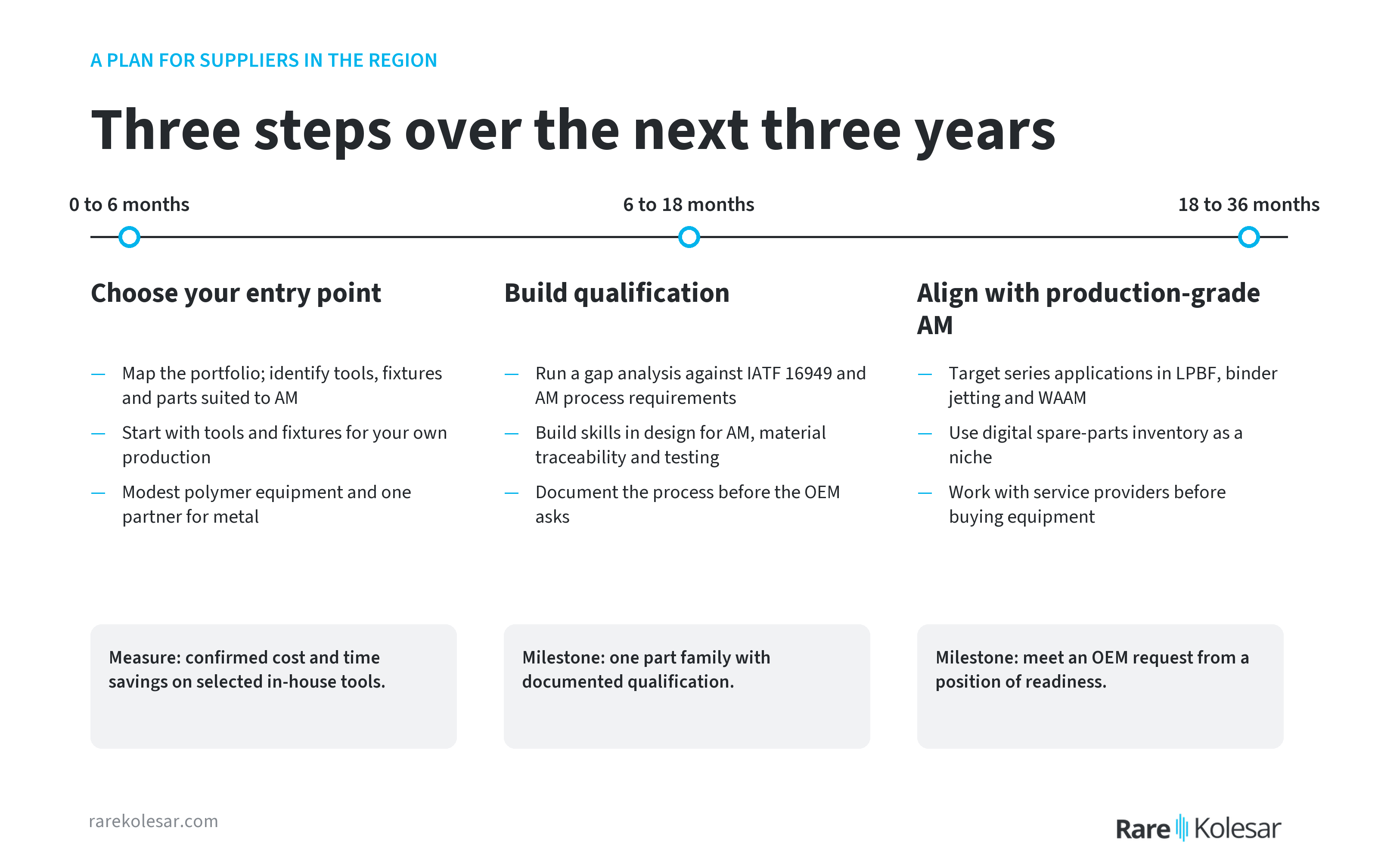
Suppliers have time, but not unlimited time. Over the next three years it makes sense to do three things, in order.
First six months, choose your entry point. Start where the OEMs started and where they still buy from outside. Map your portfolio and identify tools, fixtures and components suited to additive manufacturing because of complex geometry, small batches, frequent design changes or the chance to consolidate several parts into one. Modest polymer equipment, plus one partner for metal, is enough to start. These articles will help, When 3D printing makes sense and when it does not and Assembly consolidation.
Six to eighteen months, build qualification, not just capacity. Run a gap analysis of your quality system against IATF 16949 and the requirements for additive processes. Invest in design for additive manufacturing skills, documented material traceability, and dimensional and mechanical testing. The milestone for moving on is one part family with repeatable, documented qualification against a customer specification. Companies that develop this documentation first will have the advantage when the OEM asks.
Eighteen to thirty six months, align with production grade AM. Target the applications OEMs are moving into series production, metal LPBF for complex low volume parts, binder jetting for higher volumes of structural parts, WAAM and DED for large components, where BMW plans series production from 2027. Watch the digital spare parts inventory model as well, as at Daimler Buses and Porsche Classic, because this is where a smaller supplier can win on speed and low stock. Before investing in your own equipment, consider working with regional AM service providers as a bridge until real demand becomes clear.
Whoever prepares first enters the conversation with the OEM from a position of readiness, not from a position of still learning what is being asked. If you want to check whether additive manufacturing makes economic sense for your parts, see the cost effectiveness assessment.
Frequently asked questions
Are 3D printed parts really going into series production vehicles? Yes. BMW has fitted them in series since 2012, GM has more than 130 such parts in the Cadillac CELESTIQ, and Ford prints the parking brake bracket for the Mustang Shelby GT500 in series. For now these are mostly smaller series and special models. An overview of series production in other industries is given in High volume production of 3D printed parts.
Where is the easiest place for a supplier to start? With tools, jigs, fixtures and assembly aids for your own production. The economics are clearest there and the risk is lowest, because the part does not go into the vehicle.
Does a supplier have to buy equipment right away? No. Working with an additive manufacturing service provider lets you test demand and learn the process before investing.
Which standards matter? IATF 16949 for the automotive quality system and ISO/ASTM 52920 for qualifying industrial additive manufacturing sites. The first does not yet cover additive processes in detail, so internal documentation makes the difference.
What if the OEM starts printing the parts we supply today? That is a signal to move towards what the OEM will not do in house, special materials, metal, or qualification and inspection services. An OEM can print simple tools itself, but a documented and certified process at a supplier is much harder to replace.
Sources
- Automotive World, Hyundai, Kia open dedicated additive manufacturing centre, 2026. https://www.automotiveworld.com/news/hyundai-kia-open-dedicated-additive-manufacturing-centre/
- 3D Printing Industry, Inside Hyundai Motor Group's Additive Manufacturing Solution Center, 2026. https://3dprintingindustry.com/news/inside-hyundai-motor-groups-additive-manufacturing-solution-center-253683/
- 3D Printing Industry, Hyundai Installs New Large-Format 3D Printers for Full-Scale Automotive Parts, 2026. https://3dprintingindustry.com/news/hyundai-installs-new-large-format-3d-printers-for-full-scale-automotive-parts-254607/
- 3Dnatives, Hyundai and Kia Open Dedicated Additive Manufacturing Center in South Korea, 2026. https://www.3dnatives.com/en/hyundai-kia-additive-manufacturing-center/
- AM Insight Asia, China's FAW Opens Dedicated AM Facility, 2026. https://aminsightasia.com/news/faw-additive-manufacturing-center/
- BMW Group, Additive manufacturing moves ever closer to series production, 2026. https://www.bmwgroup.com/en/news/general/2026/additive-manufacturing.html
- BMW Group PressClub, Scalable, automated, open-material, 2026. https://www.press.bmwgroup.com/global/article/detail/T0455924EN?language=en
- TCT Magazine, BMW says broad industrialization of additive manufacturing is on track, 2026. https://www.tctmagazine.com/bmw-says-broad-industrialization-of-additive-manufacturing-is-on-track/
- 3DPrinting.com, BMW Group Expands 3D Printing Operations Under New Leadership, 2026. https://3dprinting.com/news/bmw-group-expands-3d-printing-operations-under-new-leadership/
- Ultimaker and Dynamism, Volkswagen Autoeuropa case study. https://www.dynamism.com/learn/3d-printing/ultimaker-case-study.html
- Metal AM, Volkswagen to adopt Binder Jetting in vehicle production, 2021. https://www.metal-am.com/volkswagen-to-adopt-binder-jetting-in-vehicle-production/
- GM News, Cadillac showcases 3D printed precision with CELESTIQ, 2025. https://news.gm.com/home.detail.html/Pages/topic/us/en/2025/apr/0430-Cadillac-3D-printed-precision-CELESTIQ.html
- Additive Manufacturing Media, 3D Printing for Production at Ford, 2024. https://www.additivemanufacturing.media/articles/3d-printing-for-production-at-ford-the-cool-parts-show-s2e1
- GlobeNewswire, 3D Systems and Daimler Truck, Daimler Buses, 2025. https://www.globenewswire.com/news-release/2025/01/23/3014605/8852/en/3D-Systems-Daimler-Truck-Daimler-Buses-Innovations-Maximize-Vehicle-Uptime-by-Decentralizing-Spare-Part-Production.html
- Porsche Newsroom, Innovative pistons from a 3D printer for increased power and efficiency, 2020. https://newsroom.porsche.com/en/2020/technology/porsche-cooperation-mahle-trumpf-pistons-3d-printer-power-efficiency-911-gt2-rs-21462.html
- Stratasys, Toyota Accelerates Production Innovation with Stratasys, 2025. https://investors.stratasys.com/news-events/press-releases/detail/952/toyota-accelerates-production-innovation-with-stratasys
- 3D Printing Industry, 3D Printing at Honda adds New Value for Automotive Giant, 2025. https://3dprintingindustry.com/news/3d-printing-at-honda-adds-new-value-for-automotive-giant-236994/