How the patent system shaped the market we have today
Summary
Additive manufacturing was invented in the early 1980s, but for almost three decades it was locked by patents in the hands of a small number of companies. The first patent application was filed by Hideo Kodama in Japan in 1980, but it was never granted. The patent for stereolithography went to Chuck Hull in the USA in 1986.
The turning point came when the key patents expired, for FDM in 2009 and for SLS in 2014. The open RepRap project, started in 2005, already had a community that knew how to build a printer at that moment, and manufacturers such as Ultimaker and Prusa Research grew out of it.
Today there are dozens of manufacturers for almost every process, and according to the Wohlers Report 2026 the industry was worth 24.2 billion dollars in 2025. That is why the choice of a machine is no longer limited by patents but by the buyer's knowledge, and why process and part qualification have become essential.
A third way of making a part
Before additive manufacturing, industry knew two basic ways of making a part: removing material, for example by milling or turning, and forming, which includes casting, forging and die casting. Additive manufacturing introduced a third principle, the part is built by adding material layer by layer, instead of removing or reshaping an existing mass.
The first patent that was never granted
The first recorded work on this principle comes from Japan. Hideo Kodama, a researcher at the Nagoya Municipal Industrial Research Institute, filed a patent application on 12 April 1980 for a device that cures photopolymer with UV light, layer by layer. A year later he also published a scientific paper on the same method.
The application was never granted. Not because the idea was not good, but because within one year he was unable to secure the funding and meet the formal requirements needed to keep the application valid.
Hull, stereolithography and the 1986 patent
A few years later, the American Chuck Hull developed the same principle into a concrete system that could be sold. He filed his patent application in 1984 and was granted the patent for stereolithography (SLA) in 1986. The same year he founded 3D Systems.
How was that possible, if Kodama's work had already been published? A patent does not protect a general idea, but a concrete technical implementation: the design of the device, the way it is controlled, and a process described in enough detail that an expert can reproduce it. Hull's application passed examination as such. In addition, searching foreign, especially Japanese, scientific literature was far weaker at the time than it is today, so the examiner may not even have known about Kodama's work.
Laser, powder and extrusion
The same pattern repeated with other processes.
Selective laser sintering (SLS). As a student at the University of Texas, Carl Deckard developed a process in which a laser sinters powder layer by layer. The patent was granted in 1989, and the process was commercialized by DTM, which was later acquired by 3D Systems. In Germany, EOS, founded in 1989, developed and patented its own laser sintering systems, on which metal printing was later built.
Extrusion (FDM). Scott Crump filed a patent for fused deposition modeling in 1989, founded Stratasys the same year, and the patent was granted in 1992. FDM is a registered trademark, which is why the open community still calls the same principle FFF.
Israel. Cubital developed and patented its own photopolymer curing process in the late 1980s, and Objet, founded in 1998, developed photopolymer jetting, known today as PolyJet. Objet merged with Stratasys in 2012.
Patents granted this way kept the technology under the control of a small number of companies for decades. Anyone who wanted a machine for a given process chose between one or two manufacturers.
Timeline
| Year | Event | Why it matters |
|---|---|---|
| 1980 | Kodama files a patent application in Japan | first recorded description of layer by layer photopolymer printing |
| 1981 | Kodama publishes a scientific paper | the principle becomes publicly available |
| 1984 | Hull files an application for SLA | beginning of commercial stereolithography |
| 1986 | Hull is granted the patent, founds 3D Systems | the first additive manufacturing company |
| 1989 | Deckard's SLS patent, Crump files for FDM, Stratasys and EOS founded | three basic processes under patent protection |
| 1992 | FDM patent granted | Stratasys is practically the only extrusion supplier |
| 2005 | Adrian Bowyer starts RepRap | an open source printer that can make parts for itself |
| 2009 | key FDM patent expires | the first commercial manufacturers emerge from the RepRap community |
| 2014 | key SLS patents expire | new powder system manufacturers enter |
| 2025 | the industry is worth 24.2 billion dollars | dozens of manufacturers for almost every process |
RepRap and the community that was waiting
When the FDM patent expired in 2009, a community that knew how to build a printer already existed. The RepRap project was started in 2005 by Professor Adrian Bowyer of the University of Bath in the United Kingdom, with the idea of an open source printer that can print a large share of its own parts. By the time the patent expired, the project already had mature designs, such as the Darwin and Mendel models, and an active community around the world.
The manufacturers that shaped the desktop market grew out of that community. Erik de Bruijn, a member of the RepRap core team, co-founded Ultimaker in 2011. Josef Průša, also from the project's core team, developed the simplified Prusa Mendel design and founded Prusa Research in 2012. In Barcelona, RepRap work at the Polytechnic University of Catalonia produced a team in 2011 that later became BCN3D. Bogdan Kecman from Belgrade is also on the RepRap core team list.
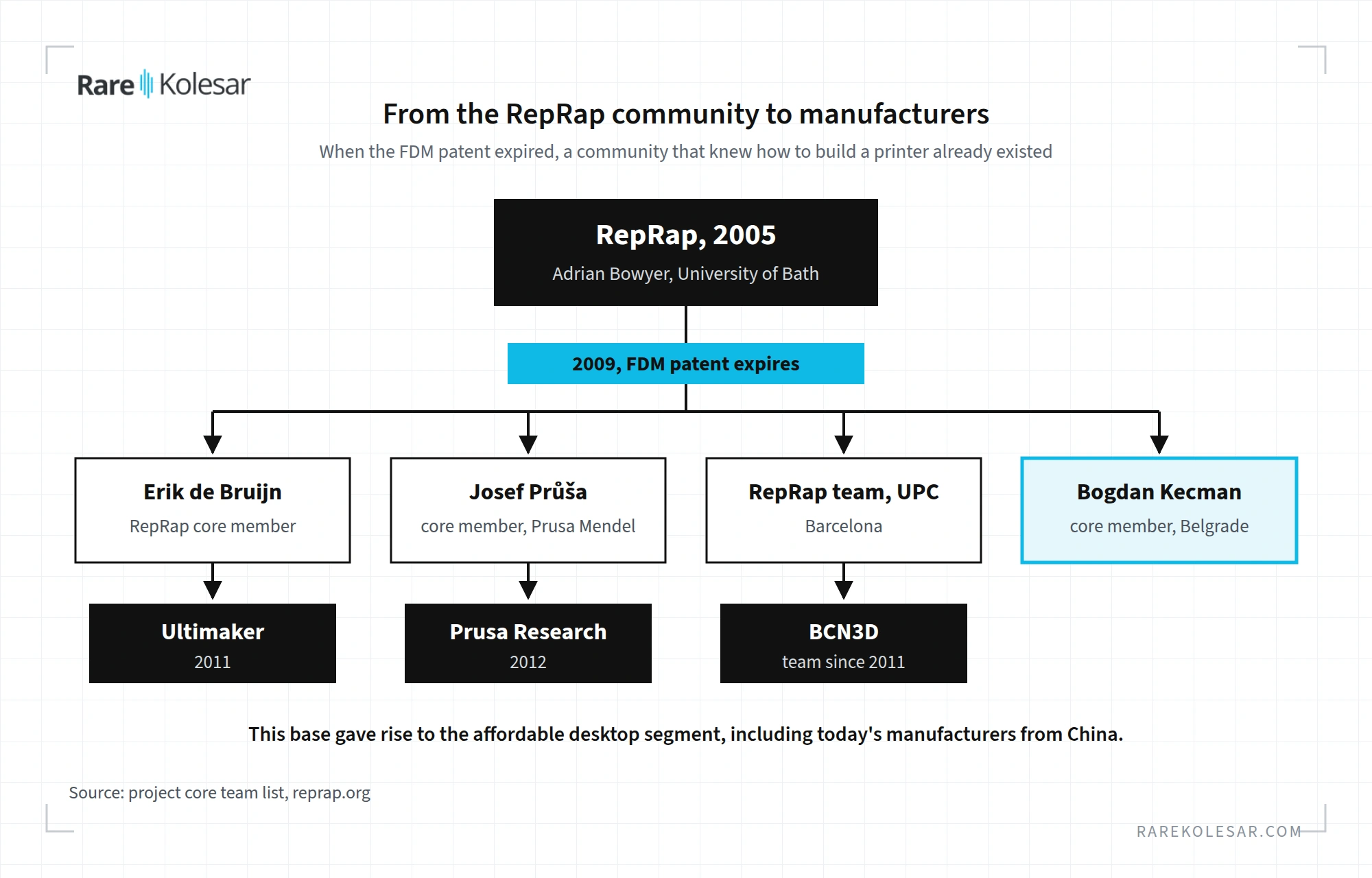
This base gave rise to the whole segment of affordable devices, including the manufacturers from China that dominate the desktop market today.
With SLS the pattern was similar, but slower. When the key patents expired in 2014, new powder system manufacturers appeared, but entering that market is more expensive, so the change was felt gradually.
Patent disputes are not a thing of the past
The gap in the Kodama and Hull story, that a patent office does not always find all relevant prior work, is not a historical curiosity. Similar disputes are still being fought in the additive industry today.
The most visible example is the dispute between Stratasys and Bambu Lab. In September 2026 a jury in Texas found that Bambu Lab had infringed four Stratasys patents and awarded damages of about 27.6 million dollars. Bambu Lab has announced an appeal, and two other patents from the same dispute had earlier been invalidated by the US Patent Trial and Appeal Board. In Europe, the Unified Patent Court in April 2026 rejected Stratasys' request to block sales of Bambu Lab's H2C, concluding that the device does not infringe the patent.
Same technology, two markets and two different outcomes. For the buyer this means that patent risk does not disappear when the key patents expire, it simply moves to the details.
Why this history matters today
While the technology was locked by patents, there was practically no choice of machine. Options were limited by law, not by real technical differences between suppliers. The expiry of the patents changed that at the root. Today there are dozens of manufacturers for almost every process, from FDM and SLS to metal processes such as powder bed fusion (PBF) and binder jetting.
| Before patents expired | Today | |
|---|---|---|
| Manufacturers per process | one or two | dozens |
| Entry price | high, no alternative | from affordable to industrial systems |
| Who decides the choice | patent law | the buyer |
| Main risk | limited choice | wrong choice |
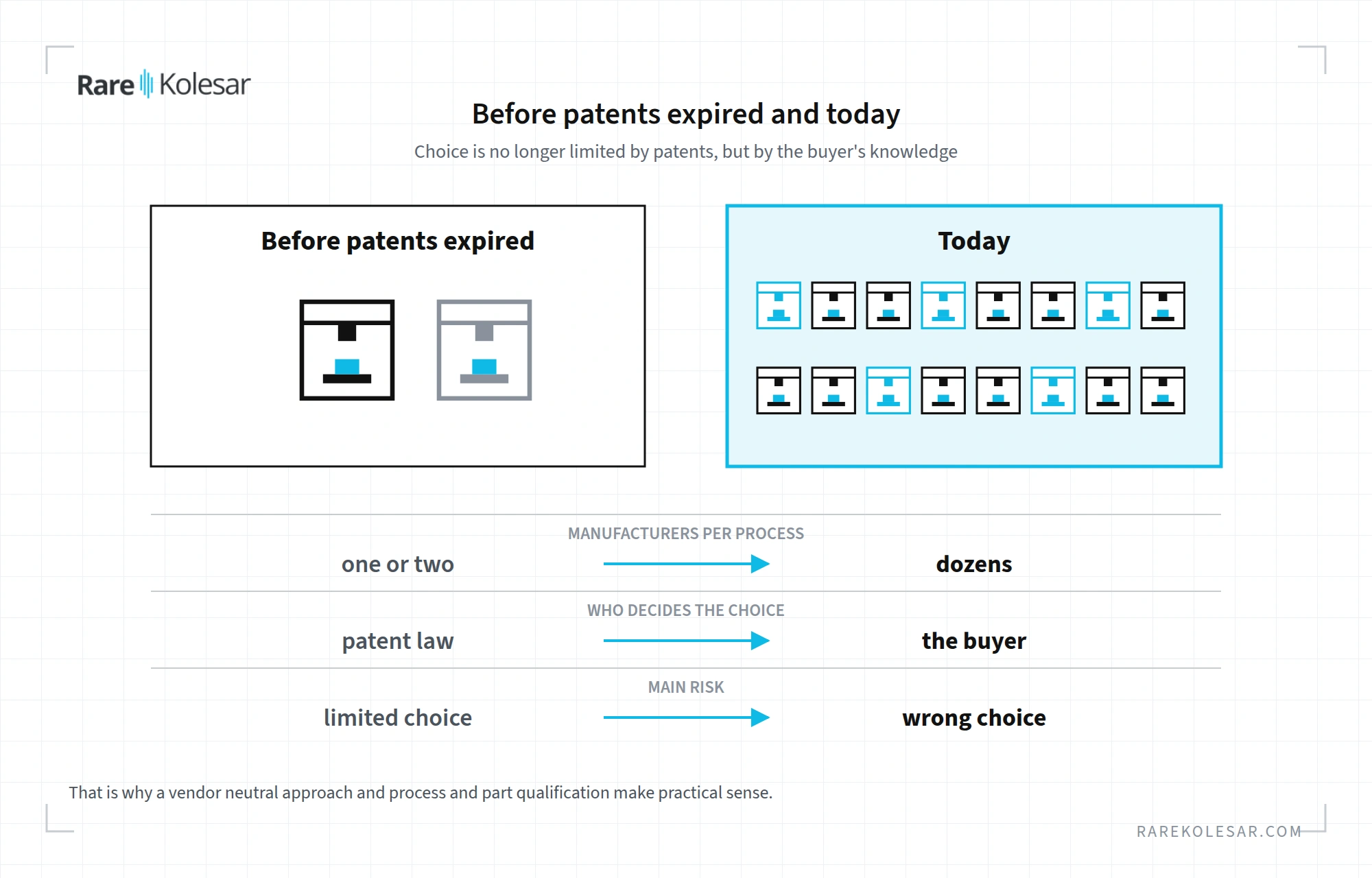
This diversity brings a new problem. When the choice was limited by patents, there was little room for error. Today the responsibility for the right choice lies entirely with the buyer. That is why a vendor neutral approach, without being tied to one manufacturer, makes practical sense, and why process and part qualification become critical. The technology is available to everyone, but checking whether a specific machine and a specific part really fit the purpose remains with the one who chooses.
For context on the vendor neutral approach, see what vendor neutral means when choosing a machine. For qualification of the process itself, see what process qualification looks like in practice, and for checking a specific part, how a single part gets qualified for production.
Frequently asked questions
Who invented 3D printing? The first patent application for layer by layer photopolymer printing was filed by Hideo Kodama in Japan in 1980, but it was never granted. The first granted patent and the first company belonged to Chuck Hull, who patented stereolithography in 1986 and founded 3D Systems.
Why did Kodama not get a patent? Within one year of filing he was unable to secure the funding and meet the formal requirements needed to keep the application valid, so the application lapsed.
How could Hull patent something that had already been published? A patent does not protect a general idea, but a concrete technical implementation. Hull's application described a fully developed system, and searching foreign scientific literature was weak at the time, so the examiner may not even have known about Kodama's work.
When did the 3D printing patents expire? The key FDM patent expired in 2009 and the key SLS patents in 2014. After that, many new manufacturers entered the market.
What is RepRap? An open source printer project started in 2005 by Adrian Bowyer of the University of Bath. Manufacturers such as Ultimaker, Prusa Research and BCN3D grew out of its community.
Do patents still affect the choice of a 3D printer today? They do, but differently than before. The basic processes are free, but disputes are fought over individual solutions, as in the case of Stratasys and Bambu Lab, with different outcomes in the USA and in Europe.
Sources
- Kodama's patent application JPS56144478A, Google Patents
- 3D Printing Journal, Kodama and the 1980 application
- Hull's patent US4575330, Google Patents
- Deckard's patent US4863538, Google Patents
- Crump, patent US5121329, Google Patents
- RepRap, project core team list
- TCT Magazine, BCN3D and RepRap
- TCT Magazine, Stratasys v. Bambu Lab verdict, 2026
- Makers101, Unified Patent Court ruling on the H2C, 2026
- Design News, Wohlers Report 2026