Low volume production of metal parts, additive and casting
Summary
This is one of my early ideas. The question was simple. How do you make an aluminium or steel part in quantities from one to a few hundred pieces, quickly and at a reasonable price, when the foundry asks for expensive tooling and a minimum order, and machining from solid becomes too expensive?
My answer was a combination of three steps. 3D printing makes the molds, cores or patterns for casting. The metal is cast in the usual way, by sand casting or investment casting. Machining is done only on the surfaces where accuracy is needed. No tooling, no minimum order, and a single piece is possible.
The first results were good and technically successful. The idea stalled because of the market, not because of the technology. Today foundries and pattern shops around the world use a similar approach, and the shortage of low volume castings troubles even the largest buyers, such as the US Navy. I believe this is still an open opportunity for the region.
The problem I wanted to solve
This is one of my earlier ideas, where I tried to solve a real industrial problem: how to enable fast and cost effective production of aluminium and steel parts in small batches, when conventional foundries do not want to make them and CNC machining is too expensive or limited by complexity.
The goal was simple. Use additive technologies to eliminate tooling and molds, and combine that with casting to get a finished metal part quickly, without large costs and without minimum quantities.
Industry constantly needs small batches, prototypes and spare parts. This includes factory maintenance, machine builders, agricultural and mining equipment, pumps and valves, marine equipment and defence.
For such a part there are two usual routes today, and both are poor for small quantities.
The first route is conventional casting. The foundry needs a pattern or tooling, and for investment casting a metal die for injecting wax. The tooling costs thousands, often tens of thousands, and takes weeks to make. For ten pieces that makes no sense, so foundries often turn small orders down.
The second route is machining from solid. For a simple part this is a good solution. For a complex part, with internal cavities and curved surfaces, a large share of the material ends up as chips and the machine runs for hours. The cost per piece becomes unacceptable.
Old machines and imported equipment are an especially hard case. A part breaks, there are no drawings, and the original manufacturer no longer exists or does not answer. The factory waits for months while the line stands still.
The core of the concept
The concept has three parts.
Producing molds, cores or patterns by 3D printing. For sand casting, the mold itself and the cores are printed in sand with a binder. For investment casting, a pattern is printed in wax or in a castable resin that burns out in the process. In both cases there is no conventional tooling.
Casting metal without conventional tooling. The foundry pours aluminium, steel, cast iron or bronze the same way it always does. Only the origin of the mold or pattern changes.
Machining where needed. Only mating surfaces, holes and threads with tight tolerances are machined. The rest of the part stays as cast.
There is no need for a batch. A single piece is possible.
How the idea works, step by step
- Input data. The customer brings a 3D model, a drawing, or just an old, worn part. When there are no drawings, the part is scanned and a 3D model is built from the scan. I wrote more about this step in Reverse engineering and 3D scanning as an entry point to additive manufacturing.
- Preparing for casting. The model is adapted for casting, with machining allowances, metal shrinkage, the gating system and risers. This is foundry work, done by a casting engineer, not by a printer operator.
- Choosing the route. Larger and medium sized parts in aluminium, cast iron and steel go to sand casting with a printed mold and cores. Smaller, thin walled and precise parts go to investment casting with a printed pattern.
- Printing. Sand molds are printed with sand Binder Jetting. Investment casting patterns are printed in wax or castable resin, on SLA, DLP or wax jetting machines.
- Casting. The foundry pours the metal. For investment casting, the pattern is first coated with a ceramic shell and then burned out or melted out.
- Finishing and inspection. The casting is cleaned, heat treated if needed, machined on functional surfaces and measured.
Why the idea was realistic
Industry constantly needs small batches, prototypes, spare parts and specific components. The problem is that conventional foundries turn down small quantities, and CNC is often too expensive and too slow.
This concept removed all the key obstacles:
- no minimum quantity,
- no special tooling,
- no limits on geometry,
- fast, stable and repeatable.
A printed core can have a shape that a conventional core box cannot make, or that would need to be assembled from many pieces.
The technology is neither new nor unproven. Sand Binder Jetting is a mature technology in foundries. The difference between sand Binder Jetting and metal Binder Jetting is explained in Metal additive manufacturing, Powder Bed Fusion versus Binder Jetting. Printed patterns for investment casting have also been in use for years.
Most importantly, the whole chain is fast, stable and repeatable. The same file gives the same mold today and in five years. The file is stored instead of tooling on a shelf.
Comparison with other routes to a metal part
| Route | Tooling | Suitable quantity | Lead time | Complex geometry | Main limitation |
|---|---|---|---|---|---|
| Machining from solid | Not needed | From one piece | Short for simple parts | Limited, internal cavities are hard | Lots of chips and machine time on complex parts |
| Conventional casting with tooling | Pattern, core box or wax die | Hundreds and thousands of pieces | Weeks to months because of tooling | Limited by the tooling | Tooling cost does not pay off at small quantities |
| Casting with a printed mold or pattern | Not needed | From one to a few hundred | Days to a few weeks | Very free | Needs a foundry that accepts this workflow |
| Direct metal 3D printing | Not needed | From one piece | Days to weeks | Most free | High cost per part, limited part size |
Choosing between these routes follows the same rule as any technology decision. Geometry, quantity and total cost decide, not the technology itself. I wrote about the break even point in When 3D printing makes sense and when it does not.
What already exists in the world
This model is not theory. Here are several verified examples from recent years.
ACTech, Freiberg, Germany. A Materialise group company that makes prototype castings and small series without tooling, in aluminium, cast iron, steel and titanium. It has its own sand mold printing, foundry and machining in one place. According to its managing director in 2025, delivery time is three to five weeks depending on the project, and the company has about 1,700 customers in 40 countries. This is the closest example of what I had in mind.
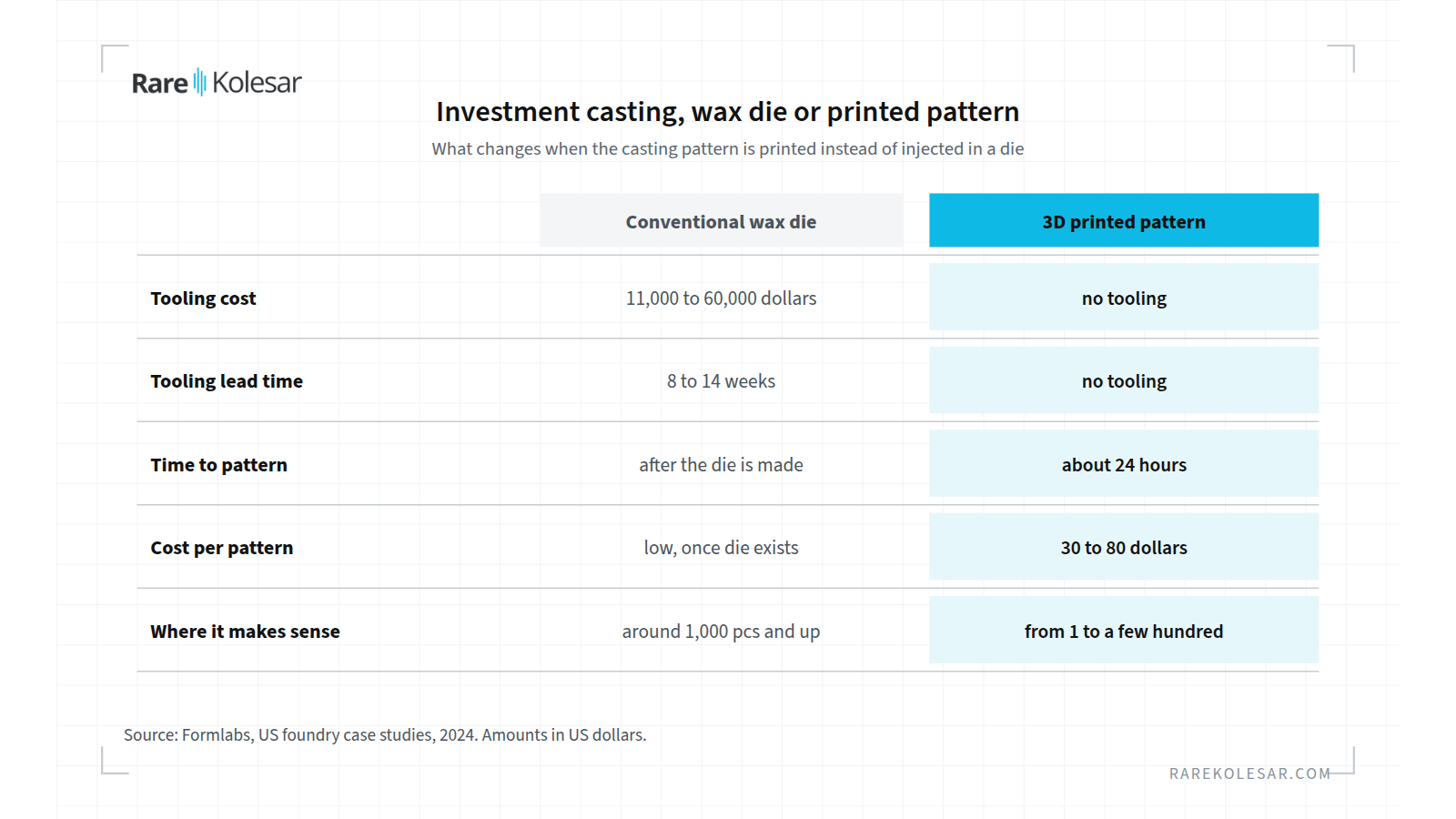
Diversified Metalsmiths, USA. An investment casting foundry that makes impellers, pump housings and valves. It prints castable resin patterns in house. According to a 2024 case study by the printer manufacturer, a pattern takes 24 hours instead of two weeks, and the pattern cost dropped from about 300 to about 80 dollars. The foundry only orders wax tooling when a customer asks for around a thousand pieces, because such tooling can cost around 30,000 dollars. In the same material, the manufacturer gives examples of wax dies from about 11,000 dollars with an 8 week lead time to about 60,000 dollars with a 14 week lead time, while a printed pattern of the same parts cost about 30 to 80 dollars.
Marine equipment in Thailand. A paper published in 2024 in the International Journal of Metalcasting describes how Speed 3D Mold, together with Chiang Mai University, prints sand molds for marine propellers, pumps and spare parts for old and imported equipment. When there are no drawings, the old part is scanned. The authors point out that broken parts can be replaced within relatively short time periods.
The US Navy. Castings are one of the weakest points in the supply chain for submarine construction. According to Defense News in 2023, more than 100 sequence critical parts were delivered more than 300 days late on average. The Navy is therefore approving the replacement of some cast parts with additively manufactured ones. This shows how real the problem of low volume castings is, even for the largest buyers.
The equipment market. Sand printer manufacturers have consolidated. After the Desktop Metal bankruptcy, ExOne GmbH came under the ownership of Anzu Partners in 2025. Anzu had earlier acquired voxeljet, and then merged both businesses into one company. Together they have installed more than 500 systems. Foundries are customers with a stable need, and this part of the market survived.
The figures on lead times and costs in these examples come from company and manufacturer sources. I take them as an order of magnitude, not as a guarantee for every part.
Where the idea stopped
The concept was technically sound, but the market at that time was too conservative. For a service like this to succeed, it needs:
- large infrastructure,
- access to foundries that want a partnership,
- a strong sales channel to Western Europe,
- patience for a long process of educating the market.
Without significant investment and a system behind it, the idea could not grow into a sustainable business model, even though the first results were good and technically successful.
What is different today
Some of the barriers are smaller than before.
Printing investment casting patterns has become accessible to smaller foundries. The US example shows that a foundry can print its own patterns without a large investment.
Spare parts and supply chains have become a topic for factory management, not only for maintenance. When the line stands still, the price of the part matters less than the lead time.
3D scanning is faster and cheaper, so the path from an old part to a new model is shorter. I described this step in more detail in the idea Centre for reverse engineering and additive manufacturing. Part files can be stored systematically, which is the topic of the idea Central laboratory for digital documentation.
What is needed to start
People. A casting engineer who knows how to prepare a part for casting. A designer who does 3D modelling and scanning. Someone who knows printing technologies and the materials for molds and patterns.
Equipment. For investment casting, a printer for wax or castable resin patterns. For sand casting, a sand Binder Jetting system, or at first contract manufacturing of molds from someone who already has one. A 3D scanner. Machining, in house or with a partner.
Partners. A foundry willing to take small orders through this workflow. This is the key partner, and without it the idea does not work. Then customers with real needs, above all factory maintenance and machine builders.
The smartest start is without buying equipment. First a few real parts through contract manufacturing of molds and patterns, with one foundry. Only when volume and repeatability are visible does it make sense to invest.
Risks and open questions
Casting quality. Porosity, shrinkage and tolerances depend on the foundry and the preparation, not on the printer. Critical parts need testing and documentation. I described how this works in practice in What process qualification looks like in practice.
Liability. Who is responsible for a part scanned from an old, worn original? This must be clearly agreed with the customer.
Cost per piece. A printed mold or pattern costs more per piece than a conventional one once the tooling already exists. This model wins only up to a certain quantity.
Foundry readiness. This was the main barrier before and it remains an open question.
For me
This idea taught me the difference between technical feasibility and market reality. It taught me how slowly industry adopts new processes, even when they are more rational, faster and cheaper. And it showed me that sometimes an idea is good, but the ecosystem is not yet ready to accept it.
I still believe this idea makes sense, especially in the region, where there are foundries, a tradition of machining and many old machines that need to be maintained.
Let's talk about applications
Interested in this idea, or would you like to talk? If you have a part that foundries turn down because the quantity is too small, or a spare part with no drawings, get in touch through the Consulting page. If you are a foundry thinking about this workflow, I would especially like to hear about your experience.
Frequently asked questions
Is a casting made in a printed mold as good as a conventional casting? The metal and the casting method are the same, so the properties can be the same. Quality depends on the foundry, the casting preparation and the inspection, just as with conventional casting.
Up to what quantity does this approach pay off? There is no single number. It depends on the tooling cost you do not pay and on the cost per mold or pattern. In the example of one US foundry, wax tooling is only introduced at around a thousand pieces.
Which metals can be cast this way? Aluminium, cast iron, steel, bronze and other metals the foundry normally casts. Printing changes only the mold or the pattern, not the metal.
When is direct metal 3D printing the better choice? When the part is small, very complex and needed in a few pieces, or when it requires a geometry that cannot be cast. For larger parts, casting with a printed mold is usually cheaper.
What if I have no drawing of the part? The old part is scanned and a 3D model is built from the scan, with allowances for casting and machining. A designer needs to check the functional dimensions.
Sources
- Industrial Investment Casting With 3D Printed Patterns Using Clear Cast Resin, Formlabs, 2024
- How Diversified Metalsmiths Uses Clear Cast Resin, Formlabs, 2024
- Precision in prototype production, ACTech GmbH, DMG MORI, 2025
- Case Studies Experience in Using 3D Sand Printing to Produce Molds for New and Replacement Cast Components, International Journal of Metalcasting, 2024
- Manufacturing woes could sink US sub fleet. Can 3D printing save it?, Defense News, 2023
- Anzu Partners affiliate receives court approval to acquire ExOne GmbH and ExOne KK, TCT Magazine, 2025
- Anzu Partners combines ExOne GmbH and voxeljet into single business, TCT Magazine, 2025