Central laboratory for digital part documentation
Summary
I propose a central laboratory that creates a complete digital record for every critical part. That means a 3D model from scanning, material data, drawings, test results and the history of every production run or repair, all tied to one unique ID. When the part is needed, nobody waits for procurement. The part is made or repaired from a record that already exists.
The idea is meant for large industrial systems in oil and gas, energy and shipping, where one day of downtime costs more than a full year of running such a laboratory. The biggest benefit is not one quickly produced part. The biggest benefit is that technical knowledge about parts stops depending on individuals, old drawings and suppliers that no longer exist.
This is not a contract manufacturing service for the open market. It is internal knowledge infrastructure for one large organization or a group of companies, with its own production capacity.
The problem this laboratory solves
Large plants hold thousands of spare parts. For many of them the documentation is incomplete, outdated or missing. The original equipment manufacturer may have stopped making the part, changed its name or closed the factory. The engineer who knew how to repair the part has retired.
When such a part fails, a chain begins that everyone in maintenance knows well. Emergency procurement, manual measuring, searching for a workshop that can copy it, then waiting for weeks or months. Meanwhile the equipment stands still or runs at higher risk.
Who has this problem:
- refineries, wells and platforms, where parts are expensive and logistics are long
- power plants and grid operators, where equipment is old and has been in service for decades
- ship owners and shipyards, where a vessel cannot wait in port for a delivery
- large manufacturing systems with their own maintenance and equipment from different generations
How the laboratory works, step by step
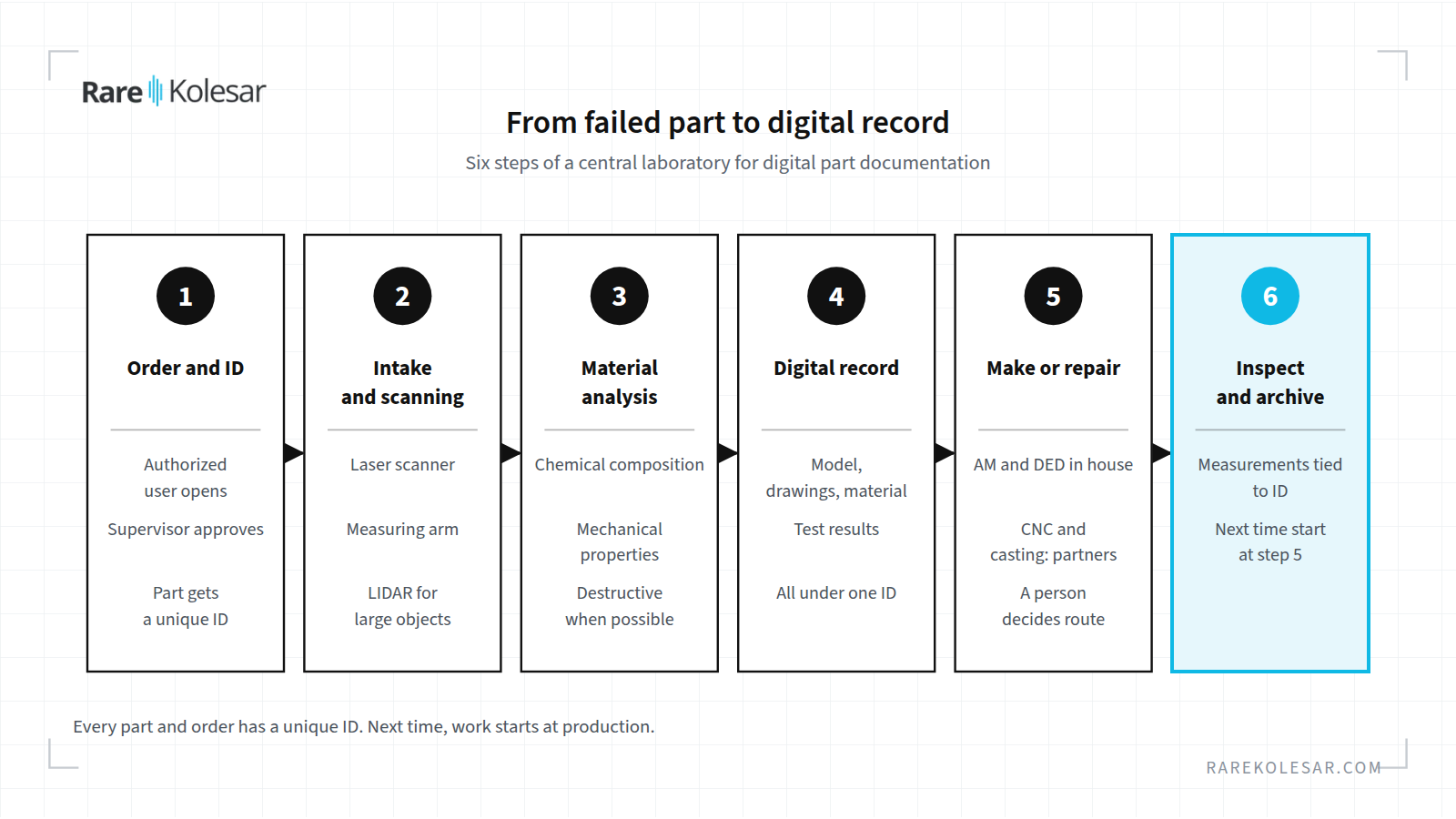
- Order and ID. Anyone with permission opens an order in the system. One person starts the order and a supervisor approves it. The part and the order receive a unique ID.
- Part intake. The part physically arrives at the laboratory, together with all the data maintenance has about it.
- Scanning and measuring. The part is scanned with a laser scanner and measured with a measuring arm. For large objects such as pipelines, boilers and power lines, LIDAR scanning is used, which also shows deformation and bending.
- Material analysis. Chemical composition and mechanical properties are determined. When the client or an engineer decides the part can no longer be used, destructive testing is also done, because it gives the most reliable data.
- Digital record. The 3D model, drawings, material data and test results are stored together under the same ID.
- Production or repair. A person, supported by the system, decides which route the part takes. Additive manufacturing and repair by metal deposition (DED) are done in the laboratory. Machining and casting go to verified partners.
- Inspection and archive. All measurements and reports are tied to the part and the order. The next time the same part is needed, work starts from step 6.
Structure of the laboratory
Software system
The core of the process is software that gives every part and every order a unique ID and tracks it through all stages of work. All 3D models, drawings, material data and test results are stored together. Fragmented documentation disappears, and so does the loss of knowledge when people leave.
The system is separate from the client's ERP and MES systems and exchanges data with them through an API connection. This way the laboratory does not depend on one IT environment and does not disrupt existing systems. Clients have access for preview, status tracking and ordering. From the start, the system includes artificial intelligence that follows the history of parts and suggests improvements, topology optimization and better materials. I wrote about a reasonable attitude toward AI tools in AI in 3D printing, where it really helps and where it does not.
3D scanning
The laboratory uses laser scanning and a measuring arm for precise measurement, from small parts to large assemblies. LIDAR scanning is used in the field, for refineries and power lines, including checks for deformation of boilers and burners and bending of pipelines. Scanning is the basis of reverse engineering, which I described in detail in Reverse engineering and 3D scanning as an entry point to additive manufacturing.
Material testing
The laboratory determines the chemical composition and mechanical properties of materials. When possible, it also performs destructive tests. Every result is permanently linked to the digital model of the part. Without this step, a copy of a part is only a copy of its shape, not of its function.
Production and repair
The laboratory has advanced manufacturing capacity, meaning additive manufacturing of metals and polymers, plus a metal deposition (DED) system for repairing and building up damaged metal components. I am considering a five axis machine that combines milling and DED, a robotic DED cell, or both. DED is also interesting for making and refurbishing drilling heads. The part value threshold above which repair is automatically considered before buying a new part still has to be defined.
Machining and casting are not part of the laboratory. Partners handle them, while the laboratory provides documentation and inspection.
Quality control
All data, measurements and reports are linked to the part and its order. This makes results repeatable and builds a knowledge base. For industries such as oil and gas and shipping there is also a clear framework, the DNV-ST-B203 standard for additively manufactured metal parts, which sets requirements according to part criticality. I explained what this looks like in practice in Process qualification in practice and How a single part gets qualified for production.
What already exists in the world
This idea is not theory. Parts of this model already work in large companies.
- Deutsche Bahn has been producing spare parts with additive manufacturing since 2015 and has passed 100,000 parts. Its digital warehouse holds about 1,000 models, with a target of about 10,000 by 2030. I described this example in more detail in the post on reverse engineering.
- Equinor reports oil and gas examples where lead time was cut from 40 to 10 weeks. Together with TotalEnergies, Shell, ConocoPhillips and Vår Energi it works on a shared digital supply network for parts.
- Wilhelmsen and Ivaldi developed on demand delivery of maritime spare parts from 2019, with DNV as an independent assurance party, including a part tracking system and a traceability registry for every part. This was one of the first cases where unique part identification was introduced as the basis of trust.
- A 2026 study of a large pulp and paper manufacturer found that only about 1 percent of the analysed spare parts were economically suitable for additive manufacturing. But that small share carries large savings, because these are expensive parts with rare demand and long, unpredictable lead times.
I do not hide the last finding, because it matters. Additive manufacturing will not replace the warehouse. That is why documentation, not the printer, is at the centre of my idea. A digital record has value for every critical part, whether the part ends up printed, repaired, cast or machined.
Conventional warehouse versus digital documentation
| Question | Conventional approach | Central laboratory |
|---|---|---|
| Where knowledge about the part lives | In people's heads, old drawings and with suppliers | In one digital record under a unique ID |
| What happens when a part fails | Emergency procurement and waiting | Production or repair from the existing record |
| Material data | Often unknown or assumed | Measured and permanently linked to the model |
| Repair instead of replacement | Rare, depends on individuals | Systematically considered for valuable parts |
| Dependence on equipment manufacturers | High, especially for old parts | Much lower |
| Next identical failure | Starting from scratch | Work starts from a ready record |
Benefits that are hard to measure
The direct benefits are faster response and lower costs. But the main effects appear in an area that is hard to measure:
- stable technical knowledge, regardless of who works in the company
- control over the whole life cycle of a part
- lower risk in demanding environments
- more predictable maintenance planning
- far fewer emergency purchases
- higher operational safety
- lower hidden costs, for example stock that sits for years just in case
In industries with a high cost of downtime, a system like this changes the logic of maintenance.
Payback estimate
The investment depends on the size and capacity of the laboratory. I picture it at the scale of one building with about 12 employees, starting with one location. Later the model can be replicated, fully or partly, at more locations, depending on the analysis.
The largest savings come from:
- drastically shorter waiting for parts
- repair instead of buying a new part
- fewer emergency purchases
- more stable maintenance
- a shorter logistics chain
- lower risk of production stoppage
In my experience, on critical equipment and in sectors where downtime is expensive, a system of this kind very often pays for itself in less than a year. This does not hold for every plant. That is why the analysis always starts from the parts list and the cost of downtime, not from choosing equipment. I do this kind of work through my production analysis.
What is needed to start
| Area | What is needed |
|---|---|
| People | Engineers for scanning and reverse engineering, a materials and testing engineer, operators for additive manufacturing and DED, a person for quality and documentation |
| Equipment | Laser scanner, measuring arm, LIDAR for field work, equipment for chemical and mechanical analysis, machines for metal and polymer additive manufacturing, a DED system |
| Software | CAD, reverse engineering software, software for 3D printing preparation and optimization, a system for IDs, orders and archive with an API link to ERP and MES |
| Partners | Machining and casting workshops, accredited laboratories for tests not done in house, a certification body for critical parts |
| Training | Selecting engineers, long term training and support |
People are the most important item on this list. I wrote about this in The human factor in additive manufacturing. Software is the second thing that makes the difference, more on that in Software that makes the difference in additive manufacturing.
Risks and open questions
- Intellectual property rights. Reverse engineering a part from another manufacturer raises legal questions. Contracts, warranties and rights must be checked for each type of part.
- Qualification. For critical parts, a correct shape is not enough. Process and part qualification is required, which takes time and money.
- Small share of suitable parts. Studies show that only a small part of the inventory suits additive manufacturing. The value of the laboratory must therefore be measured through documentation and repairs, not only through the number of printed parts.
- Repair threshold. The value limit above which DED repair is automatically considered still has to be defined for each client.
- Integration with existing systems. An API link to the client's ERP and MES is simple on paper, but in practice it depends on the quality of existing data.
- Role of AI. System suggestions are support, not decisions. At least at the start, a person decides on the production route.
Let's talk about implementation
If you run maintenance in an organization where downtime is expensive, or you are thinking about how to keep knowledge about your parts before it is lost, I would be glad to talk about what such a laboratory could look like for you. We can start with a simple analysis of your list of critical parts. More about my work is on the consulting page, and you can write to me directly through the contact page.
Related ideas are the Reverse engineering and additive manufacturing center, focused on contract manufacturing for the European market, and Small batch production of metal parts.
Frequently asked questions
How is this laboratory different from a digital warehouse? A digital warehouse usually stores only print files. This laboratory stores a complete record of the part, the model, material, tests and repair history, and has the capacity to make or repair the part. The digital warehouse is one component of it.
Should every spare part be printed? No. Studies show that only a small percentage of parts are economically suitable for additive manufacturing, in one case about 1 percent. The goal is that every critical part has a digital record, and the production method is chosen separately for each part.
Which industries benefit most from this laboratory? Industries where downtime is expensive and equipment is old or remote, such as oil and gas, energy and shipping. It is also useful for large manufacturing systems with their own maintenance.
Does the laboratory replace an existing ERP or MES system? No. The laboratory system is separate and exchanges data with the client's systems through an API connection. It does not disrupt existing processes, and part data becomes available where it is needed.
How many people does the laboratory need? I picture the laboratory at the scale of one building with about 12 employees. The key people are engineers for scanning, reverse engineering, materials, additive manufacturing and quality.
How quickly does such a laboratory pay for itself? In my experience, on critical equipment in sectors with expensive downtime, often in less than a year. The exact answer depends on the parts list, the cost of downtime and current procurement costs, so I always start with an analysis.
Sources
- Revolutionizing railway maintenance, DB reaches 100,000 3D printed spare parts, Railmarket, 2023
- 100,000 spare parts produced, DB Fahrzeuginstandhaltung, 2023
- 3D printing, Equinor Magazine, 2023
- 6 strategic maritime customers benefit from Wilhelmsen and Ivaldi 3D printing on demand, 3D Printing Industry, 2019
- 3D printed spare parts revolutionize maritime supply chain, DNV
- The role of additive manufacturing in process industry spare parts supply chains, Journal of Manufacturing Technology Management, Emerald, 2026
- DNV additive manufacturing standard updated with new edition, DNV, 2022
- Additive manufacturing standards and guidelines, DNV