Part consolidation means that several separate parts, which previously had to be joined by bolts, welding or bonding, are designed and made as one part. Additive manufacturing makes this possible because it does not depend on tool access or on pulling the part out of a mold.
The gain is not only shorter assembly. There are fewer joints that can fail, fewer suppliers, less transport and less inventory, and the part is often lighter. This is how BMW is putting a center console carrier into series production from 2027 that has one part instead of seven and is 30 percent lighter.
Consolidation is not always a good idea. If the assembly has to combine different materials, has parts that wear and get replaced, or already works cheaply and reliably, combining parts adds risk and qualification cost without real benefit. The decision starts from total cost of ownership, not from whether combining is technically possible.
Why assemblies are split in the first place
Conventional manufacturing forces parts apart for very practical reasons. CNC machining cannot reach internal cavities without tool access. Casting requires the part to be drawn out of the mold, which limits geometry. An assembly of several parts also makes repair easier, because a failed element is replaced on its own, without scrapping the whole assembly.
Additive manufacturing removes the first two limits, because it builds layer by layer. This opens the possibility of joining back into one part an assembly that was split only because of manufacturing. The third reason, repair, remains and has to be decided separately.
What consolidation brings
Fewer places to fail. Every joint, whether a bolt, a weld seam or a bonded joint, is a place where fatigue, corrosion, loosening or leakage can occur. Fewer joints means fewer places where something can go wrong.
Lower total cost, not just shorter assembly. Saving assembly time is only part of the story. If an assembly of seven parts needs CNC machining, sheet metal work and welding, comes from three suppliers, and is then transported, stored and only then assembled, the sum of those costs often exceeds the price of one printed part that arrives finished.
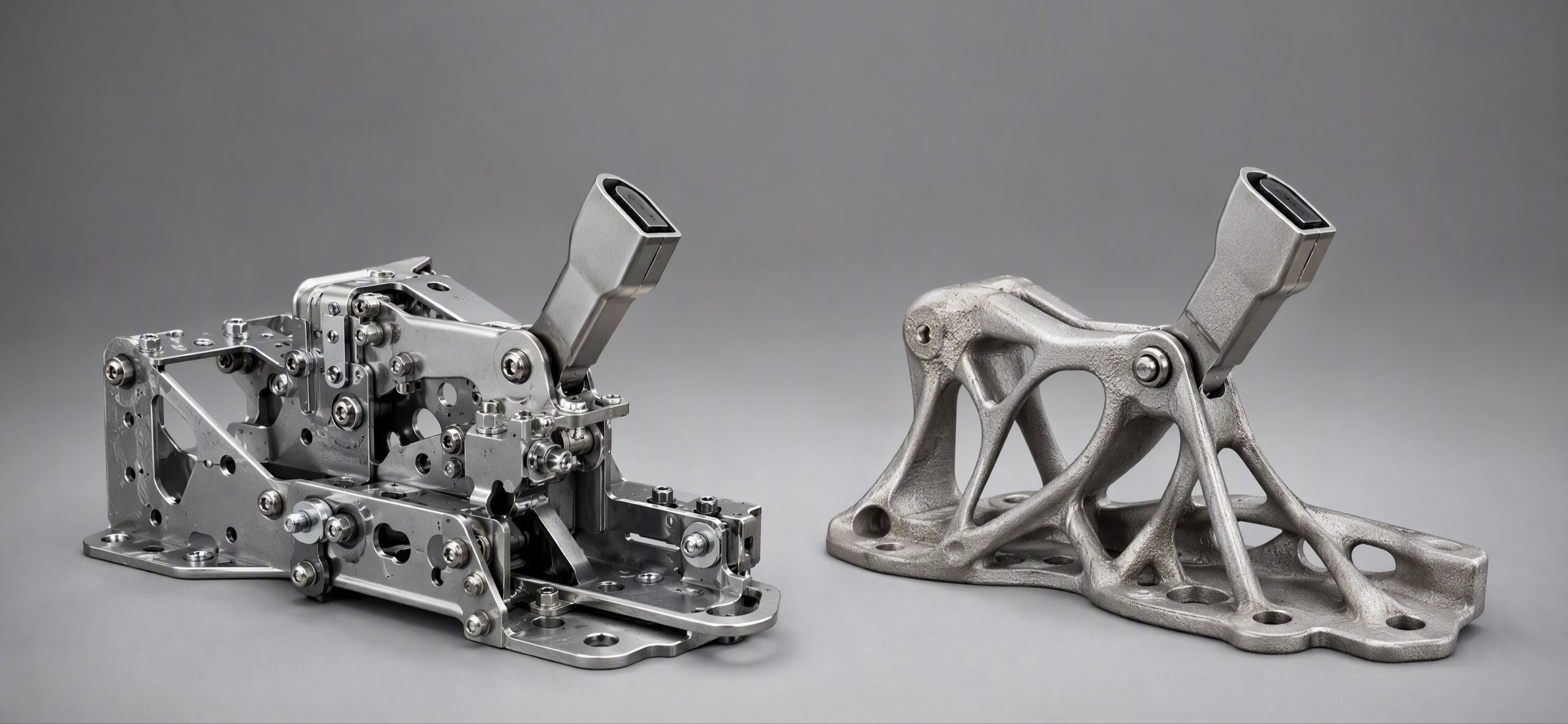
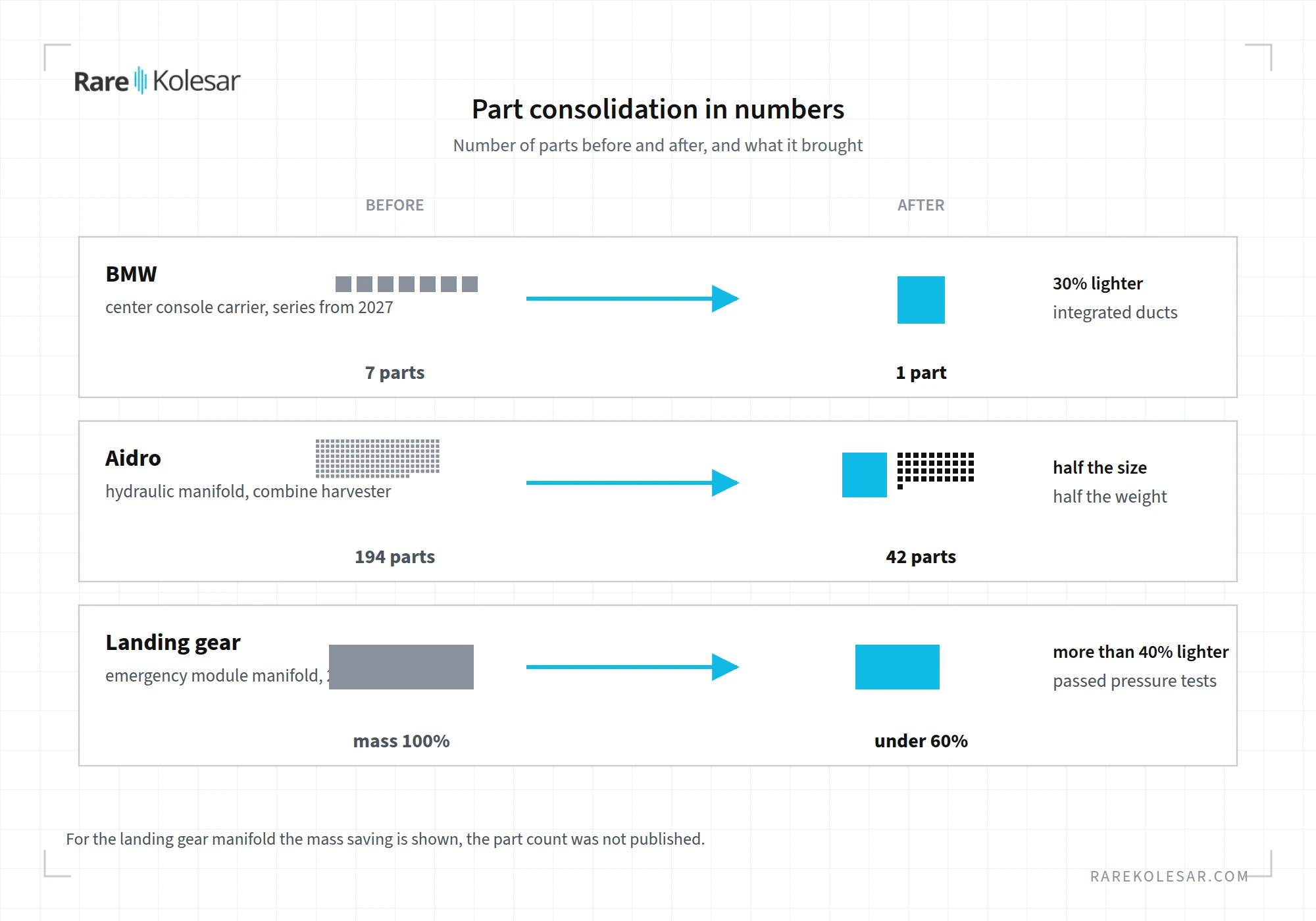
BMW is a good example. The center console carrier for one of its vehicles, entering series production in 2027, is printed by large format robotic printing from granulate, in PA11 with 40 percent recycled carbon fiber. A conventional assembly of seven injection molded and sheet metal parts is replaced by one part. It also integrates air ducts that would otherwise need a separate injection molding tool. The part is 30 percent lighter, printing takes 3 hours and 40 minutes, and about 18,000 units per year are planned.
Lower mass. Fasteners, flanges and extra material for joining are simply not designed in. This is especially valuable in aerospace and automotive, where every gram has a price.
Function integration. The biggest effect is seen in parts with internal channels, such as hydraulic manifolds. In a conventional manifold, channels are drilled in straight lines, auxiliary holes are closed with plugs, and valves sit in separate housings. In a printed manifold, channels can follow the shortest path, without sharp corners and without plugs.
| Example | Before | After | Result |
|---|---|---|---|
| BMW, center console carrier, series from 2027 | 7 parts, injection molding and sheet metal | 1 part, printing from granulate | 30% lighter, integrated air ducts, about 18,000 units per year |
| Aidro, hydraulic manifold for a combine harvester | 194 parts, 13 main blocks and 12 valve bodies | 42 parts, one central block, PBF-LB, 316L | half the size and half the weight |
| Hydraulic manifold for a landing gear emergency module, research 2023 | conventionally machined block | printed in AlSi10Mg | more than 40% lighter, passed proof, 100,000 cycle impulse and burst tests |
The landing gear example also shows the other side: the weight saving is real, but the part had to pass a full series of qualification tests, and the authors point out that fatigue is still the key open question for parts like this.
When consolidation is not a good idea
Consolidation is not a universal solution, and this is where mistakes are most often made.
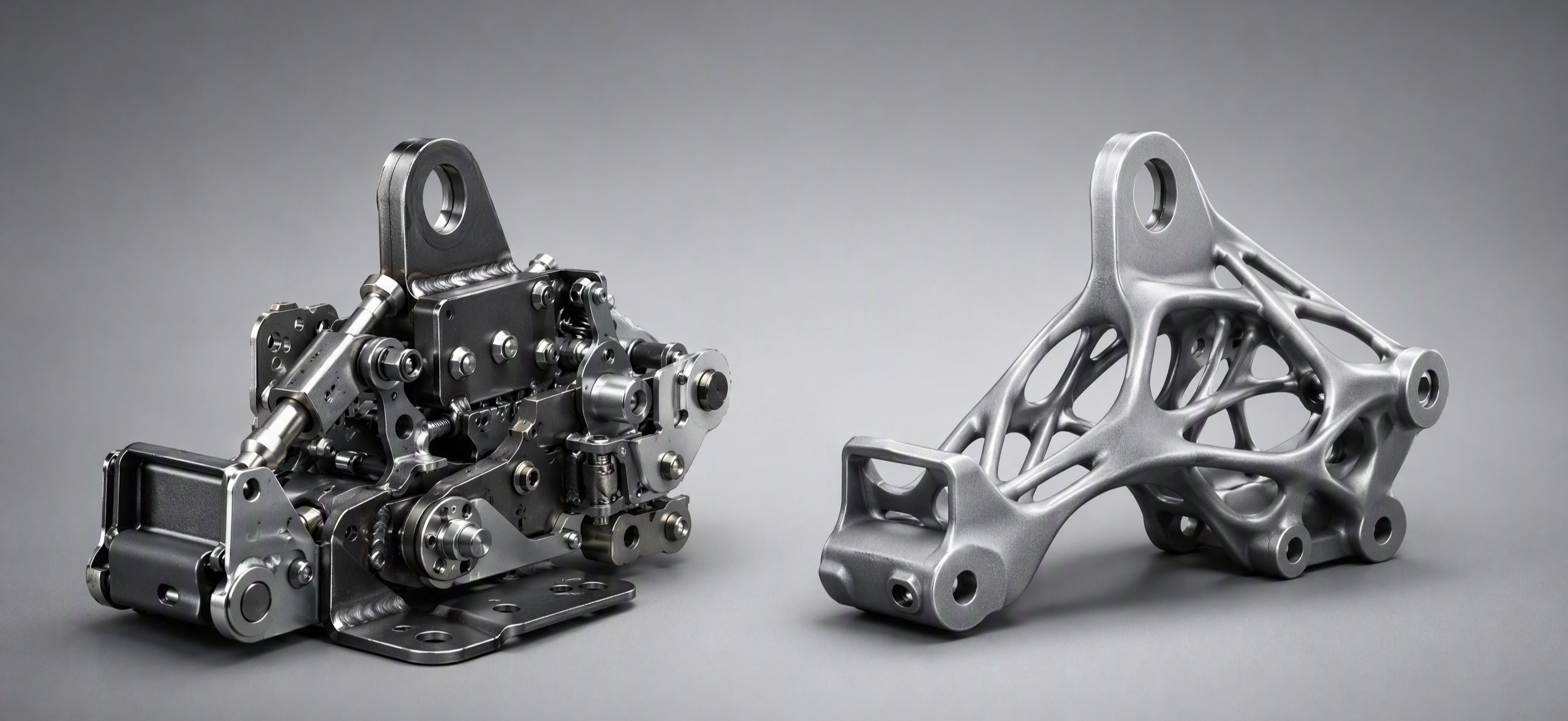
The assembly needs different materials. If one part has to be stiff and another flexible, or one wear resistant and another light, combining them into one part from one material can sacrifice what the separate parts each did in their own role.
The assembly has parts that wear or move. Seals, bearings, springs and moving elements are replaced more often than the rest of the assembly. If they are merged with the load bearing structure, replacing a wear part becomes replacing the whole part.
The assembly already works cheaply and reliably. Consolidation for its own sake adds risk and the cost of qualifying a new part, without real benefit.
The inside cannot be checked. In metal powder bed printing, internal channels have to be cleared of powder and inspected, often with industrial CT. If that is not possible, the consolidated part carries a risk the assembly of separate parts did not have.
Qualification costs more than the saving. A new consolidated part is a new part. For parts in regulated industries, that means new qualification, which I wrote about in how a single part gets qualified for production.
Maintenance has two sides
An assembly of several parts makes repair of a large and expensive assembly easier, because only the failed part is replaced. For small assemblies the opposite holds. The part itself is cheap, but service is not, because the smaller the part, the more disassembly and assembly hours cost relative to its price. Replacing one finished subassembly is faster and cheaper for a technician than searching for which of seven small parts failed.
That is why the goal is not to combine everything, but to recognize the subassemblies where combining makes sense. Nobody needs to print a whole machine as one part.
Small assemblies: foldable phone hinges
Additive manufacturing is also entering assemblies so small and so loaded that every millimeter counts. In the Find N5, launched in February 2025, OPPO made the hinge cover and the plate connecting the hinge to the display by printing Grade 5 titanium alloy. This contributed to a folded thickness of only 8.93 millimeters.
This is not classic consolidation of seven parts into one, but integration of several functions into fewer, thinner and stronger parts. Most hinge parts are still made by metal injection molding and machining. Printing is used where it gives something those processes cannot, and that is exactly the logic of good consolidation.
How the decision is made
The decision has to start from real costs and risks, not from whether combining is technically possible.
| Question | Speaks for consolidation | Speaks against |
|---|---|---|
| What does the assembly cost today, with purchasing, transport, inventory and assembly? | high total cost, several suppliers | the assembly is cheap and stable |
| Where does the assembly fail? | at joints, leakage, loosening | at wear parts |
| Can all parts be made of the same material? | yes | no, different properties are needed |
| Are there parts that are replaced regularly? | no | yes |
| Can the inside of the new part be cleaned and inspected? | yes | no |
| Does the saving cover qualification of the new part? | yes, at realistic volume | no |
This is only one dimension of the broader DfAM approach, design for additive manufacturing: where the part really carries load, and where there is room to simplify geometry and production. If you have an assembly that is a candidate for combining, that is exactly a question for a production analysis.
Frequently asked questions
What is part consolidation? Designing and making several parts that were previously joined by bolts, welding or bonding as one part. It is most often done by additive manufacturing, because it does not depend on tool access or on pulling the part out of a mold.
How much can consolidation save? It depends on the assembly. BMW reduced a center console carrier from seven parts to one and cut its mass by 30 percent, and Aidro reduced a hydraulic manifold from 194 to 42 parts, halving its mass and size. The saving comes from less purchasing, transport, inventory and assembly, not only from the cost of making the part.
When should parts not be combined? When the assembly needs different materials, when it has parts that wear and are replaced regularly, when the inside of the new part cannot be inspected, and when the assembly already works cheaply and reliably.
Does consolidation make maintenance harder? For large and expensive assemblies it can, because the whole part is replaced instead of one element. For small assemblies it often makes maintenance easier, because replacing a finished subassembly is faster than searching for the small part that failed.
Is consolidation only possible with 3D printing? No, some assemblies can be combined by casting or by a smarter redesign for conventional machining. Additive manufacturing is needed when the combined part has a geometry other processes cannot make, for example curved internal channels.
Sources
- Additive Manufacturing Media, BMW Group vehicle to adopt 3D printed center console, 2025
- Metal AM, How metal Additive Manufacturing is transforming modern hydraulic systems, 2024
- Arena et al., Design and Qualification of an Additively Manufactured Manifold for Aircraft Landing Gears Applications, Aerospace, 2023
- Metal AM, Titanium Additive Manufacturing hinge components used in world's thinnest foldable smartphone, 2025