Summary
Industrial additive manufacturing rarely works seriously without a dedicated software layer. That layer is not classic CAD and it is not a slicer for a hobby printer. It solves the problems that come with building in layers, such as part orientation, supports, nesting parts in the build chamber, predicting distortion and residual stress, laser paths for a specific machine and tracking the history of every part.
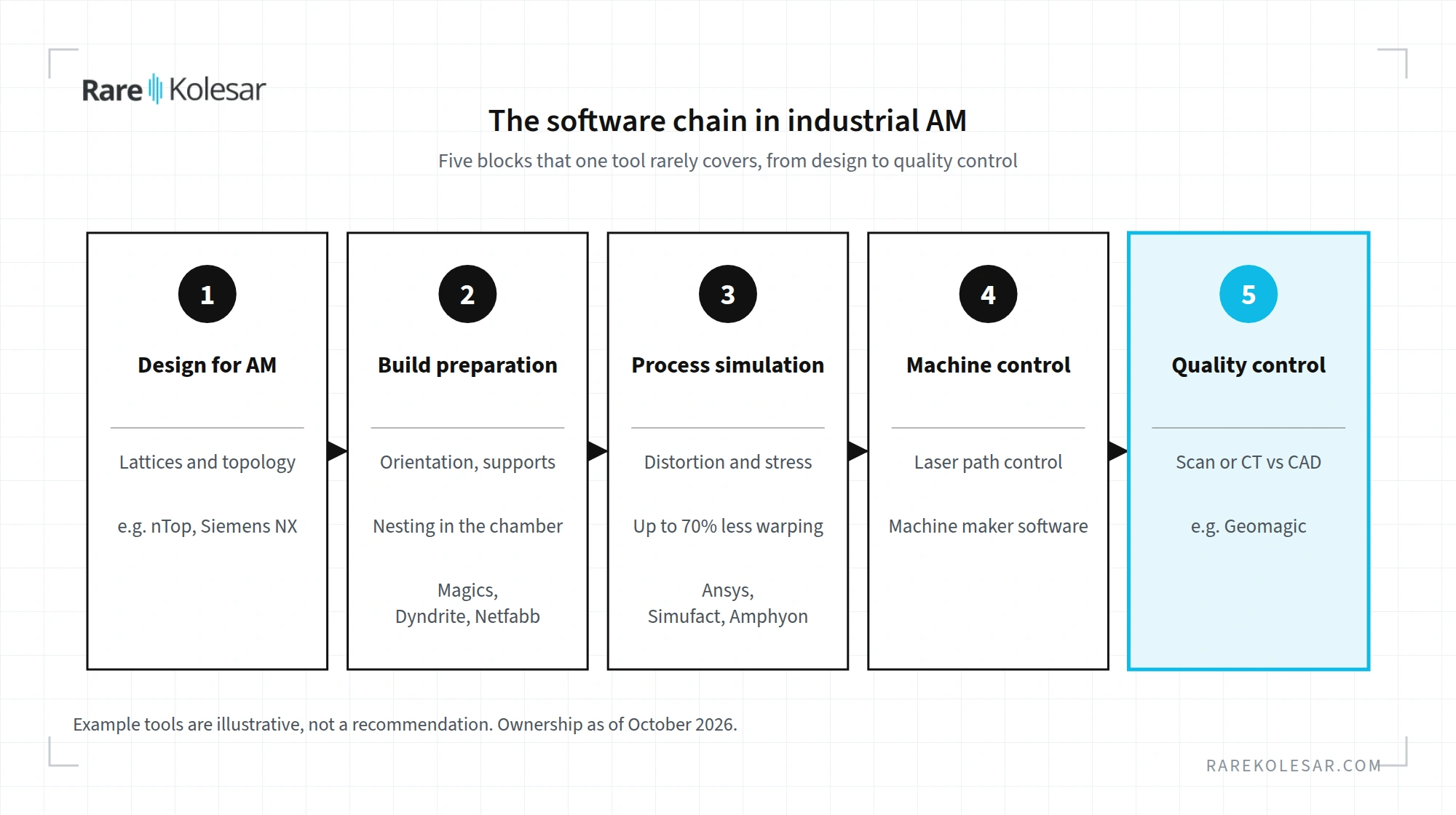
One tool rarely does all of this. The work is done by a chain of five blocks, which are design for AM, build preparation, process simulation, machine control and quality control. In metal powder bed fusion, distortion simulation is not a luxury but a condition for the build to succeed at all.
The market for this software was heavily reshuffled in 2025 and 2026. Ansys is now part of Synopsys, Altair is part of Siemens, Simufact moved to Cadence, and 3D Systems sold Geomagic, Oqton and 3DXpert. Before you tie your process to a tool, check who develops it today and what the plan for it is.
Why a dedicated software layer is needed
CAD defines geometry and design intent. A desktop slicer turns a model into layers and G code for one known machine. Between these two, an industrial machine requires a whole series of decisions that neither tool covers.
How do you orient a part so that supports are minimal and stress is least dangerous? How many parts fit into one build so that machine time pays off? Where will the part bend after it is cut from the plate? In what order and with what power does the laser pass through each layer? Which powder batch does each part belong to? The answers decide whether additive manufacturing in a company is profitable or an expensive experiment. I wrote about when it makes sense in when 3D printing makes sense and when it does not.
Five categories of software
All of this rarely comes from one tool. Most industrial users combine several solutions.
Design for AM, generative design and topology optimization. Tools such as nTop use implicit modeling. This means geometry is described by a mathematical function rather than a mesh of surfaces. That is how lattice structures and topology optimized shapes are created, shapes that classic CAD struggles to represent or process at scale. More on this in generative design in practice.
Build preparation. This is where part orientation is set, supports are generated, several parts are nested in the chamber and the build is sliced. Materialise Magics is the long standing standard in this area. Next to it are Dyndrite, Siemens NX and Autodesk Netfabb, which is sold today as Fusion with Netfabb.
Process simulation. It predicts thermal history, distortion and residual stress before powder and machine time are spent. Well known names are Ansys Additive, Simufact Additive, Amphyon and Netfabb Local Simulation, which Autodesk offers as a separate product for metal PBF and DED.
Machine control and build monitoring. This software turns a prepared build into laser paths and parameters for a specific machine and monitors the build. Machine manufacturers work here with their own software, as does Materialise with its build processors and the CO-AM platform, and newer players such as Dyndrite.
Quality control. This software compares a 3D scan or CT scan with the original CAD model. It reveals dimensional deviation, porosity and voids, and even internal channels you cannot measure any other way. An example is Geomagic Control X, which has been part of Hexagon since 2025. The link between scanning and additive manufacturing is described in the article on reverse engineering and 3D scanning.
| Category | What it solves | Example tools |
|---|---|---|
| Design for AM | Lattices, topology optimization, lighter parts | nTop, Siemens NX, Dassault 3DEXPERIENCE |
| Build preparation | Orientation, supports, nesting, slicing | Materialise Magics, Dyndrite, Siemens NX, Fusion with Netfabb |
| Process simulation | Distortion, residual stress, geometry compensation | Ansys Additive, Simufact Additive, Amphyon, Netfabb Local Simulation |
| Machine control | Laser path, parameters, build monitoring | Machine manufacturer software, Dyndrite, Materialise build processors |
| Quality control | Comparing a scan or CT scan with the CAD model | Geomagic Control X, CT software |
Materialise and Dyndrite, two different approaches
Materialise Magics is the established, technology neutral standard for data and build preparation. It is built on decades of additive manufacturing experience and has modules for supports, lattices, simulation and automation. The current version is Magics 30.
Dyndrite differs in architecture. It was written from scratch with new logic instead of extending an older foundation. It uses a geometry kernel accelerated by the graphics processor that works directly with CAD data, without a triangle mesh as an intermediate step. It also offers Python access, so processes are easy to automate.
I have personally worked in both Dyndrite and Materialise software. The speed claims Dyndrite makes proved accurate in my work. The software is extremely fast and easy to use, and everything I tried ran incredibly fast compared to what I was used to. Still, every team should test such claims on its own parts before deciding, and that applies to every vendor. I described what a neutral choice looks like in what vendor neutral means in machine selection.
Why distortion simulation is critical in metal printing
In laser powder bed fusion (LPBF) the laser melts the powder, and the melt then abruptly turns solid. Between the hot melt zone and the cooler surrounding material, large temperature gradients appear. The material expands and contracts unevenly. Because it is held by previous layers and supports, residual stress stays in the part and builds up layer by layer.
The consequences are well known:
- deformation that rises above the powder layer during the build and hits the recoater blade, which stops the build and can damage the machine
- bending of the part after it is cut from the plate, the so called banana effect
- cracking when stress exceeds material strength
- the part or supports separating from the plate during the build
- parts out of tolerance that end up as scrap
Simulation predicts all of this before the build. The engineer can then change orientation, redesign supports and export geometry that is deliberately pre deformed. After printing and stress relief, such a part ends up at nominal dimensions. An independent 2025 study on Ti6Al4V showed that simulation predicted deformation with a deviation of up to 14 percent from measured values, and that pre compensated geometry reduced deformation by up to 70 percent.
It pays to be realistic. Simulation significantly reduces risk, but it does not solve everything. With complex geometry or a new combination of material and parameters, surprises still happen.
That is why I believe metal 3D printing is still not a good fit for contract manufacturing in the classic sense. When shape, supports and even the material change from order to order, it is very hard to keep build success stable. Every new combination needs a new simulation and tuning, not just loading a new file into a proven recipe. This is also why process qualification in practice matters so much for metal.
Integration with MES and ERP remains a weak point
MES is the system that runs production on the shop floor, and ERP runs the business side of the company. Additive manufacturing data often lives in proprietary formats. Every machine manufacturer usually has its own software and format, which creates digital islands.
Classic MES and ERP systems were built for subtractive manufacturing, which is linear, high volume and predictable. Additive manufacturing is data driven, with CAD files, build parameters and sensor data. On top of that, material genealogy keeps changing, because powder is recycled, sieved, blended and reused. A classic traceability model struggles to follow this.
The industry's answer is AM MES layers that connect to existing ERP and PLM through APIs instead of replacing them, and platforms with a central data store such as Materialise CO-AM or Oqton. Interoperability is improving, but additive manufacturing is still mostly a separate island in the factory. Closing that gap is active, unfinished work. In our region the challenge is bigger, because even basic MES and ERP systems are often not used to their full capacity, as I wrote in the real state of additive manufacturing in the region.
Who owns which software today
Ownership of AM software has changed quickly over the last two years. This matters because the new owner decides on development, license prices and support.
| Date | Event | What it means for users |
|---|---|---|
| November 2024 | Dyndrite and Nikon SLM Solutions announce integration of LPBF Pro on Nikon SLM machines | Open architecture, laser path control at vector level |
| March 2025 | Siemens completes the acquisition of Altair | Altair simulation joins the Siemens Xcelerator portfolio |
| April 2025 | Hexagon completes the purchase of Geomagic software from 3D Systems | Geomagic Design X and Control X are now Hexagon products |
| 2025 | Ursa Major signs a multi year agreement for Dyndrite LPBF Pro | Software becomes the core of a rocket engine maker's AM strategy |
| July 2025 | Synopsys completes the acquisition of Ansys | Ansys Additive is now part of the Synopsys portfolio |
| July 2025 | Desktop Metal files for bankruptcy protection, months after being acquired by Nano Dimension | Consolidation is no guarantee of stability |
| September 2025 | 3D Systems announces the sale of Oqton MOS and 3DXpert to Hubb Global Holdings | 3D Systems focuses on 3D Sprint for polymers |
| February 2026 | Cadence completes the acquisition of Hexagon's Design and Engineering business | MSC software, including Simufact, moves to Cadence |
In addition, nTop received an investment from NVIDIA's NVentures fund in September 2024 and announced integration with NVIDIA technologies for visualization and simulation.
Software, not the machine, is the current constraint
More and more people in the industry say that today software, not hardware, limits the wider use of additive manufacturing. Forecasts for 2026 highlight AI agents that would coordinate complete workflows, and a cheaper software layer that would bring simulation and quality control to less expensive machines. These are predictions, not established facts. I wrote about where AI really helps and where it does not in AI in 3D printing.
Still, a healthy dose of caution is worth keeping. When a company quickly builds its own software tool instead of using a proven product, the result is often a brittle, isolated solution that struggles to grow with the company. People from the AM software industry have warned about exactly this.
My recommendation is simple. Treat software as an investment equal to the machine, not as an add on. For metal PBF, plan for simulation and serious build preparation from day one. Choose solutions with open API access, so you do not get locked into one closed system. If you want an independent assessment of what your plant really needs, see consulting.
Frequently asked questions
Is a regular slicer enough for industrial 3D printing? For simple polymer parts it often is. For metal powder bed fusion and serious series production it is not, because a regular slicer does not do distortion simulation, advanced supports, nesting or part traceability.
What is distortion simulation in metal 3D printing? It is a calculation that predicts, before the build, how a part will deform because of residual stress. Based on it, orientation or supports are changed, or pre deformed geometry is exported, so the part ends up at nominal dimensions after printing.
How accurate is distortion simulation? It depends on the tool, material and geometry. One independent 2025 study on Ti6Al4V measured a prediction deviation of up to 14 percent and a deformation reduction of up to 70 percent with pre compensated geometry. Simulation reduces risk, but it does not remove the need for a trial build of new parts.
What is the difference between Materialise Magics and Dyndrite? Magics is the established, technology neutral standard for build preparation, with decades of development and many modules. Dyndrite is newer and written from scratch, with a geometry kernel accelerated by the graphics processor that works directly with CAD data and laser path control at vector level.
Why does it matter who owns AM software? The owner decides on development, license prices, support and supported machines. In 2025 and 2026 alone, Ansys, Altair, Geomagic, Simufact, Oqton and 3DXpert changed owners, so check who develops a tool today before deciding.
Does AM software integrate easily with ERP and MES systems? Not yet. Data is often in proprietary machine formats, and classic systems were not built for data driven production and powder recycling. AM MES solutions with API connections help, but integration still needs planning and work.
Should a company develop its own 3D printing software? Mostly not as a replacement for proven products. Custom scripts and automation on top of existing tools make sense, but an in house tool built in a hurry often becomes a brittle, isolated solution that struggles to grow with the company.
Sources
- Dyndrite and Nikon SLM Solutions Announce Metal Printing Partnership, Digital Engineering 24/7, 2024
- AM Software Provider Dyndrite Forms Multi-Year Partnership with Ursa Major, 3DPrint.com, 2025
- Siemens acquires Altair to create most complete AI-powered portfolio of industrial software, Siemens, 2025
- Synopsys completes acquisition of Ansys, VoxelMatters, 2025
- Hexagon completes acquisition of 3D Systems' Geomagic portfolio, TCT Magazine, 2025
- 3D Systems Provides Update on Software Strategy, 3D Systems, 2025
- 3D Systems shifts its software strategy to focus on 3D Sprint, Engineering.com, 2025
- Desktop Metal files for Chapter 11 bankruptcy, TCT Magazine, 2025
- Cadence completes acquisition of Hexagon design business, Engineering.com, 2026
- MSC Software Is Now Part of Cadence, GSAS India, 2026
- nTop integrates with Nvidia's ray tracing and graphics platforms, SiliconANGLE, 2024
- Assessment of simulation software for predicting induced distortions in laser-beam powder bed fusion of Ti6Al4V, The International Journal of Advanced Manufacturing Technology, 2025
- Residual Stress Formation Mechanisms in Laser Powder Bed Fusion, Materials (MDPI), 2023
- 3D Printing Predictions for 2026: Scaling AM Through Software, 3DPrint.com, 2026
- Magics, data and build preparation software, Materialise, 2026
- Autodesk Fusion with Netfabb, Autodesk, 2026