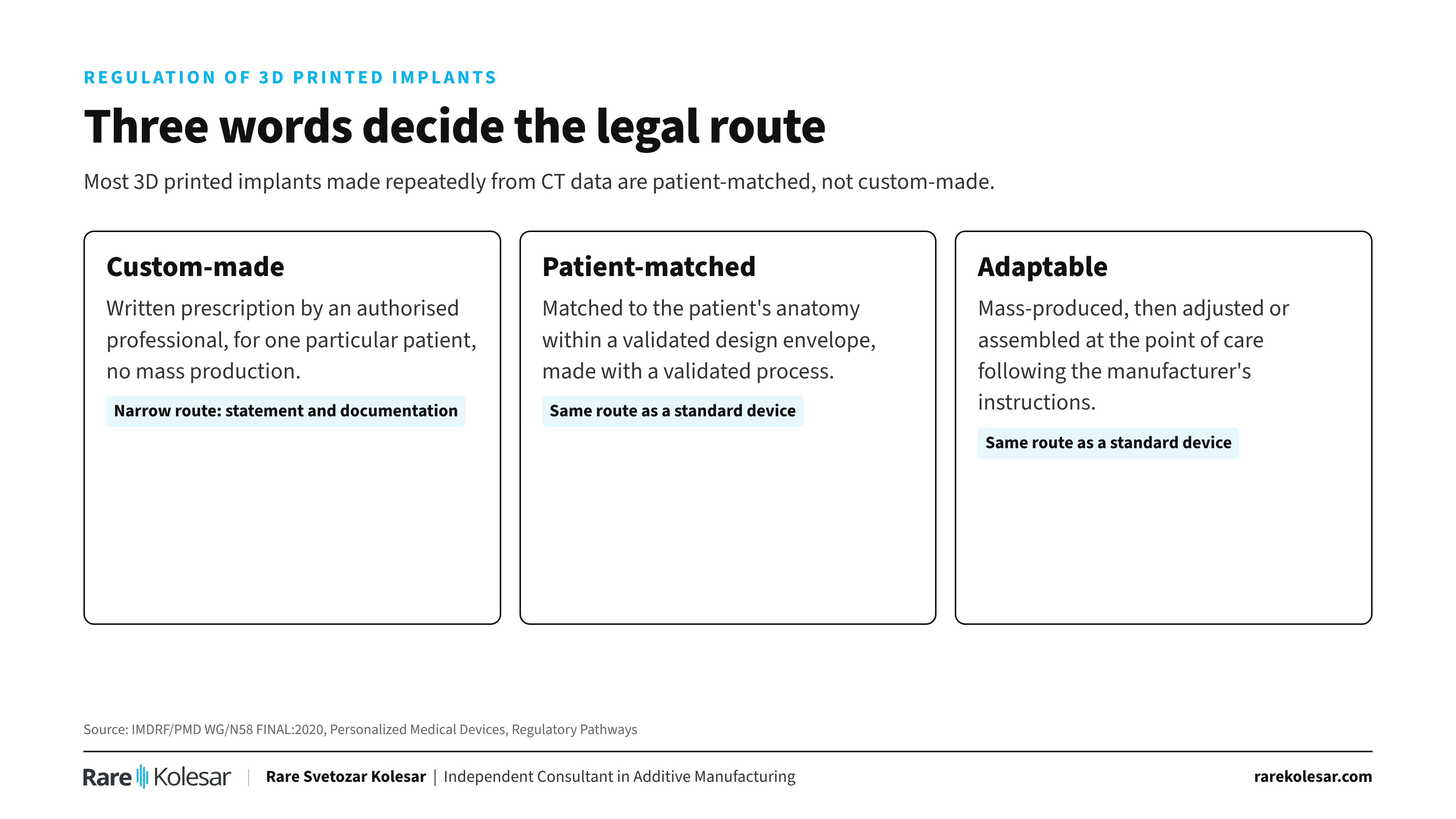
- Every regulator we checked separates three things that are often all called "custom": a custom-made device (one patient, written prescription, no mass production), a patient-matched device (made to the patient's anatomy within a validated design envelope) and an adaptable device (adjusted at the point of care). Most 3D printed implants made repeatedly from CT data are legally patient-matched, not custom-made.
- Custom-made is the narrow route. Patient-matched devices go through the same approval route as ordinary devices.
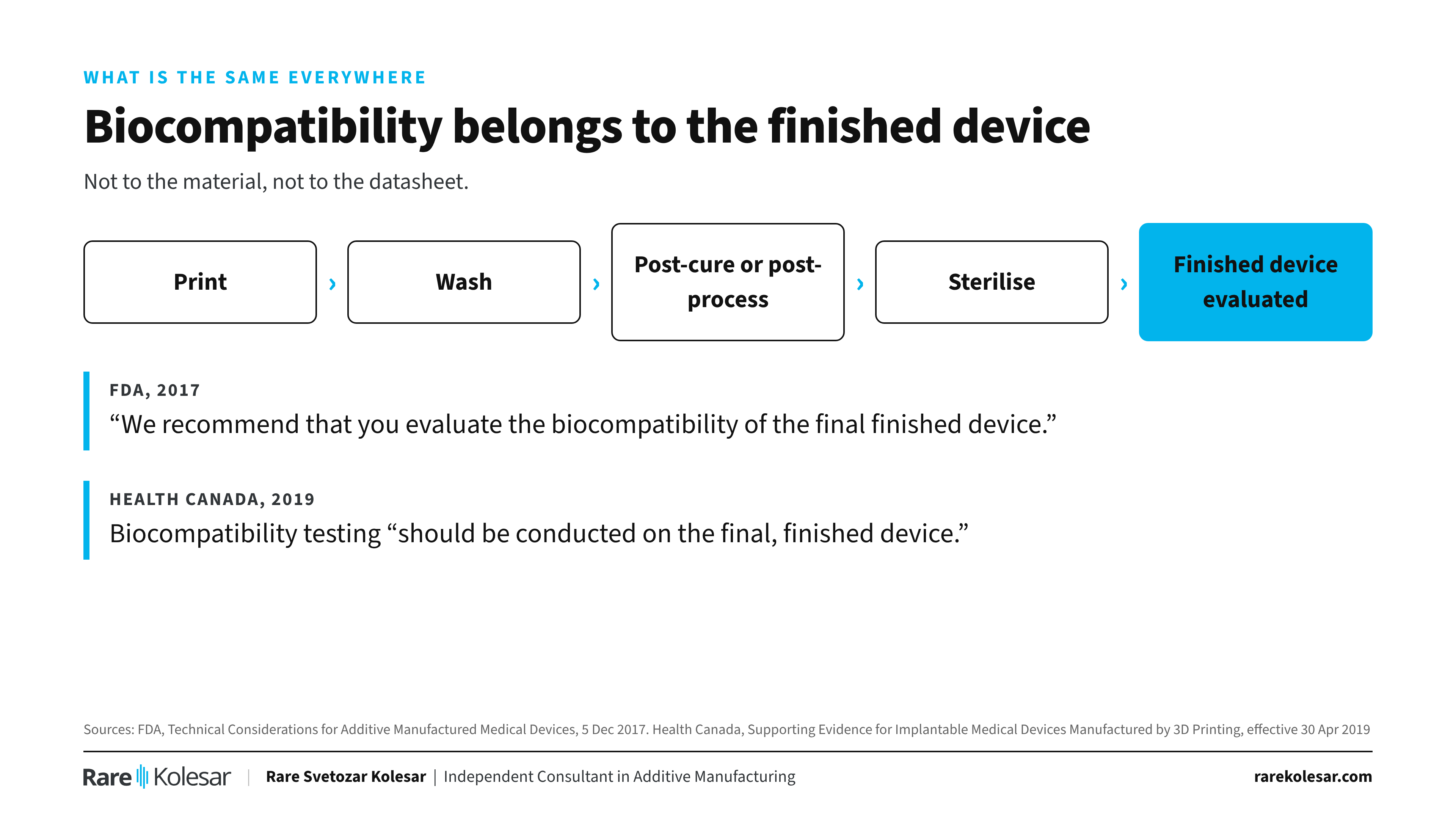
- No route skips biocompatibility. The FDA and Health Canada both say in writing that biocompatibility should be evaluated on the final, finished device, after printing, cleaning, post-processing and sterilisation.
- We verified the rules for the EU and EEA, Switzerland, Great Britain, Serbia, Bosnia and Herzegovina, the USA, Canada, Brazil, China, Japan, India (definition only) and Australia. For other countries we list what we could not confirm instead of guessing.
This article is a companion to Biocompatible materials and real applications in surgery, which explains what biocompatibility means and shows real clinical examples. Here the question is narrower: in which legal box does a printed implant fall, country by country.
Three words that decide everything
The International Medical Device Regulators Forum (IMDRF) published common definitions in 2020 (document IMDRF/PMD WG/N58 FINAL:2020). Most regulators now use the same logic:
| Category | What it is | Typical example | Usual legal route |
|---|---|---|---|
| Custom-made | Made on a written request of an authorised professional, for one particular patient, when no other device meets the need | A one-off reconstruction for a rare defect | Special, lighter route with a statement and documentation |
| Patient-matched | Matched to the patient's anatomy within a specified design envelope, made with a process that can be validated | Cranial plates, cutting guides, acetabular components made from CT in series | Same as a standard device: certification, clearance or registration |
| Adaptable | Mass-produced, then adjusted or assembled at the point of care following the manufacturer's instructions | Plates bent in surgery | Same as a standard device |
Why this matters for anyone with a printer in a hospital or a lab: the moment you make the same kind of implant again and again with a validated workflow, you are usually no longer in the custom-made category, even if each part is unique.
What is the same everywhere: biocompatibility of the finished device
Every jurisdiction below expects a biological evaluation based on the ISO 10993 series, and two regulators say very clearly what is evaluated:
- FDA (USA), Technical Considerations for Additive Manufactured Medical Devices, 5 December 2017: "We recommend that you evaluate the biocompatibility of the final finished device." The guidance names additives, catalysts, binding and curing agents and uncured monomers as chemicals that need attention.
- Health Canada, Supporting Evidence for Implantable Medical Devices Manufactured by 3D Printing, effective 30 April 2019: biocompatibility testing "should be conducted on the final, finished device", and evidence from a previously approved non-printed device "is generally not considered sufficient".
In practice this means that a material datasheet, a resin certificate or a USP Class VI statement is where questions start, not where they end. Washing, post-curing, powder reuse and sterilisation all change what ends up in the patient.
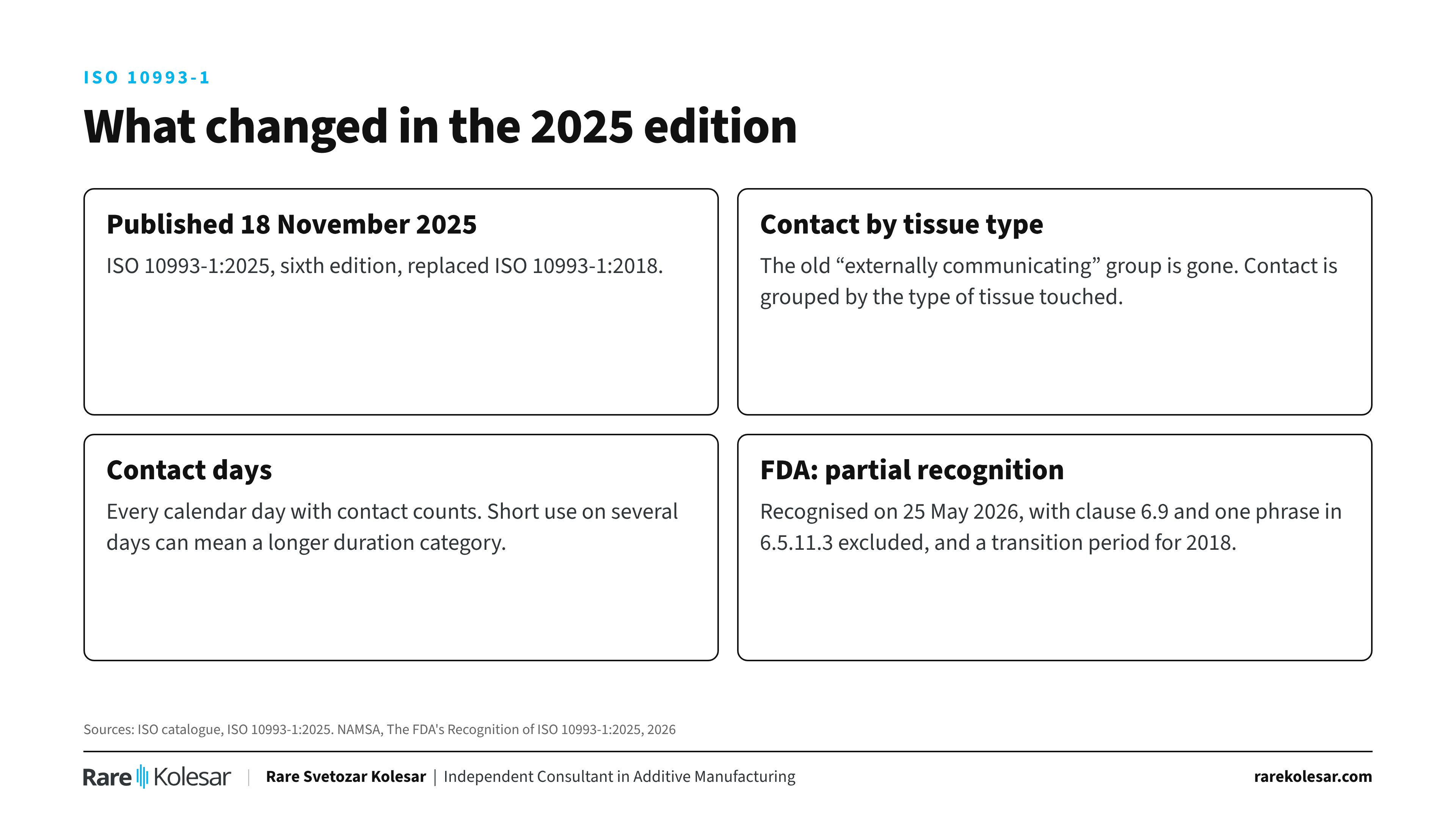
The core standard changed recently. ISO 10993-1:2025 (sixth edition) was published on 18 November 2025 and replaced ISO 10993-1:2018. On 25 May 2026 the FDA gave it partial recognition, excluding the phrase "consumer products or" in clause 6.5.11.3 and clause 6.9 (biological risk estimation), with a transition period for the 2018 edition.
Europe
European Union and EEA
Regulation (EU) 2017/745 (MDR) applies in all EU member states, including Romania, Croatia and Slovenia, and in the EEA countries.
- Custom-made device (Article 2(3)): made according to a written prescription of an authorised person, who gives specific design characteristics under his or her responsibility, for the sole use of a particular patient. Mass-produced devices that are adapted, and devices mass-produced by industrial processes from written prescriptions, are not custom-made.
- Route (Article 52(8) and Annex XIII): no CE mark. The manufacturer draws up a statement for each device and keeps documentation available to the authorities (at least 10 years, 15 years for implantable devices).
- Class III implantable custom-made devices additionally need a notified body: a quality management system assessment under Annex IX Chapter I, or Annex XI Part A.
- Patient-matched devices follow the normal CE marking route.
- Hospitals making their own devices can use the health institution exemption in Article 5(5) if the device is not transferred to another legal entity, the hospital has an appropriate quality management system, and it justifies that no equivalent device on the market meets the patients' needs.
- Guidance: MDCG 2021-3 (questions and answers on custom-made devices) and MDCG 2023-1 (health institution exemption).
A published example of compliance: the University Hospital of Parma registered as a manufacturer of custom-made devices with the Italian Ministry of Health and classified its in-house 3D printed vascular planning models as class I devices under the MDR (Diagnostics, 2025).
Switzerland
The Medical Devices Ordinance (MedDO) follows the EU logic. Article 10 states that custom-made devices are subject to Annex XIII of the EU MDR, and that manufacturers of class III implantable custom-made devices must also carry out a conformity assessment under Annex IX Chapter I or Annex XI Part A.
Great Britain
The UK Medical Devices Regulations 2002 apply in Great Britain. According to MHRA guidance updated on 20 July 2026:
- A custom-made device is made to a written prescription of a registered medical practitioner or another authorised professional, for the sole use of one patient. Mass-produced devices adapted by a professional are not custom-made.
- Custom-made devices do not need UKCA marking and do not need an approved body.
- For devices that would be class IIa, IIb or III, or active implantable, the manufacturer issues a statement. The label must say "custom-made device".
- The manufacturer or UK responsible person must register with the MHRA before placing devices on the market, and must run post-market surveillance.
- Separate rules apply in Northern Ireland.
Serbia
The Law on Medical Devices (Zakon o medicinskim sredstvima, Official Gazette of RS No. 105/2017) entered into force on 1 December 2017 and has applied since 1 December 2018.
- It recognises the custom-made device: made on the order of an appropriate health professional who specifies its design characteristics for a particular patient. Serially produced devices adapted to a professional's needs are not custom-made.
- The Ministry of Health issues the licence for manufacturing a custom-made device for a particular patient.
- The law aligned Serbian rules with the earlier EU directives (93/42/EEC, 90/385/EEC, 98/79/EC), not with the MDR.
- There is no rule specific to 3D printing. The general essential requirements and the harmonised ISO 10993 standards apply.
Bosnia and Herzegovina
- The state-level Law on Medicinal Products and Medical Devices (Official Gazette of BiH No. 58/08) and the Rulebook on Medical Devices (Official Gazette of BiH No. 4/10) define a custom-made device as one made according to the written instructions of an appropriate professional for an individual patient.
- The label must say "urađeno po narudžbi" (made to order).
- We found no separate rule for 3D printed devices.
- Republika Srpska adopted its own law on medicinal products and medical devices in 2022. The Office of the High Representative and the EU Delegation stated that it contravenes state law, so manufacturers should check the current legal position before relying on it.
North America
United States
- Custom device exemption (section 520(b) of the Federal Food, Drug, and Cosmetic Act): very narrow. Patient-matched devices, even when marketed as customised, do not qualify.
- Patient-matched devices go through 510(k), De Novo or PMA, with the range of variation defined as a design envelope.
- Additive manufacturing guidance: Technical Considerations for Additive Manufactured Medical Devices, 5 December 2017. It covers patient-matched design, imaging, file conversion, material controls, post-processing and testing of the final device.
- Biocompatibility guidance: Use of International Standard ISO 10993-1, final version of 8 September 2023.
- ISO 10993-1:2025: partially recognised on 25 May 2026.
- Example: in April 2024 a manufacturer announced FDA 510(k) clearance of a system for printing patient-specific PEEK cranial implants, covering the planning software, the printer and the implant-grade material as one validated workflow.
Canada
- Custom-made devices are handled under Part 2 of the Medical Devices Regulations (SOR/98-282), which also covers special access, not under ordinary licensing.
- Class III and IV implantable devices made by 3D printing are licensed under Part 1 and must follow the guidance Supporting Evidence for Implantable Medical Devices Manufactured by 3D Printing (effective 30 April 2019). It asks for testing on the final, finished device after all post-printing processing, cleaning and sterilisation, and for validation of how accurately a patient-matched device reproduces the patient images.
- The guidance excludes custom-made devices, anatomical models and bioprinted products containing living cells.
South and Central America
Brazil
ANVISA Resolution RDC No. 305 of 24 September 2019 regulates personalised medical devices and distinguishes custom-made (sob medida), patient-specific (paciente-específico) and adaptable devices.
- Custom-made devices do not need product registration, but manufacturers or importers of class III and IV custom-made devices need prior authorisation (anuência), and each device made must be notified.
- Patient-specific devices are registered like standard devices.
- ANVISA states that additive manufacturing is a production method and does not by itself make a device personalised.
- The general registration rule is RDC 751/2022. RDC 305/2019 has been amended since 2019, so check the consolidated text on the ANVISA site.
Mexico and the rest of Latin America
We could not confirm a specific rule on custom-made or patient-matched 3D printed devices from a primary source for Mexico (COFEPRIS) or for Argentina, Chile, Colombia, Peru, Uruguay, Ecuador, Venezuela, Bolivia, Paraguay, Guatemala, Honduras, El Salvador, Nicaragua, Costa Rica, Panama, Cuba, the Dominican Republic or the Caribbean states. Clinical work does exist: a clinical trial of 3D printed PEEK cranial implants is registered with a site in Guadalajara, Mexico (NCT06782711).
Asia
China
The National Medical Products Administration (NMPA) and the National Health Commission issued the Provisions on the Supervision and Administration of Customized Medical Devices (Trial) on 26 June 2019. They apply from 1 January 2020.
- A customized device is made for a particular patient with a rare, special condition when no marketed product meets the need. It is filed case by case with the provincial regulator, jointly by the manufacturer and the hospital.
- Only Grade III (top-tier) hospitals with the right clinical capability may use customized devices.
- The manufacturer must already hold a registration certificate and production licence for the same type of mass-produced device.
- Contract manufacturing is prohibited, and customized devices may not be advertised in mass media.
- Records of implantable customized devices must be kept permanently, and an annual report is filed.
- Patient-matched devices (examples given: dentures, orthokeratology lenses, orthopaedic guide plates) are excluded and go through ordinary registration.
- Devices containing drugs or living cells and tissues are excluded.
Japan
Under the Act on Securing Quality, Efficacy and Safety of Products Including Pharmaceuticals and Medical Devices (PMD Act), implants need marketing approval. The Ministry of Health, Labour and Welfare published Notification 0925 No. 1 on 25 September 2015, with a guidance for evaluating custom-made orthopaedic implants made by additive manufacturing from patient image data. The implants are made by modifying an approved base design to fit a patient's bone. The manufacturer must evaluate how the customisation affects mechanical and biological safety. The guidance is not a legal standard, and early consultation with the PMDA is recommended.
South Korea
According to an IMDRF working group presentation from March 2018, Korean law had no definitions for custom-made or patient-specific devices at that time, but the Ministry of Food and Drug Safety (MFDS) had a guideline for reviewing and approving patient-matched devices made by 3D printers. We could not confirm whether the legal definitions have changed since then.
India
The Medical Devices Rules, 2017 define a custom made medical device (Rule 3(r)): made according to a written prescription of a registered medical practitioner specialised in the relevant area, under his responsibility, for the sole use of a particular patient, excluding mass production. We could not confirm from the primary text how such devices are licensed.
Other Asian countries
We could not confirm specific rules from primary sources for Taiwan, Singapore, Thailand, Malaysia, Indonesia, Vietnam, the Philippines, Israel, Saudi Arabia or the United Arab Emirates.
Oceania
Australia
The Therapeutic Goods Administration (TGA) introduced a framework for personalised medical devices on 25 February 2021, with refinements from 20 August 2021.
- It defines four types: custom-made, patient-matched, adaptable, and devices made with a medical device production system.
- Custom-made devices are limited to rare cases where no patient-matched or adaptable device is suitable. They are exempt from inclusion in the Australian Register of Therapeutic Goods (ARTG), but must be notified to the TGA.
- Patient-matched devices must be included in the ARTG. The transition period for devices previously supplied as custom-made ended on 1 November 2024.
New Zealand: not verified.
Africa
We could not confirm specific rules from primary sources for South Africa, Egypt, Nigeria, Kenya, Morocco or other African countries.
Summary table
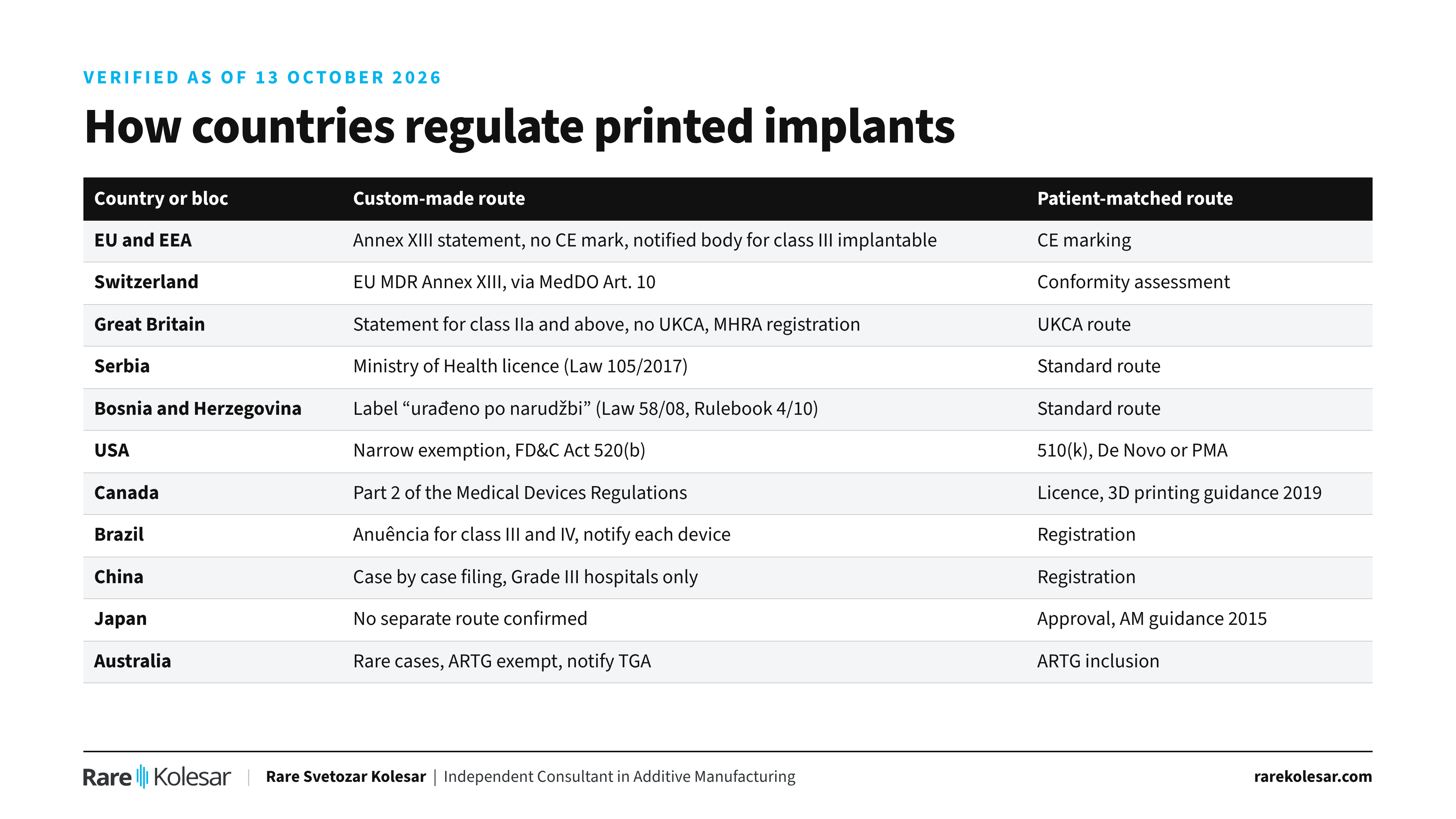
| Country or bloc | Regulator | Custom-made route | Patient-matched route | Main source, date |
|---|---|---|---|---|
| EU and EEA (incl. Romania, Croatia, Slovenia) | National authorities, notified bodies | Annex XIII statement, no CE mark; notified body for class III implantable | CE marking | MDR 2017/745, applies from 26 May 2021 |
| Switzerland | Swissmedic | Annex XIII of EU MDR via MedDO Art. 10 | Conformity assessment | MedDO |
| Great Britain | MHRA | Statement for class IIa and above, no UKCA, MHRA registration | UKCA route | UK MDR 2002, guidance updated 20 July 2026 |
| Serbia | Ministry of Health, ALIMS | Ministry licence for manufacture | Standard route | Law 105/2017, applies from 1 December 2018 |
| Bosnia and Herzegovina | ALMBIH | Label "urađeno po narudžbi" | Standard route | Law 58/08, Rulebook 4/10 |
| USA | FDA | Narrow exemption, 520(b) | 510(k), De Novo or PMA | AM guidance 5 December 2017 |
| Canada | Health Canada | Part 2 of the Medical Devices Regulations | Licence, 3D printing guidance | Guidance effective 30 April 2019 |
| Brazil | ANVISA | Anuência for class III and IV, notification per device | Registration | RDC 305/2019 |
| China | NMPA, NHC | Case by case filing, Grade III hospitals only | Registration | Provisions in force 1 January 2020 |
| Japan | MHLW, PMDA | No separate route confirmed | Approval, AM guidance as reference | Notification 0925 No. 1, 25 September 2015 |
| South Korea | MFDS | No legal definition (as of 2018) | Approval, MFDS guideline | IMDRF presentation, March 2018 |
| India | CDSCO | Defined, Rule 3(r); licensing not confirmed | Not confirmed | Medical Devices Rules 2017 |
| Australia | TGA | Rare cases, ARTG exempt, notification | ARTG inclusion | Framework from 25 February 2021 |
What this means in practice
- First decide the category, then the material. A planning model that never enters the sterile field, a surgical guide and a permanent implant are three different regulatory and biological situations.
- Repeated work is rarely custom-made. If a hospital or a company prints the same type of implant regularly with a defined workflow, regulators will usually see a patient-matched device.
- The workflow is the product. The clearance announced in the USA in 2024 covered the software, printer and material as one system. Changing one element changes what was validated.
- Biocompatibility follows the finished part. Whatever the route, the evidence has to describe the device as it reaches the patient.
Frequently asked questions
Is every 3D printed implant a custom-made device? No. In the EU, UK, Switzerland, USA, Canada, China, Brazil and Australia, devices made to a patient's anatomy within a validated design envelope are patient-matched and follow the standard route. Custom-made is reserved for a written prescription for one patient.
Does a custom-made device need biocompatibility evidence? Yes. It must still meet the general safety and performance requirements (EU, Switzerland) or essential requirements (Great Britain, Serbia, Brazil), which include biological safety.
Can a hospital print implants for its own patients in the EU? Under Article 5(5) of the MDR it can, if the device stays within the institution, the hospital has an appropriate quality management system and it justifies that no equivalent device on the market meets the need. MDCG 2023-1 explains the conditions.
Which edition of ISO 10993-1 applies? ISO 10993-1:2025 replaced the 2018 edition on 18 November 2025. The FDA partially recognised it on 25 May 2026 and allows a transition period. Check which edition your notified body or regulator expects for your submission.
Is the regulation the same in Serbia as in the EU? Not yet. Serbia's Law on Medical Devices from 2017 follows the earlier EU directives, not the MDR. The concept of a custom-made device exists, and the Ministry of Health licenses its manufacture.
Sources
Standards and international - ISO 10993-1:2025, ISO catalogue: https://www.iso.org/standard/10993-1 - IMDRF/PMD WG/N58 FINAL:2020, Personalized Medical Devices, Regulatory Pathways: https://www.imdrf.org/sites/default/files/docs/imdrf/final/technical/imdrf-tech-200318-pmd-rp-n58.pdf - IMDRF Personalized Medical Devices working group update, March 2018: https://www.imdrf.org/sites/default/files/docs/imdrf/final/meetings/imdrf-meet-180321-china-presentation-working-group-update-pmd.pdf - NAMSA, The FDA's Recognition of ISO 10993-1:2025, 2026: https://namsa.com/resources/blog/fda-recognition-iso-10993-12025/
Europe - Regulation (EU) 2017/745 (MDR): https://eur-lex.europa.eu/eli/reg/2017/745/oj - MDCG 2021-3, Questions and Answers on Custom-Made Devices: https://health.ec.europa.eu/document/download/385d7e20-d8b5-49d0-abd7-8daf269bf1b8_en - MDCG 2023-1, Health institution exemption: https://health.ec.europa.eu/system/files/2023-01/mdcg_2023-1_en.pdf - University Hospital of Parma, Diagnostics 2025: https://www.ncbi.nlm.nih.gov/pmc/articles/PMC11719810/ - Swiss Medical Devices Ordinance, Article 10: https://lawbrary.ch/law/art/MEPV-v2023.09-en-art-10 - MHRA, Custom-made devices in Great Britain: https://www.gov.uk/government/publications/custom-made-medical-devices/custom-made-devices-in-great-britain - Serbia, Zakon o medicinskim sredstvima: https://www.paragraf.rs/propisi/zakon-o-medicinskim-sredstvima.html - BDK Advokati, The New Medical Devices Act in Serbia, 2019: https://bdkadvokati.com/the-new-medical-devices-act-in-serbia - Bosnia and Herzegovina, Law 58/08: https://fuzip.gov.ba/wp-content/uploads/2022/11/Zakon_o_lijekovima_i_medicinskim_sredstvima_sl_glasnik_bih_broj_58_2008.pdf - Bosnia and Herzegovina, Rulebook 4/10: https://sluzbenilist.ba/page/akt/G6iS6vOUz88= - OHR and EU on the Republika Srpska law: https://www.eeas.europa.eu/delegations/bosnia-and-herzegovina/ohr-i-eu-o-zakonu-o-lijekovima-i-medicinskim-sredstvima_bs
North America - FDA, Technical Considerations for Additive Manufactured Medical Devices, 2017: https://www.federalregister.gov/documents/2017/12/05/2017-26196/technical-considerations-for-additive-manufactured-medical-devices-guidance-for-industry-and-food - FDA, Use of ISO 10993-1, 2023: https://www.govinfo.gov/content/pkg/FR-2023-09-08/html/2023-19402.htm - MassDevice, FDA clears 3D printed PEEK cranial implant system, 15 April 2024: https://www.massdevice.com/fda-clears-cranial-implant-3d-systems/ - Health Canada, Supporting Evidence for Implantable Medical Devices Manufactured by 3D Printing: https://www.canada.ca/en/health-canada/services/drugs-health-products/medical-devices/application-information/guidance-documents/3d-licensing-requirements/document.html
South and Central America - ANVISA, RDC 305/2019: https://bvsms.saude.gov.br/bvs/saudelegis/anvisa/2019/rdc0305_24_09_2019.pdf - ClinicalTrials.gov NCT06782711: https://clinicaltrials.gov/study/NCT06782711
Asia and Oceania - CMS, Highlights on China's regulations on customized medical devices: https://cms.law/en/chn/publication/highlights-on-recent-regulations-on-customized-medical-devices - MHLW Notification 0925 No. 1, custom-made orthopaedic implants by additive manufacturing: https://dmd.nihs.go.jp/jisedai/tsuuchi/3D%20Additive%20Manufacturing%20Technology-Based,%20Custom-made%20Orthopedic%20Implants%20Produced%20from%20Patients%E2%80%99%20Image%20Data.pdf - India, Medical Devices Rules 2017: https://cdsco.gov.in/opencms/resources/UploadCDSCOWeb/2022/m_device/mdr,%202017%20(1).pdf - TGA, Regulatory framework for personalised medical devices, FAQ: https://www.tga.gov.au/how-we-regulate/manufacturing/manufacture-medical-device/manufacture-specific-types-medical-devices/personalised-medical-devices/regulatory-framework-personalised-medical-devices-frequently-asked-questions