Summary
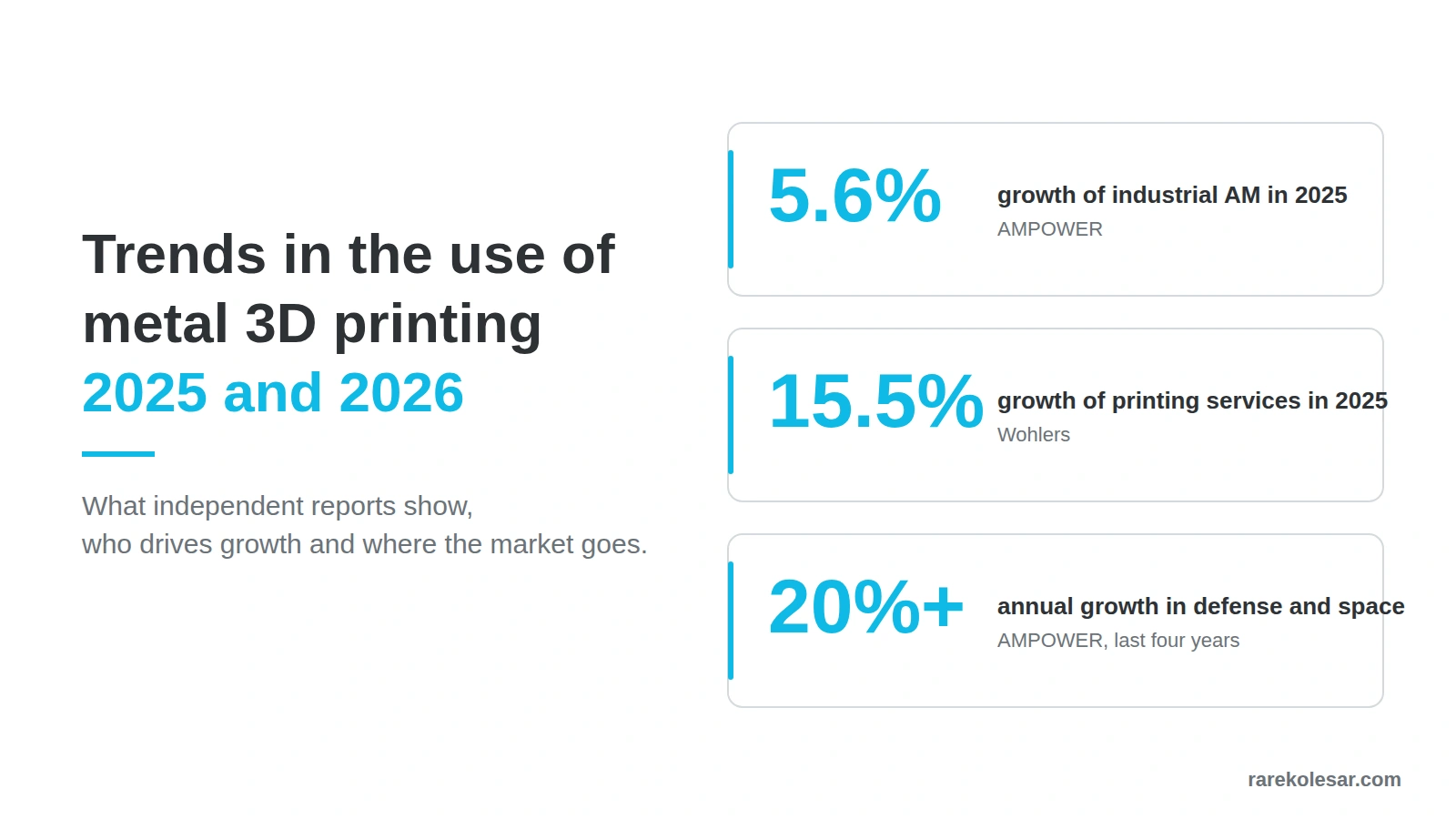
Metal 3D printing is no longer just a prototyping technology, but it is not taking over series production exponentially either. After years of growth above 20 percent, the metal AM market declined for the first time in 2024, and in 2025 industrial AM as a whole returned to moderate growth of 5.6 percent.
Growth is shifting. Services grow faster than machine sales. Defense and space drive demand. Chinese manufacturers are changing prices and competition. Technologies that did not deliver on their promises are going through consolidation.
For companies in the region this is good news. Entry is cheaper than ever, but profitability still depends on the specific part, not on the trend.
What independent reports say
Two reports are considered the industry reference. AMPOWER estimates the industrial additive manufacturing market at about 11 billion euros in 2025, with 5.6 percent growth after stagnation in 2024. The metal AM market alone was worth about 3.4 billion euros in 2024 and fell 3 percent, the first decline after years of average growth above 20 percent. The forecast to 2030 is annual growth of about 13.5 percent.
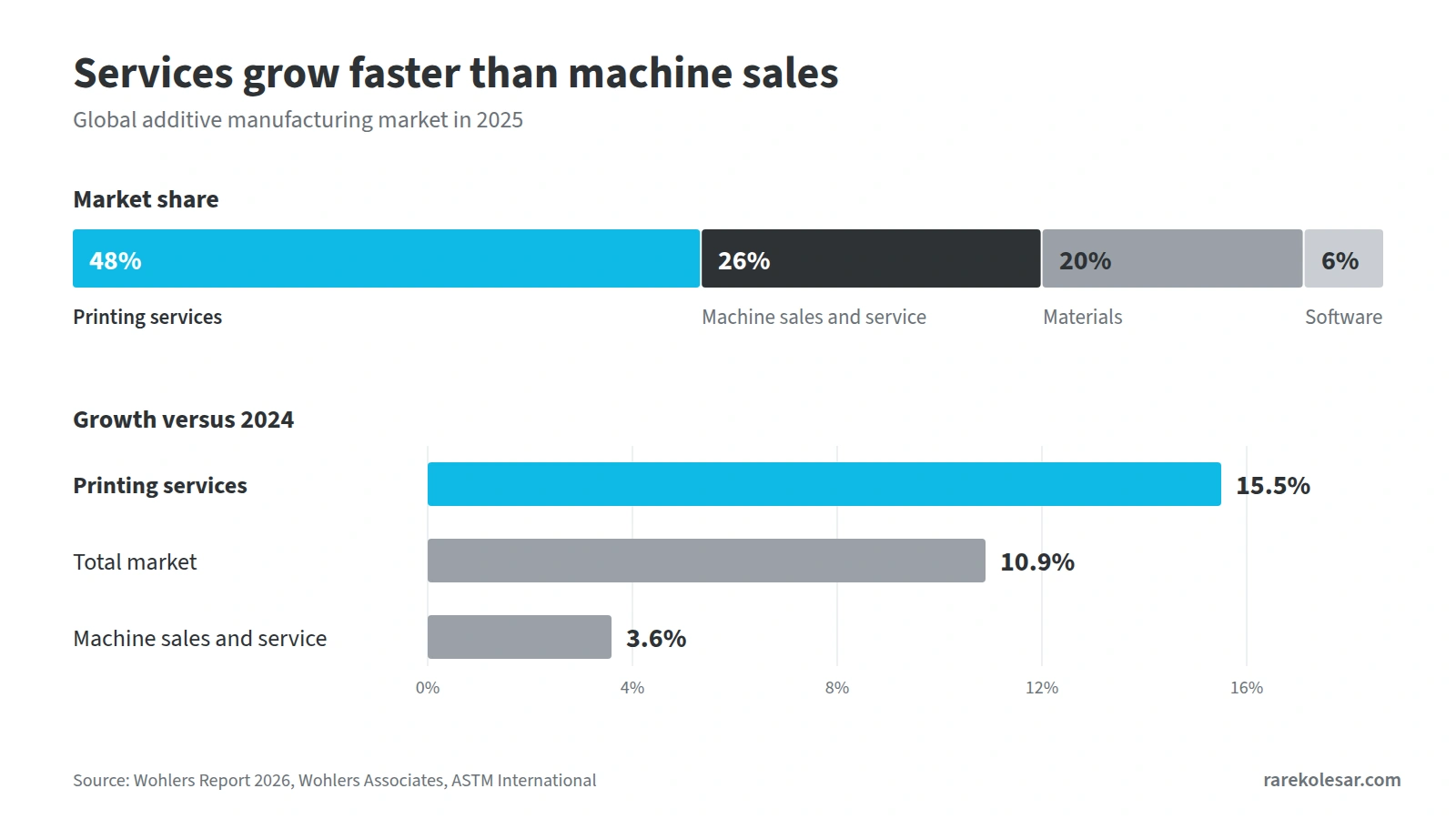
Wohlers Report 2026 measures a broader market, including services and materials, and records 10.9 percent growth in 2025. The most interesting part is the structure of that growth. Printing services make up 48 percent of the market and grow 15.5 percent. Machine sales make up 26 percent and grow only 3.6 percent.
One note. Online you will find dozens of reports from firms selling generic market analyses, with completely different numbers for the same market. For decisions, use sources that explain their methodology.
Trend one, growth is back, but selective
The industry no longer grows because everyone buys machines to try them. It grows where there is a clear business case. Wohlers describes an industry adjusting to tighter capital conditions and more selective investment. Companies buy less, but smarter, and want proof of profitability before buying.
Trend two, services grow faster than machines
More and more companies use metal printing without owning a machine. Service providers give them access to the technology without investment, operator training or the risk of an idle machine. Only when volume and repeatability justify it do they move to their own equipment. I wrote about this choice in detail in Why 90 Percent of Companies Get 3D Printing Wrong.
Trend three, defense and space drive growth
According to AMPOWER, defense and space are the leading application area, with growth above 20 percent per year over the last four years. The reasons are development speed, short series, complex parts and the need to produce closer to the point of use. Aerospace, energy and medical remain important, while the automotive industry uses metal printing mainly for tooling, prototypes and small series.
Trend four, Chinese manufacturers are changing the market
The ten largest L-PBF machine manufacturers hold 78.3 percent of global revenue, but that share fell from 80 percent a year earlier as new, mainly Chinese, manufacturers enter the market. They bring large machines with many lasers, today up to 36, upgradable to 64, at prices that were unthinkable a few years ago. For buyers this means more choice and lower prices, but also a greater need to check service, spare parts availability and the manufacturer's long-term stability.
Trend five, consolidation, not every technology makes it
Laser powder bed fusion, L-PBF, remains the dominant technology. Binder jetting was promoted for years as the path to mass production of metal parts, but growth was slower than promised. Desktop Metal, one of the best known champions of the technology, filed for bankruptcy in 2025. More on comparing the two technologies in Metal AM Comparison: Powder Bed Fusion vs Binder Jetting.
At the same time, DED technologies, with wire or powder, are gaining ground for large parts, repairs and cladding. Where fine geometry is not needed, but large volume and speed are, DED is often a more rational choice than L-PBF.
Trend six, automation and qualification as a condition for series production
Series production does not depend on the machine alone. It depends on automated powder handling and depowdering, post-processing, digital tracking of every part and a qualified process. Companies that succeed in series production do not just buy a machine, they buy the whole chain. I wrote about what this looks like in practice in What Process Qualification Actually Looks Like.
Trend seven, materials are developed for specific applications
Material development no longer aims for the longest possible list, but for specific applications. Copper and copper alloys for heat exchangers and electric motors. Nickel alloys for high temperatures. High-strength aluminum for lightweight structures. Refractory metals such as tungsten for space and defense. For standard alloys, an overview of properties is in Comparing alloys in metal additive manufacturing.
What this means for companies in the region
Entering metal 3D printing has never been more accessible, whether through service providers or own equipment. But trends do not bring profitability by themselves. The smartest path for most companies is to start with service providers on specific parts, collect real data on cost and quality, and only then decide on their own machine. The region has knowledge and a manufacturing tradition, and the defense and automotive industries are natural places to start. I wrote about where the region stands today in The Real State of Additive Manufacturing in the Region, a View from the Inside.
Frequently asked questions
Is metal 3D printing still growing? Yes, but slower than before. After the decline in 2024, the market returned to moderate growth in 2025, and independent forecasts to 2030 point to about 13 percent annual growth.
Which industry uses metal 3D printing the most? According to AMPOWER, defense and space, with growth above 20 percent per year over the last four years. Aerospace, medical and energy follow.
Is it better to buy a machine or use a service provider? For most companies, a service provider at first. An own machine makes sense when there is steady volume and known parts.
Are Chinese machines a good choice? They can be, since they offer a lot for their price. Before buying, check service in the region, spare parts availability and references from users with similar parts.
Is binder jetting replacing laser technologies? Not for now. L-PBF remains dominant, and binder jetting makes sense for a narrower range of parts and large series.
Sources
- AMPOWER Report 2026, AMPOWER, March 2026
- AMPOWER, Metal Additive Manufacturing market 2025
- Wohlers Report 2026, Wohlers Associates, ASTM International, February 2026
- Desktop Metal, Chapter 11 bankruptcy filing, July 2025
- Eplus3D EP-M2050, technical specification
For a deeper comparison of the two dominant metal technologies, see: Comparison of Metal Additive Manufacturing Technologies: PBF and Binder Jetting.