Additive manufacturing builds a part by adding material, layer by layer, directly from a 3D model and without tooling. Its real value does not come from being "modern". It comes from solving a concrete problem: a spare part that no longer exists, a mold that cools too slowly, a fixture you wait three weeks for.
When someone asks me what additive manufacturing is, the shortest correct answer is this: you make a part by adding material instead of removing it. That's it. The rest is detail, but that detail decides whether it pays off or ends up as an expensive toy in the corner of the shop floor.
Three ways to make a part
A milling machine starts with a block of metal and removes everything that is not the part. Injection molding and casting shape the part in a mold, and a mold costs money and takes weeks to make. Additive manufacturing starts with empty space and builds the part layer by layer, straight from a 3D model.
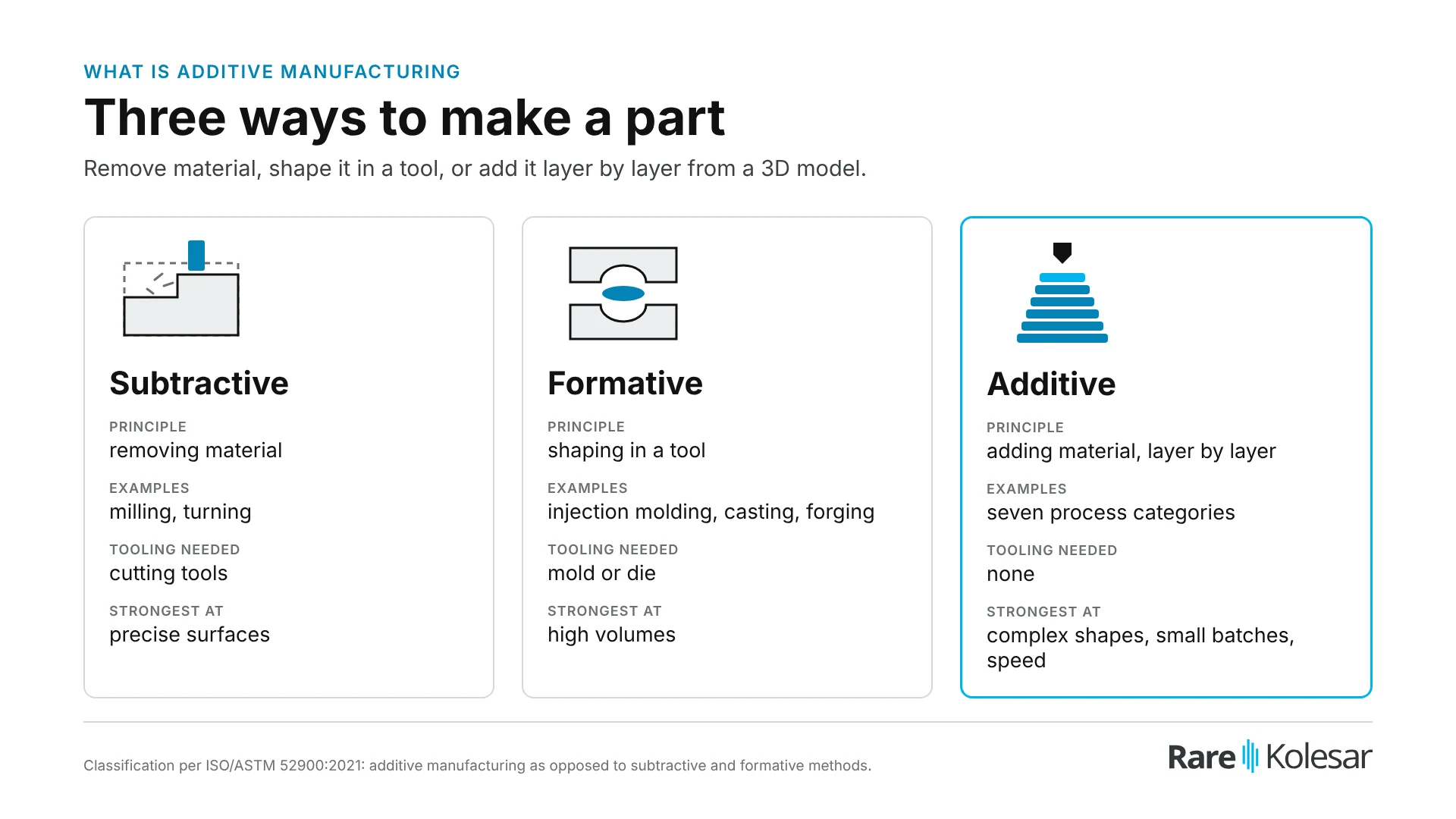
| Subtractive | Formative | Additive | |
|---|---|---|---|
| Principle | removing material | shaping in a tool | adding material |
| Examples | milling, turning | injection molding, casting, forging | seven process categories |
| Tooling needed | cutting tools | mold or die | none |
| Strongest at | precise surfaces | high volumes | complex shapes, small batches, speed |
Officially, the international standard ISO/ASTM 52900:2021 defines additive manufacturing as joining materials to make parts from 3D model data, usually layer upon layer, as opposed to subtractive and formative methods. In plain words: no milling, no mold.
What actually changes
The tool disappears. No mold, so the first piece and the tenth piece take the same route. A small batch no longer has to be a punishment.
Complexity stops being the main cost driver. Internal channels, lattice structures, shapes a milling cutter cannot reach. The machine does not care.
The warehouse becomes a file. A spare part does not have to sit on a shelf for five years. It can wait on a server and be made when it is needed.
Several parts become one. An assembly of several pieces, screws and seals can often be redesigned as a single part. Less assembly, fewer places where something can leak or come loose.
Production and assembly aids in days instead of weeks. This is usually where companies first see additive manufacturing saving money instead of spending it.
Three examples from practice
The warehouse that became a file. Deutsche Bahn has been using additive manufacturing for ten years. Today it has more than 200,000 additively manufactured parts in service and has saved over 20 million euros since 2015. It started with a plastic coat hook. Today it uses twelve different processes with plastic, metal and sand, and produces parts the original manufacturer no longer supplies. One of the most interesting is a gearbox housing for shunting locomotives, cast in a mold that was made additively. So it is not always the part itself that gets printed. Sometimes additive manufacturing only makes the mold, and a good old foundry does the rest.
The mold that cools faster. In plastic injection molding, cooling takes around 70 percent of the cycle. Conventional cooling channels are drilled, so they run straight. An additively made insert can have channels that follow the shape of the part. That is conformal cooling. In one real industrial case published in 2023, cooling time was cut by 66 percent. Another study from 2024 reports a cycle more than 36 percent shorter. For a toolmaker, that means the same machine makes more parts in the same time.
A fixture in a day. The least glamorous application, but often the first one that pays off. In 2024 Audi Sport reported that it makes its production tools additively, in a day instead of several weeks, at lower cost.
3D printing or additive manufacturing?
In everyday language they are the same, and nobody is wrong to say 3D printing. The standard is more precise: additive manufacturing is the broader term, 3D printing the narrower one. My practical rule is simpler. If you are making a figurine, you are 3D printing. If you are making a part that has to work, repeatably, with known material and properties, that is additive manufacturing. Same physics, different responsibility.
Not one machine, but a whole family
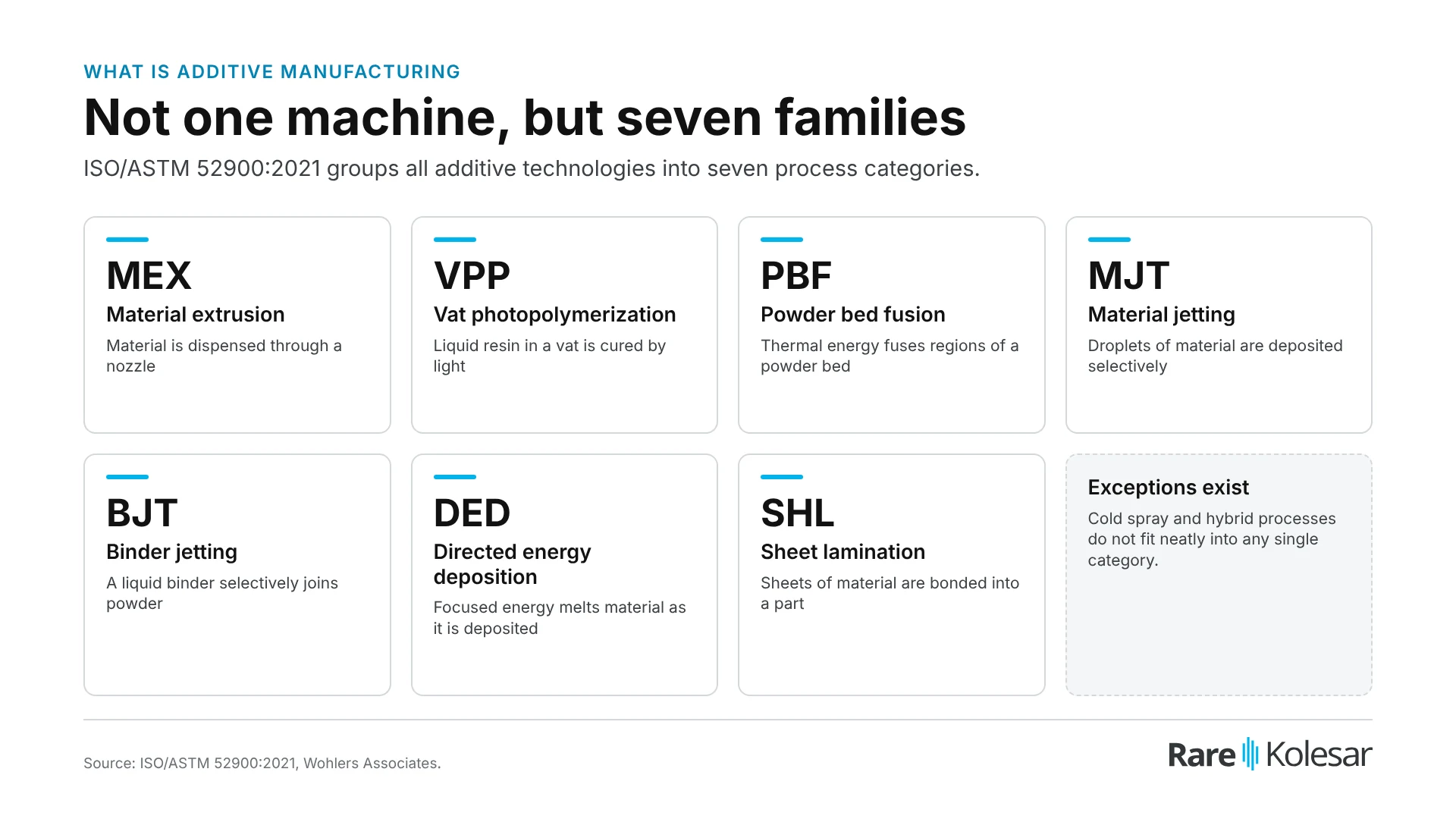
The standard groups all technologies into seven categories. They range from extruding material through a nozzle, to curing resin with light, to melting metal powder with a laser. That is why "can 3D printing make my part?" has no single answer. The first question is which technology, which material and what the part is for.
What additive manufacturing is not
It is not a button labeled "make". There is model preparation, orientation, supports, overhangs and post-processing. Someone has to know what they are doing.
It does not replace injection molding when you need a million identical pieces. There the mold still wins, and it will stay that way.
It is not just for prototypes. That was true fifteen years ago. Today additively made parts are installed and do real work.
A few numbers
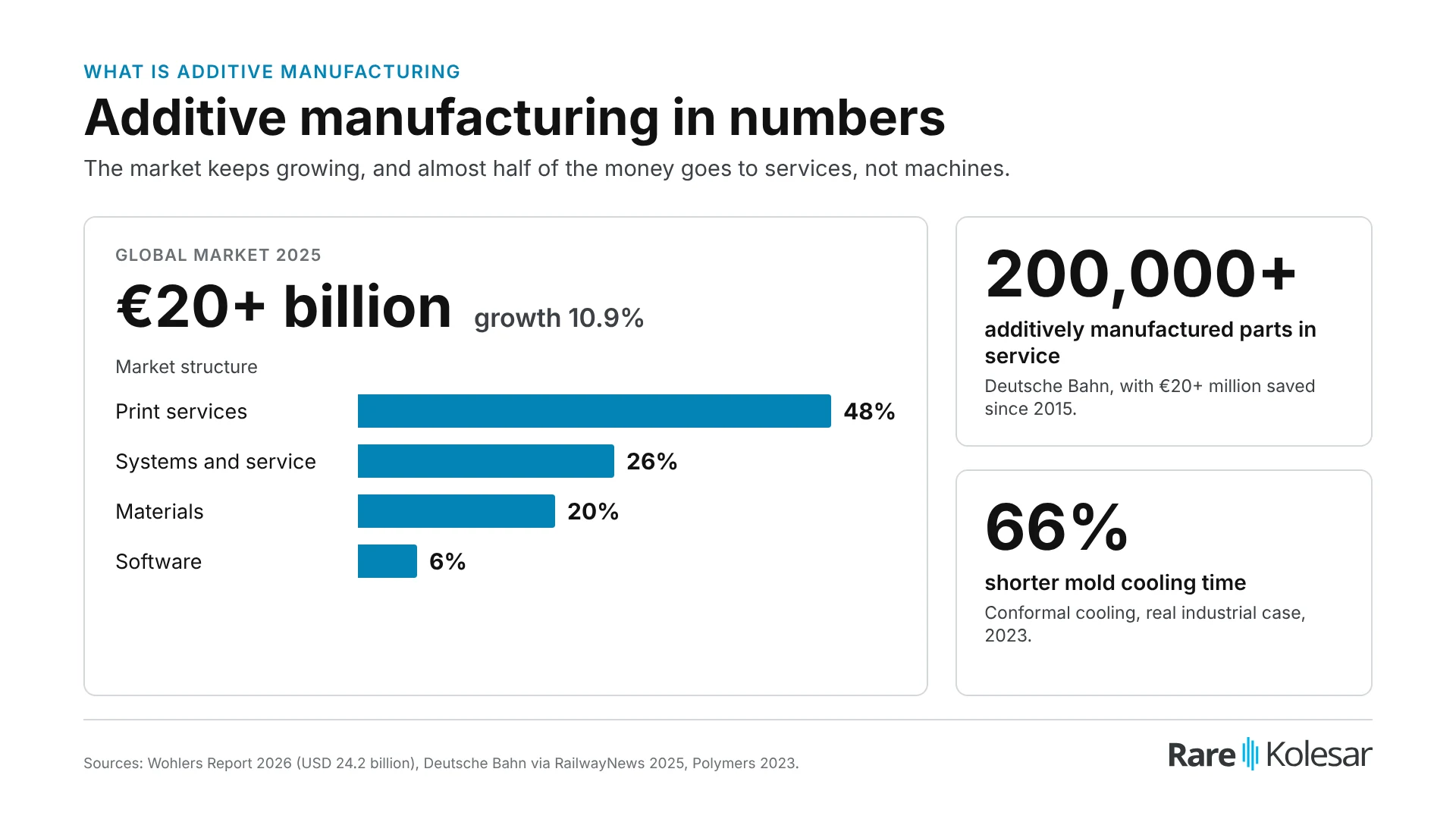
According to Wohlers Report 2026, the global additive manufacturing market was worth over 20 billion euros in 2025, growing by around 11 percent. The more interesting figure is another one: almost half of the market, 48 percent, is print services. In other words, most companies do not buy machines, they buy parts. For many of them, outsourcing production is a smarter first step than buying equipment.
The real question
The real question is not what additive manufacturing is. It is where in your production it solves a real problem: downtime because of a spare part, an expensive tool for a small batch, assembly that takes too long, a fixture you wait three weeks for. If such a place exists, it is worth running the numbers. If it does not, do not buy a machine just because your neighbor did.
You add instead of remove, from a 3D model, without tooling. The rest is engineering and common sense.
Frequently asked questions
Are 3D printing and additive manufacturing the same thing? In everyday language, yes. In the ISO/ASTM 52900 standard, additive manufacturing is the broader term and 3D printing the narrower one.
Does additive manufacturing replace conventional manufacturing? No. It complements it. For large batches of identical parts, injection molding and casting stay cheaper. Additive manufacturing wins with complex shapes, small batches, spare parts and tooling.
How many additive process categories are there? ISO/ASTM 52900:2021 defines seven: material extrusion, vat photopolymerization, powder bed fusion, material jetting, binder jetting, directed energy deposition and sheet lamination.
Do I need to buy a machine to get started? No. Almost half of the global additive manufacturing market is print services. Outsourcing is often the fastest and cheapest way to find out whether it pays off for you.
Where does additive manufacturing pay off fastest? Most often with production and assembly aids, spare parts that are no longer available, and mold inserts with conformal cooling.
Read also
- Metal AM: Powder Bed Fusion vs Binder Jetting
- How to choose the right material without guessing
- How much does an industrial SLS, MJF or SAF printer really cost?
Sources
- ISO/ASTM 52900:2021: https://www.iso.org/standard/74514.html
- Wohlers Report 2026 (TCT Magazine): https://www.tctmagazine.com/wohlers-report-2026-additive-manufacturing-revenues-reach-24-2-billion/
- Wohlers Report 2026, market structure (3DPrint.com): https://3dprint.com/324044/3d-printing-news-briefs-2-19-2026/
- Deutsche Bahn, 200,000 parts (RailwayNews, 2025): https://railwaynews.net/germanys-db-200000-3d-printed-rail-parts-e20m-saved.html
- Deutsche Bahn, gearbox housing (RailTech, 2023): https://www.railtech.com/?p=37598
- Conformal cooling, industrial case (Polymers, 2023): https://pmc.ncbi.nlm.nih.gov/articles/PMC9921164
- Conformal cooling (Universidad de Jaén, 2024): https://investigacion.ujaen.es/documentos/66674331f44d1159d56c3573?lang=en
- Audi Sport (Digital Engineering, 2024): https://digitalengineering247.com/article/audi-sport-boosts-design-and-production-with-help-of-ultimaker/3d-printing