Additive manufacturing survey results, October 2026
Summary
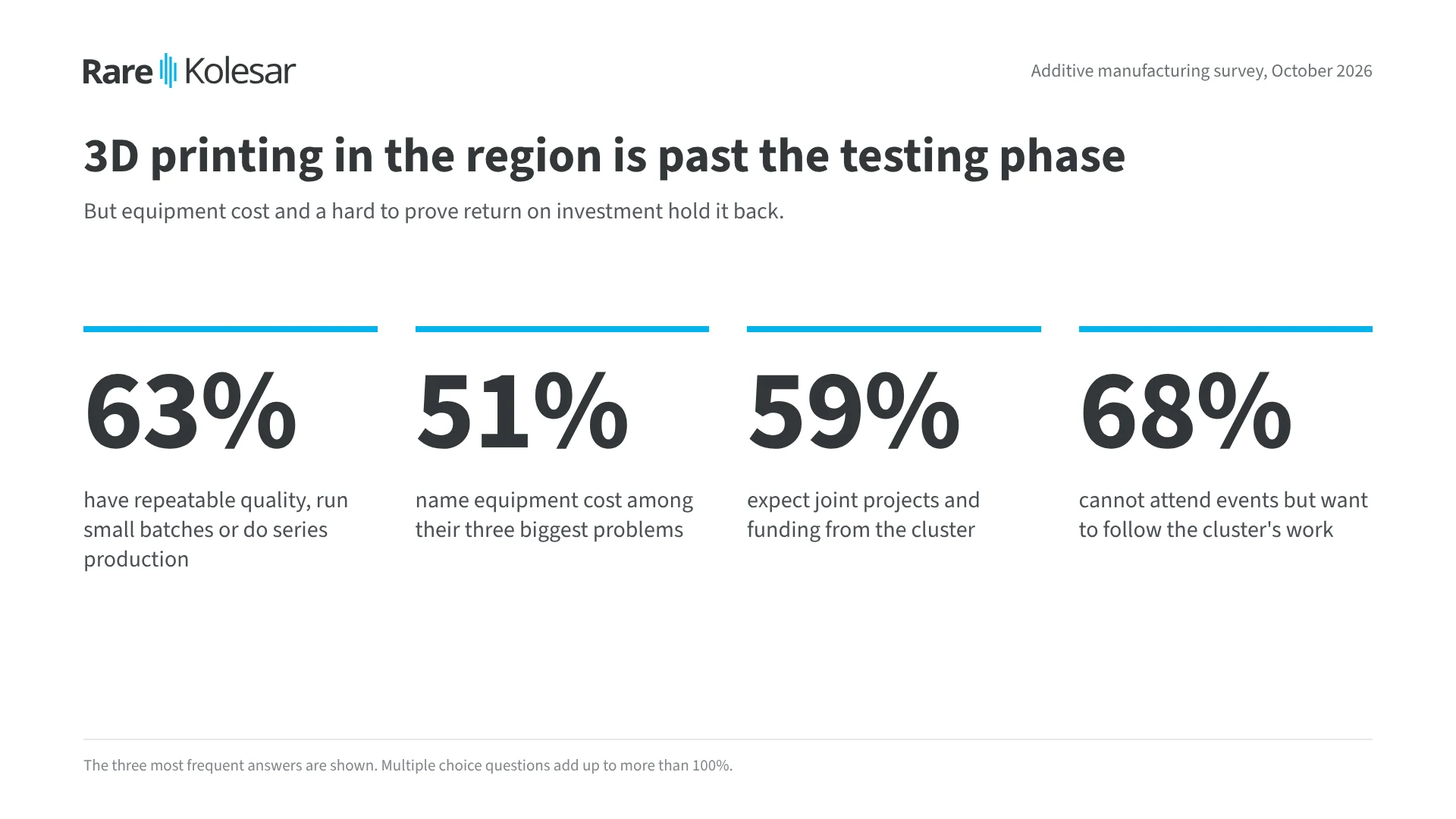
3D printing in the region is past the testing phase, but equipment cost and a hard to prove return on investment hold it back. Respondents expect joint projects, funding and exchange of experience from the cluster, and two thirds want to follow its work remotely.
- 63% have repeatable quality, run small batches or do series production.
- 51% name equipment cost among their three biggest problems.
- 59% expect joint projects and funding from the cluster.
- 68% cannot attend events but want to follow the cluster's work.
I ran the survey on the initiative of CECIMO, the European Association of Manufacturing Technologies, within the Automotive and Mobility Cluster of Serbia. It was open from 1 to 20 October 2026. Respondents came from industry and academia in Serbia and Bosnia and Herzegovina. For each question I show the three most frequent answers. Multiple choice questions add up to more than 100%.
At the cluster's general assembly I was elected Chair of the Advanced Manufacturing Working Group. The results of this survey are the starting point for its work.
1. Who responded
The survey was answered by people who work with the technology every day. Professors, researchers and engineers gave three quarters of the answers, while sales people and hobbyists are almost absent.
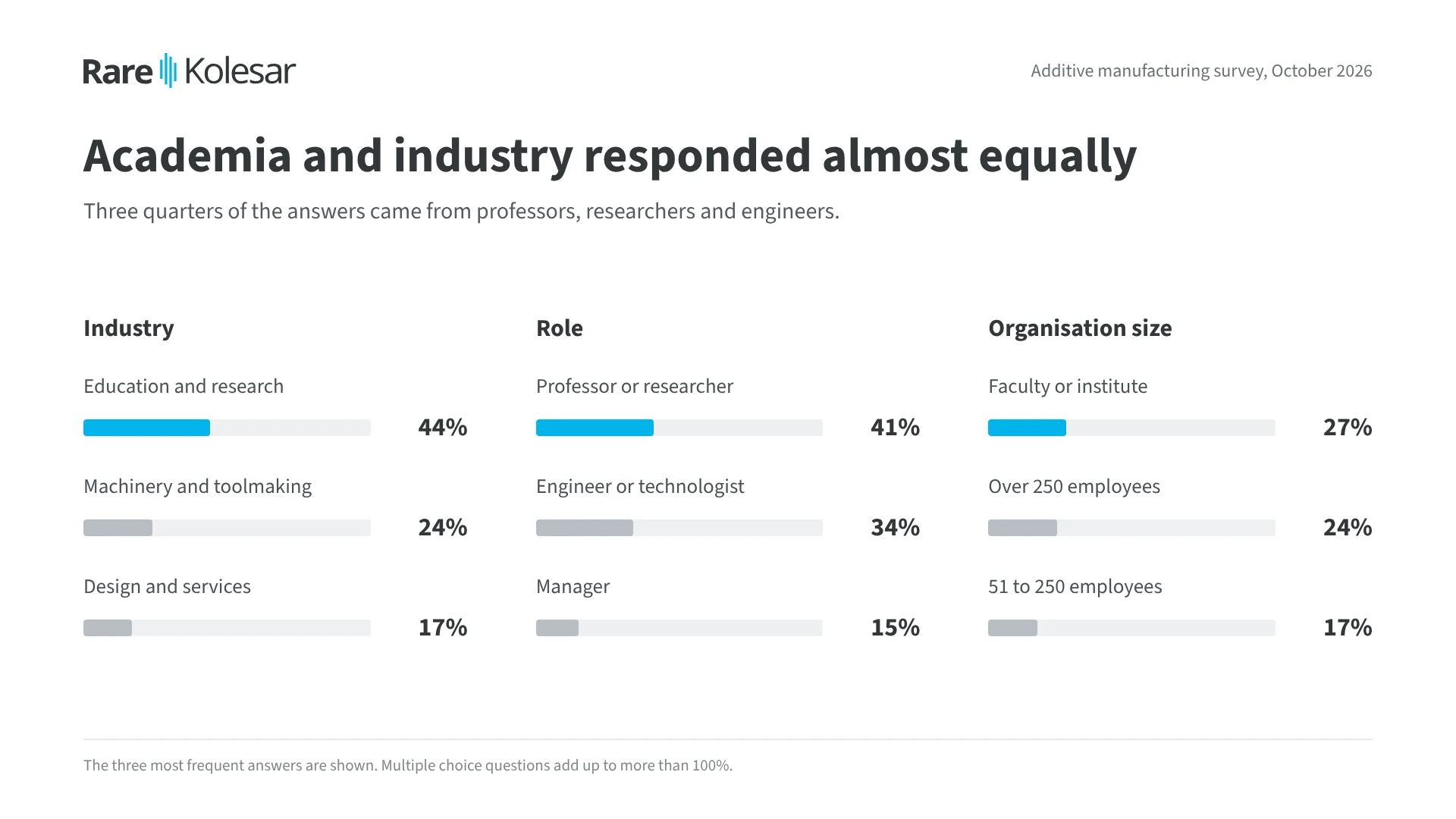
Faculties and institutes are the largest single group, but all industrial sectors together outnumber academia. Large companies with over 250 employees are almost as well represented as faculties. Small companies with up to 10 employees have the same share as medium sized ones, 17% each.
What it means: the cluster has both sides at the same table. Its first task is to connect university know how with the needs of production.
2. Maturity and use
Most respondents are past their first printer. 63% have repeatable quality, run small batches or do series production. In terms of technology, however, it all comes down to FFF and resin.
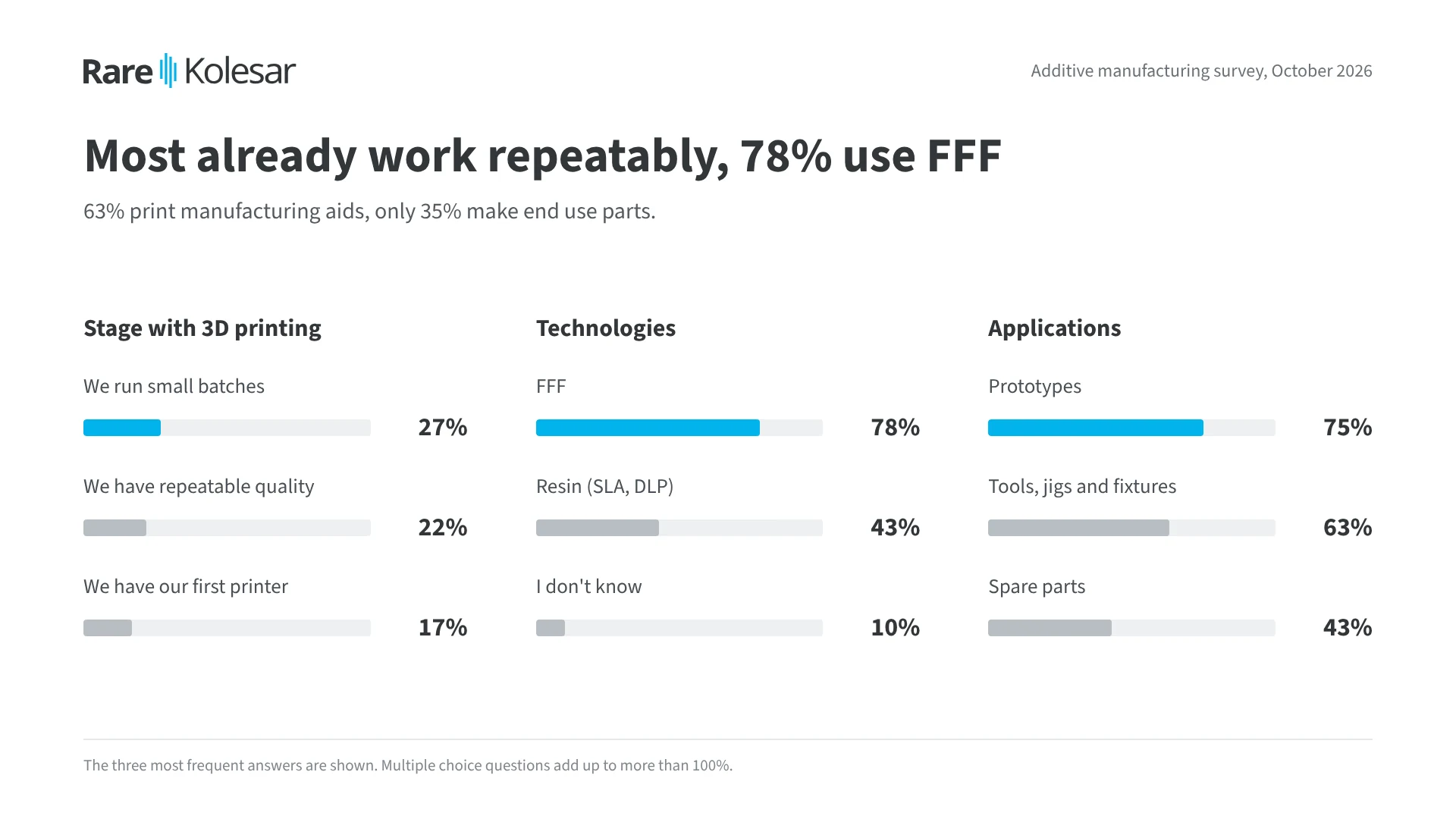
63% print manufacturing aids, that is tools, jigs and fixtures. This means 3D printing already saves money on the shop floor. 35% make end use parts, and metal and powder technologies are used by only 5% each. One in ten does not know which technology their organisation uses.
What it means: the biggest room for growth is the move from prototypes and manufacturing aids to end use parts and industrial technologies. That step needs know how in technology selection and design for additive manufacturing.
3. Barriers
Equipment cost is the number one problem, but proving return on investment and quality follow right behind. These are barriers solved by knowledge, not only by money.
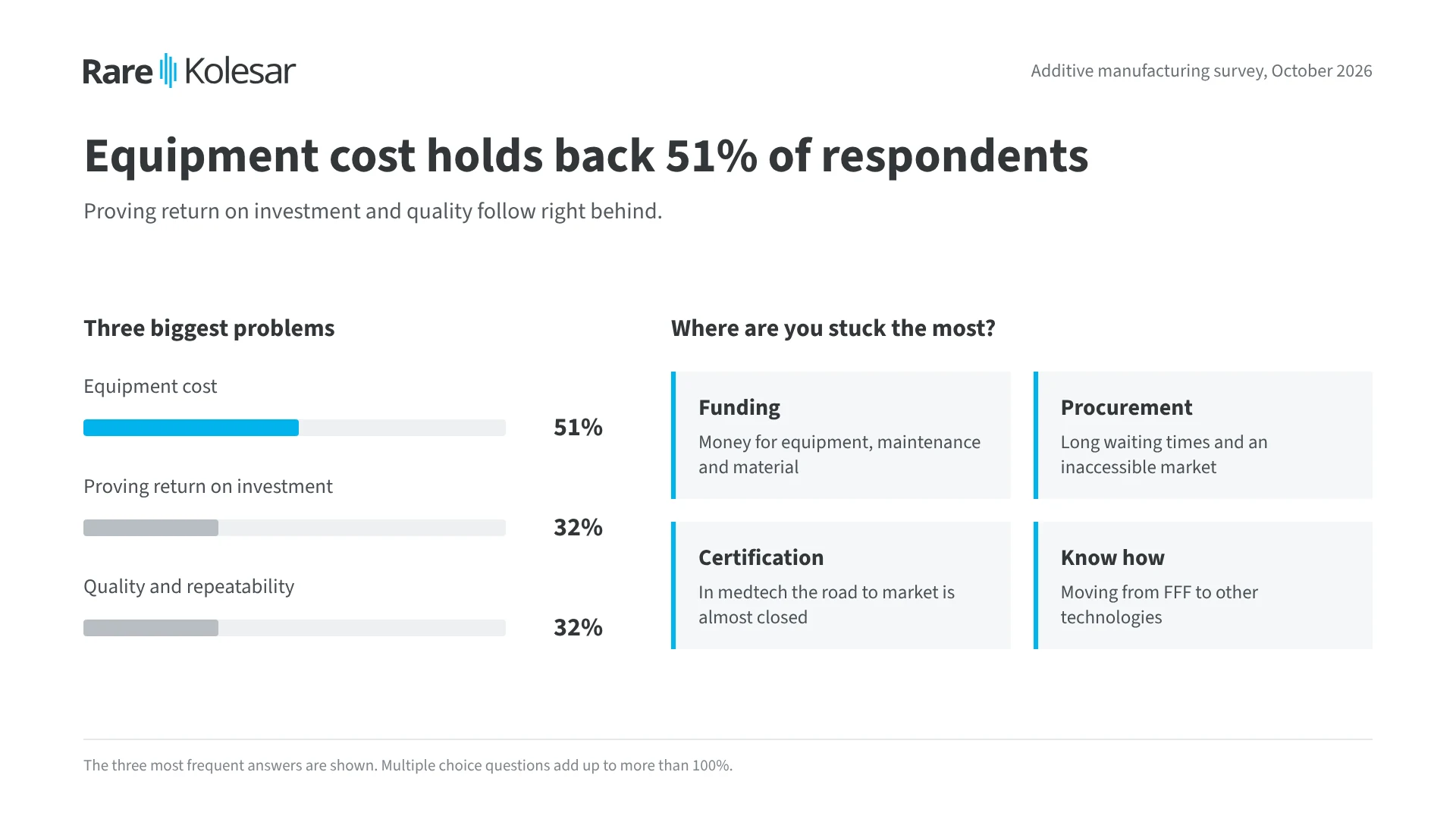
In the open answers about where they are stuck the most, four themes keep coming back:
- Funding. Especially at faculties and schools there are machines, but no money for maintenance and material.
- Procurement. Long waiting times for equipment and material, and an inaccessible market.
- Certification. In medtech, the road to market without certification is almost closed.
- Know how. Moving from FFF to other technologies, and specific modelling.
When equipment cost is read together with proving return on investment, the problem is not just an expensive machine. The problem is that its return is hard to prove to management. 20% name a lack of knowledge and staff, and 27% name post processing.
What it means: the cluster can help most with shared return on investment calculations, practical examples and access to funding for equipment.
4. What is expected from the cluster
The cluster is expected to deliver concrete value. Joint projects and funding come first, followed closely by exchange of experience with other users.
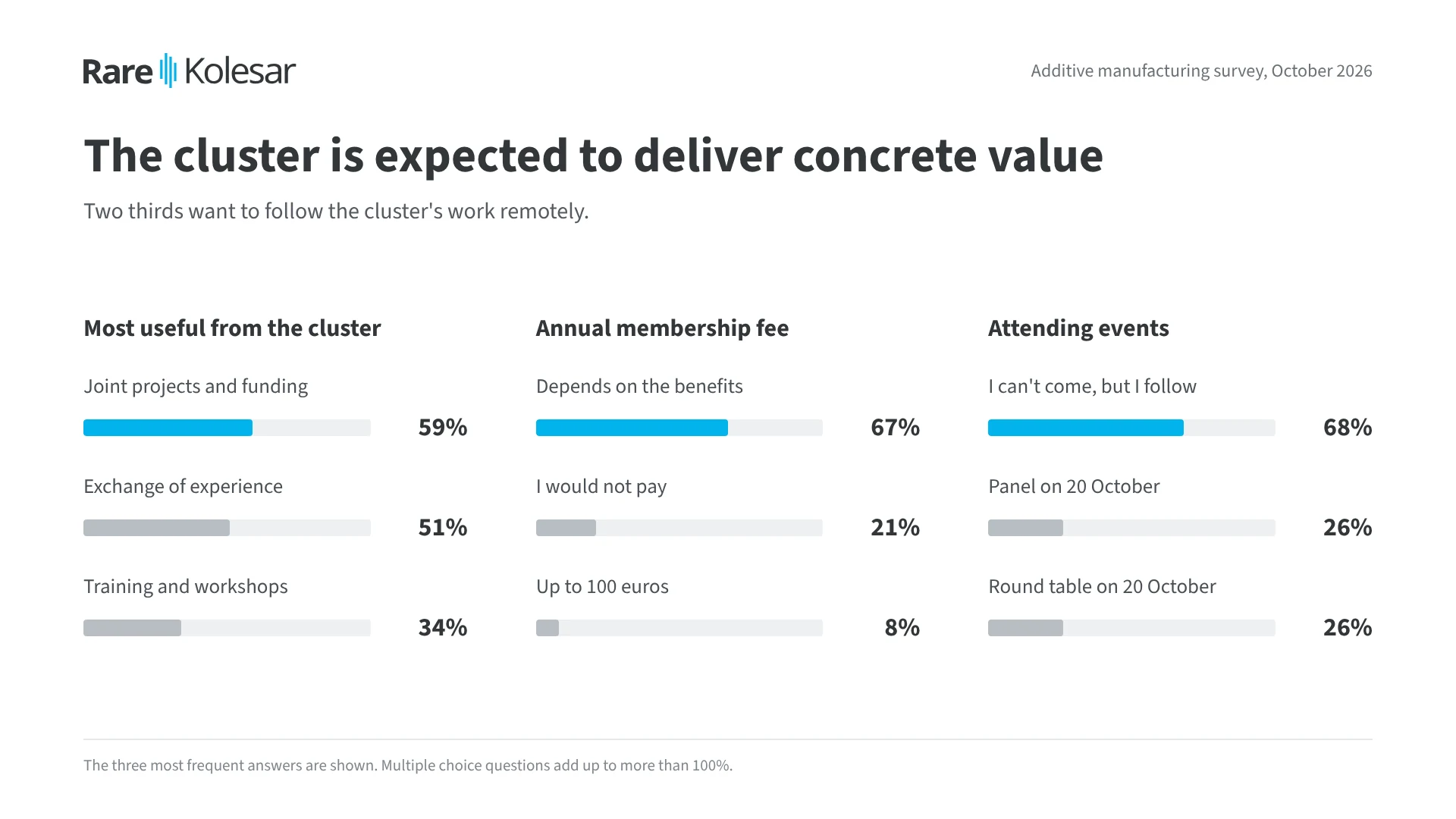
In 53% of cases the director or owner decides on investing in 3D printing, but engineers take part in a third of decisions. Two thirds tie a membership fee to the benefits, and only a fifth is firmly against paying.
The most frequent answer about events was "I can't come, but I follow the work". This is not a lack of interest. It is a clear message that people want to take part in a way that does not cost them a whole day. At the same time, 56% are ready to share their experience in a discussion.
The questions respondents proposed for the panel fall into five themes: materials and their mechanical properties, barriers to end use parts, cooperation between research and industry, technology selection, and concrete production requests that members can take on.
What it means: the cluster must first prove its value through projects, exchange and training, and only then talk about membership fees. And the work has to be available remotely.
5. Conclusion
The region has the knowledge and equipment for more serious use of 3D printing. What it lacks is proof of return on investment, access to funding and a place to exchange experience. The cluster can solve this if it works concretely and remotely.
- Joint projects and funding are the first priority, including European programmes where faculties and companies apply together.
- Return on investment calculations and practical examples help get equipment approved by management.
- Exchange of experience and training support the move from FFF and prototypes to end use parts and industrial technologies.
- Remote work lets people take part even when they cannot attend events.
- A membership fee comes only once the cluster has proven its value.
Frequently asked questions
Who conducted the survey?
The survey was conducted by Rare Kolesar, Chair of the Advanced Manufacturing Working Group of the Automotive and Mobility Cluster of Serbia, elected at the cluster's general assembly. The survey was launched on the initiative of CECIMO. It was open from 1 to 20 October 2026.
What is the biggest barrier to 3D printing in the region?
Equipment cost, named by 51% of respondents. Proving return on investment and quality and repeatability follow with 32% each.
What do companies and faculties expect from an additive manufacturing cluster?
Most of all joint projects and funding (59%), followed by exchange of experience (51%) and training and workshops (34%).
What is 3D printing used for most in the region?
For prototypes (75%), tools, jigs and fixtures (63%) and spare parts (43%). 35% of respondents make end use parts.