In 2027, choose an industrial 3D printer based on the part you need to produce, not the machine. Before you buy, calculate the total cost of ownership and compare it with outsourced production. Check who will service the machine in five years, because manufacturers are consolidating and some are disappearing. From 20 January 2027, new machines in the EU and Serbia must meet new machinery safety rules.
The choice of industrial 3D printers has never been wider, and neither has the risk of a wrong purchase. According to Wohlers Report 2026, additive manufacturing was worth 24.2 billion dollars in 2025 and grew 10.9 percent, but system sales grew only 3.6 percent. Companies no longer buy machines in advance, they use the ones they have better. At the same time, according to the AMPOWER Report, the number of metal PBF machine manufacturers grew from 96 to 107 in a single year. More supply means lower prices, but also more manufacturers that may not survive. I write more about what is changing in the industry in The printer got cheap. The model became the product..
1. Start with the part, not the machine
The first question is not which printer, but which part. How many units per year? Which material? What tolerances and certifications? Is it a prototype, a production or assembly aid, a spare part or a series part? Only when you know this does it make sense to choose a technology. I showed this decision sequence in How to choose a technology for industrial 3D printing.
| Technology | Typical use |
|---|---|
| FDM | prototypes, production and assembly aids |
| CFF | light and stiff parts, load bearing fixtures |
| Resin (SLA, DLP) | precise parts, smooth surfaces, molds |
| SLS and MJF | functional parts and small series without supports |
| Metal LPBF | complex metal parts, tools with conformal cooling |
| DED and WAAM | large metal parts, repair and cladding |
| Metal binder jetting | series of smaller metal parts |
A detailed comparison of polymer technologies is in How much does an industrial SLS, MJF or SAF printer really cost?, metal technologies in Metal Additive Manufacturing, Powder Bed Fusion vs Binder Jetting, and material selection in How to choose the right material without guessing.
2. Buy or outsource?
Outsourced production is now the largest part of the market. According to Wohlers it accounts for 48 percent and grows 15.5 percent per year, faster than system sales. The reason is simple: an idle machine is the most expensive machine. If you do not know whether the printer will run most of the working time, start with outsourced production, measure real demand and buy when you know how much you will use it. When it is better not to buy, I covered in When 3D printing makes sense and when it does not, and you can check whether a specific part can be printed, and what needs fixing, with Dokimion.
3. Total cost, not machine price
The machine price is only part of the calculation. Total cost of ownership includes material, service contract, software, people, post processing, site preparation, energy and downtime. With some manufacturers the annual service contract is about 10 percent of the equipment price, so in five years it reaches half the price of the machine. I showed the full calculation for one part in What does SLS for wire harness tooling really cost?.
Formlabs Fuse X1 or HP MJF 1200?
Two new polymer PBF systems are a good example. Based on announcements, Formlabs Fuse X1 and HP MJF 1200 are in the same price class. The Fuse X1 costs from 72,499 EUR in Europe, while HP announced a price below 60,000 dollars for the MJF 1200. Which one is really cheaper will only become clear in operation: material, service contract, powder refresh and utilization. The real difference is build volume and speed. The Fuse X1 has a chamber of about 61 liters, the HP MJF 1200 of 12 liters, about five times smaller. That is why HP promises a full chamber in under 12 hours, regardless of the number of parts. For smaller parts in smaller series that may be enough, for larger parts or larger series build volume is decisive.
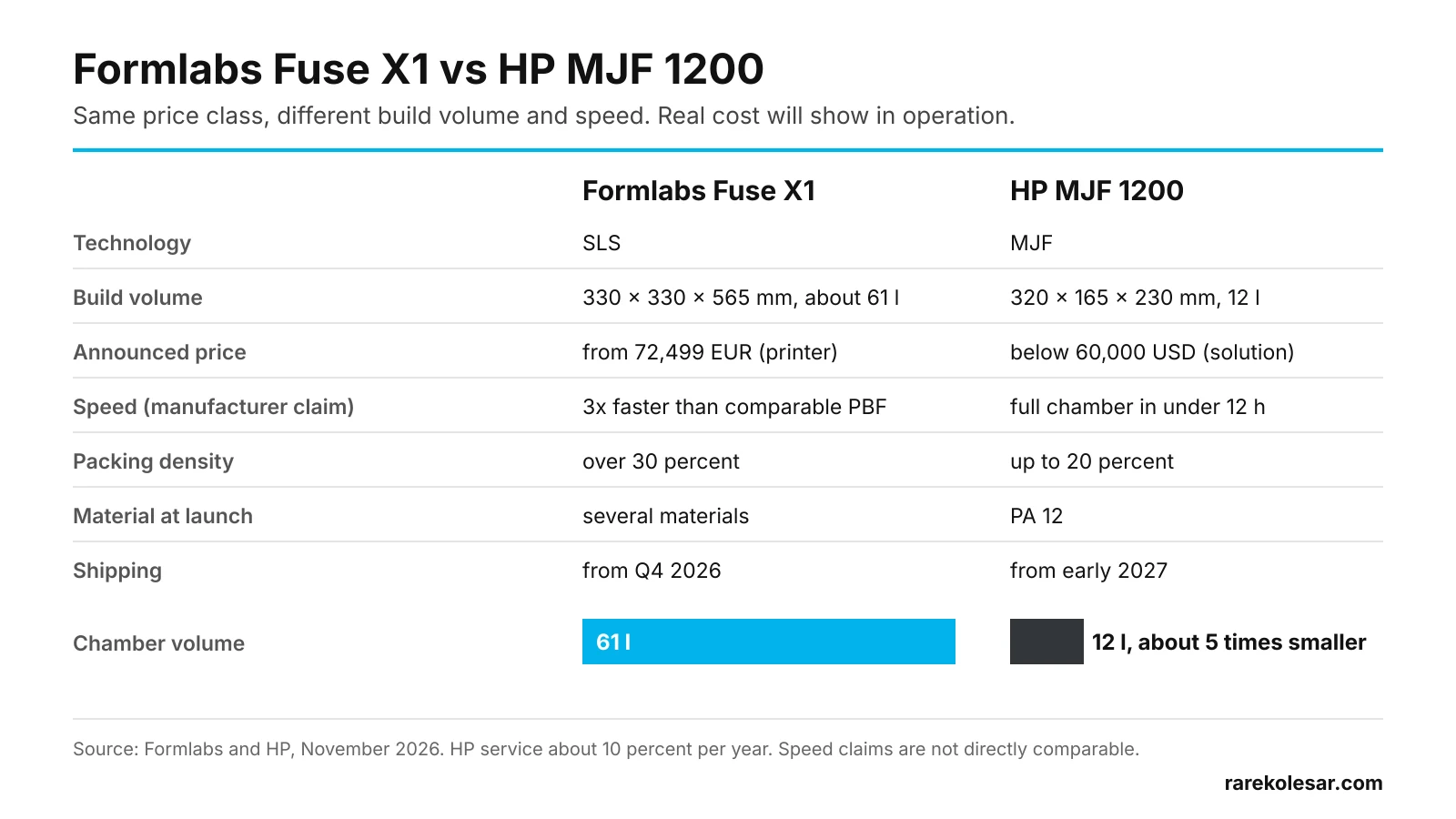
| Formlabs Fuse X1 | HP MJF 1200 | |
|---|---|---|
| Technology | SLS | MJF |
| Build volume | 330 x 330 x 565 mm, about 61 l | 320 x 165 x 230 mm, 12 l |
| Announced price | from 72,499 EUR (printer) | below 60,000 USD (solution) |
| Speed per manufacturer | 3 times faster than comparable PBF | full chamber in under 12 h |
| Packing density | over 30 percent | up to 20 percent |
| Material at launch | several materials | PA 12 |
| Shipping | from Q4 2026 | from early 2027 |
4. Open or closed materials
A closed system means you buy material only from the manufacturer. You get proven quality, but you pay more and depend on one supplier. An open system gives lower material prices and more choice, but more responsibility for the result shifts to you. Ask the vendor what the material will cost over the next five years and whether the warranty applies if you use third party material. Also check the material choice at launch: the HP MJF 1200, for example, will initially work only with PA 12.
5. Who will service the machine in five years?
The industry is consolidating. Desktop Metal filed for bankruptcy in 2025. Markforged changed owners twice in less than two years, and in 2026 Stratasys bought it for 42.5 million dollars, about a third of what Nano Dimension paid a year earlier. BCN3D filed for bankruptcy in 2025. A machine can run for ten years, but only if service, spare parts and software exist.
Ask who services the machine in your region, how fast a technician arrives, which spare parts are in stock and how long the manufacturer guarantees software and parts support. I described the most common buying mistakes in Why 90 Percent of Companies Get 3D Printing Wrong.
6. New rules from 2027
From 20 January 2027, the new EU Machinery Regulation (EU) 2023/1230 applies, replacing the 2006 directive. Serbia adopted its own Rulebook on Machinery (Official Gazette RS no. 2/2026), applicable from the same day. Additive manufacturing machines are explicitly covered. The new rules introduce obligations for importers and distributors, digital instructions and cybersecurity requirements.
Connected devices fall under another EU law, the Cyber Resilience Act. From 11 December 2027, every new product with digital elements sold in the EU, including printers connected to the internet or a cloud, must meet mandatory cybersecurity requirements.
Machines placed on the market before 20 January 2027 remain under the old rules and do not need to be recertified. If you buy after that date, ask the vendor for the declaration of conformity under the new rules, how software is updated and where your files and data are stored.
7. Repeatability and qualification
For series production it is not enough for a machine to make a good part once. It must make it the same every time. ISO/ASTM 52920 defines requirements for qualifying AM processes and production sites, and ISO/ASTM 52930 covers qualification of PBF-LB equipment (installation, operation and performance). The most mature use of AI in additive manufacturing is layer by layer process monitoring with cameras and sensors. Ask whether the machine keeps a record of every build and whether you can hand that record to your customer as proof of quality.
8. Site and safety
Metal powder is flammable and requires inert gas, explosion protection and trained people. Polymer powder requires dust control, and resin requires ventilation and protective equipment. ISO/ASTM 52931 and ISO 27548 cover health and environmental aspects. Site preparation sometimes costs more than the price difference between two machines, so include it in the budget from day one.
9. Chinese or European manufacturer?
According to the VDMA spring 2026 survey, 52 percent of German additive manufacturing companies see Chinese manufacturers as direct competitors. BLT, Farsoon and Eplus3D offer metal LPBF machines with 16 or more lasers, at prices that have put pressure on the market. The question is not only price, but service in your region, customer references with similar parts, spare parts availability and possible restrictions for the defense industry.
Checklist: questions for the vendor
| Question | Why it matters |
|---|---|
| Which of my parts does this machine make better than outsourced production? | shows whether the purchase is justified |
| What is the total cost over five years? | machine price is only part of it |
| How much is the service contract? | it can reach half the machine price |
| Does the warranty apply with third party material? | determines material cost |
| Who services the machine in my region and how fast? | downtime costs more than the machine |
| Does the machine comply with the rules from 20 January 2027? | mandatory for new machines |
| Where do my files and data go? | cybersecurity and trade secrets |
| Does the machine keep a record of every build? | proof of quality for customers |
| What does the site need for safety? | hidden cost |
| Which customers with similar parts already use this machine? | real experience instead of a brochure |
Frequently asked questions
How much does an industrial 3D printer cost in 2027? From a few thousand euros for desktop FDM printers to several hundred thousand euros for large metal systems. Entry level industrial polymer PBF systems have come down to 60,000 to 85,000 dollars.
Which is better, Formlabs Fuse X1 or HP MJF 1200? Based on announcements they are in the same price class. The Fuse X1 has a chamber about five times larger, while the HP MJF 1200 promises a full chamber in under 12 hours. For larger parts and series, build volume is the advantage, and the real cost per part will show in operation.
Do I have to replace my existing machine because of the new regulation? No. Machines placed on the market before 20 January 2027 remain under the rules that applied when they were bought.
Do the new rules apply outside the EU? Every machine sold in the EU must comply, wherever it is made. Serbia applies its own Rulebook on Machinery from the same date, 20 January 2027.
Is a Chinese printer worse than a European one? Not necessarily. Chinese manufacturers now lead in number of lasers and machine size. The difference is more often in service, regional references and spare parts availability than in the machine itself.
When does buying a printer pay off compared to ordering parts? When you know the machine will run most of the working time and when speed or confidentiality matters more than price per part. Until then, outsourced production is usually cheaper.
Before you buy, you can request an independent assessment, with no ties to any manufacturer: consulting.
Sources
- Wohlers Report 2026, Wohlers Associates and ASTM International.
- AMPOWER Report 2026.
- VDMA AG Additive Manufacturing, spring 2026 survey.
- Regulation (EU) 2023/1230 on machinery.
- Rulebook on Machinery, Official Gazette RS no. 2/2026.
- Regulation (EU) 2024/2847, Cyber Resilience Act.
- HP and Formlabs, official product announcements 2026.