Summary
Powder Bed Fusion (PBF) melts metal powder layer by layer with a laser, and the part leaves the machine as dense metal. Binder Jetting only glues the powder with a liquid binder, and the part gets its metal properties only after debinding and sintering in a furnace, shrinking by about 15 to 20 percent per dimension. Faster printing therefore does not mean faster or cheaper production, because most of the work, risk and cost comes after printing.
Binder Jetting of sand molds and cores for casting is a mature and widespread technology. Binder Jetting of metal parts is a different story, with a narrower field of application than was expected a few years ago, as shown by the Desktop Metal bankruptcy in 2025 and the reshuffling of ownership among vendors.
The two technologies mostly do not compete with each other. PBF is the choice for high value parts with demanding properties. Metal Binder Jetting makes sense for series of smaller parts with moderate requirements, where its main competitor is metal injection molding (MIM).
Two different routes to a metal part
In Powder Bed Fusion, metal powder is melted layer by layer with a laser, or with an electron beam in the EBM variant. The part leaves the machine as dense metal, welded to the build plate and with supports. Then come stress relief, removal from the plate, support removal, heat treatment and machining where needed.
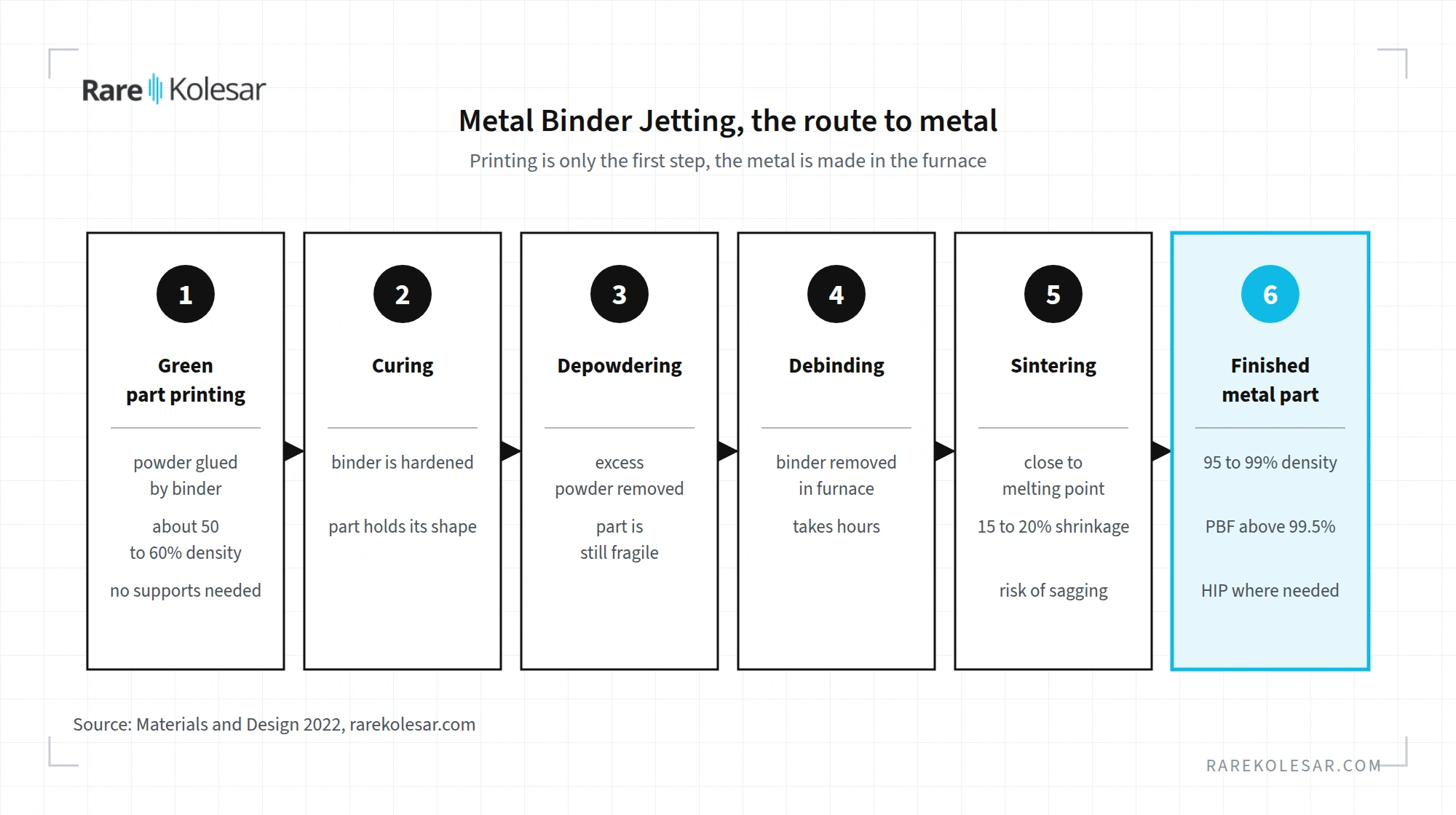
In Binder Jetting, the printer produces a so called green part. The powder is not melted but glued with a liquid binder. The green part is therefore fragile, with a density of about 50 to 60 percent of solid metal. After printing come binder curing, depowdering, debinding and sintering in a furnace at a temperature close to the melting point. Only then does the part become metal.
Binder Jetting therefore always requires additional equipment, furnaces with a controlled atmosphere, more floor space and more production steps.
Binder Jetting for sand and for metal are not the same
These two are constantly mixed up in discussions about Binder Jetting.
Sand Binder Jetting prints molds and cores for metal casting. There is no sintering and no shrinkage, because metal is simply poured into the mold after printing. It is a mature technology that foundries have used for years, because it enables cores and molds of complex shape without conventional patterns and core boxes.
Metal Binder Jetting prints the metal part itself, and that is where all the challenges of debinding and sintering arise. Success in the first application says nothing about the second.
The market shows the difference too. When Desktop Metal went bankrupt, its sand Binder Jetting business, the German ExOne GmbH and the Japanese ExOne KK, was sold as a separate unit to the investment group Anzu Partners, with court approval in August 2025. Foundries are customers with a clear and stable need, so that part of the business found a buyer separately from the metal side.
Why metal Binder Jetting was expected to replace PBF
Binder Jetting prints faster, offers larger build volumes, and the printer itself is often cheaper than a PBF system. There is no melting during printing, so there are no residual stresses or thermal distortion. Parts can be stacked on top of each other in the build box, without supports.
That is why Binder Jetting looked like the natural route to series production of metal parts, and why many expected it to push PBF aside as volumes grew.
In practice, the advantage at the printing stage proved insufficient to offset the complexity of what comes after. This does not mean the technology does not work. It means the market for it is smaller than expectations suggested.
Who offers metal Binder Jetting today
Since 2025 the ownership picture among vendors has changed considerably. I describe it as a statement of fact, not as a recommendation.
Desktop Metal, which acquired Binder Jetting pioneer ExOne in 2021, filed for bankruptcy in July 2025. Its metal Binder Jetting intellectual property was bought in the bankruptcy process by the investment group Arc Impact Acquisition Corporation, which relaunched the company in September 2025 with a focus on defense and national security.
Markforged, whose metal Binder Jetting line comes from the Swedish company Digital Metal, became part of Israel's Nano Dimension in 2025. In May 2026 Stratasys agreed to buy Markforged for 42.5 million US dollars, with closing planned for the second half of 2026. Nano Dimension is carving out and keeping exactly the metal Binder Jetting line.
HP offers the Metal Jet S100 system. One of its users is the Indian company INDO-MIM, a large MIM parts manufacturer, which in early 2025 announced an expansion to a total of eight HP Metal Jet systems in India and the United States. This shows well where metal Binder Jetting naturally belongs, with companies that already master sintering.
Colibrium Additive, formerly GE Additive, made its Binder Jet Series 3 system commercially available in mid 2024, after a deliberately slow market introduction.
For a buyer the message is simple. Before entering metal Binder Jetting, it is worth checking who will stand behind the machine, materials and service for the next five to ten years. A broader view of market developments is in the article Trends in the use of metal 3D printing.
Main limitations of metal Binder Jetting
The biggest challenges arise after printing.
Shrinkage. During sintering the part shrinks by about 15 to 20 percent per dimension. The exact amount depends on green part density, powder, furnace and the position of the part in the furnace, and shrinkage is not equal in all directions. The lower the green density, the greater the shrinkage.
Distortion in the furnace. At sintering temperature the part is soft. Thin and unsupported sections can sag under their own weight, and friction against the setter disturbs uniform shrinkage. Sintering simulation software exists that predistorts the geometry so the part has the correct shape after the furnace. That is additional work and additional know how, and research shows that simulation is less accurate for taller parts, precisely because of uneven shrinkage.
Density. After sintering, parts typically reach 95 to 99 percent of full density, while PBF as a rule exceeds 99.5 percent. For parts where fatigue is critical, the remaining porosity matters and is often addressed with an additional HIP step.
Time and cost. Debinding and sintering take hours, and with cooling and preparation the full cycle takes from one to several days. Furnaces, energy, protective gases and process control often make total costs higher than expected.
Limitations of Powder Bed Fusion
To keep the comparison fair, PBF has its own limitations.
Printing is slow, because the laser has to melt every cross section of the part. Residual stresses from rapid melting and cooling require supports, stress relief and careful orientation planning. Supports are removed by hand or by machining, and overhanging surfaces and internal channels need special attention in design. Cost per part is high, and PBF rarely makes sense for simple parts in large series.
For a first check of whether a metal part is suitable for PBF, you can use the free SLM DFAM Checker.
The real comparison, Binder Jetting vs MIM
Debinding and sintering are the same steps as in metal injection molding (MIM), a technology industry has used for decades for small, complex metal parts in large series. That is why MIM, not PBF, is the natural reference for metal Binder Jetting.
MIM requires tooling, so it pays off only at large volumes. Binder Jetting requires no tooling, so it makes sense for small and medium series, for prototypes of MIM parts and for parts whose geometry changes often. For companies that already know how to run a sintering process from MIM production, entering Binder Jetting is much easier than for companies starting from zero. The INDO-MIM example in the previous section confirms this.
Why small and simple parts are usually not a good fit
It is often said that Binder Jetting suits small parts with simple geometry. In industrial practice that is usually not the case.
Such parts are produced fastest, cheapest and most reliably by CNC machining, and in large series by MIM or casting. CNC offers high accuracy, short lead times and a low price per piece, with no sintering and no shrinkage compensation.
Where each technology makes sense
| Powder Bed Fusion | Metal Binder Jetting | Sand Binder Jetting | |
|---|---|---|---|
| What leaves the machine | dense metal part | green part, metal only after sintering | casting mold or core |
| Part density | as a rule above 99.5 percent | typically 95 to 99 percent | not applicable |
| Shrinkage | small, but residual stresses | about 15 to 20 percent per dimension | none |
| Supports | required | not required | not required |
| Typical series | small to medium | medium | single pieces to small series |
| Main competitor | CNC, casting | MIM, CNC | conventional patterns and core boxes |
| Typical application | high value parts, aerospace, medical, tools with conformal cooling | smaller parts with moderate requirements in series | complex molds and cores for foundries |
Metal Binder Jetting makes sense for parts with complex internal geometry that CNC cannot produce economically, where full density is not decisive and where the volume justifies developing a sintering process. PBF remains the standard where mechanical properties, reliability and qualification are key. How much properties change with heat treatment in PBF alloys is shown in the article Comparison of alloys in metal additive manufacturing.
Conclusion
Binder Jetting and Powder Bed Fusion mostly do not compete in the same applications. PBF is the choice for high value metal parts with high requirements. Metal Binder Jetting makes sense for series of smaller parts with moderate requirements, where the real comparison is with MIM. Sand Binder Jetting is a separate, mature application in foundries.
There is no universal solution. There is only technology that is applied correctly or incorrectly.
Choosing between technologies is part of the broader approach described in the article What Vendor Neutral means in additive manufacturing. Once a technology is chosen, the real test is process qualification in practice.
Frequently asked questions
Is Binder Jetting faster than PBF? The printing itself is. After printing come debinding and sintering, so the total time to a finished metal part is often not shorter than with PBF.
How much does a part shrink in metal Binder Jetting? During sintering about 15 to 20 percent per dimension, depending on the powder, green part density and furnace. The geometry is therefore scaled up and corrected in advance, often with sintering simulation software.
Does metal Binder Jetting produce dense metal? After sintering a part typically has 95 to 99 percent of full density, while PBF as a rule exceeds 99.5 percent. For parts where fatigue is critical, a HIP step is often added.
Is sand Binder Jetting the same as metal Binder Jetting? No. Sand Binder Jetting prints molds and cores for casting, with no sintering and no shrinkage. Metal Binder Jetting prints the part itself, which is then sintered in a furnace.
When is Binder Jetting a better choice than MIM? When the volume is not large enough to justify an injection mold, for prototypes of MIM parts, or when the part geometry changes often.
What happened to Desktop Metal? Desktop Metal filed for bankruptcy in July 2025. Its metal Binder Jetting intellectual property was bought by Arc Impact Acquisition Corporation, while sand Binder Jetting, through ExOne GmbH and ExOne KK, was sold separately to Anzu Partners.
Who makes metal Binder Jetting systems today? Among the better known vendors are HP with the Metal Jet S100, Colibrium Additive (formerly GE Additive) with the Binder Jet Series 3, the relaunched Desktop Metal, and Nano Dimension, which keeps the Markforged metal Binder Jetting line after selling Markforged to Stratasys.
Sources
- Desktop Metal relaunches under new ownership, TCT Magazine, 2025
- US Court approves Anzu Partners affiliate to acquire ExOne, VoxelMatters, 2025
- Stratasys acquires Markforged from Nano Dimension for $42.5 million, VoxelMatters, 2026
- Stratasys to acquire MarkForged from Nano Dimension in $42.5m all cash deal, TCT Magazine, 2026
- INDO-MIM to install 5 more HP Metal Jet S100 units, VoxelMatters, 2025
- Colibrium Additive's Series 3 Metal Binder Jet System Fully Commercial, 3DPrint.com, 2024
- Numerical simulation of shrinkage and deformation during sintering in metal binder jetting with experimental validation, Materials and Design, 2022